
Overview
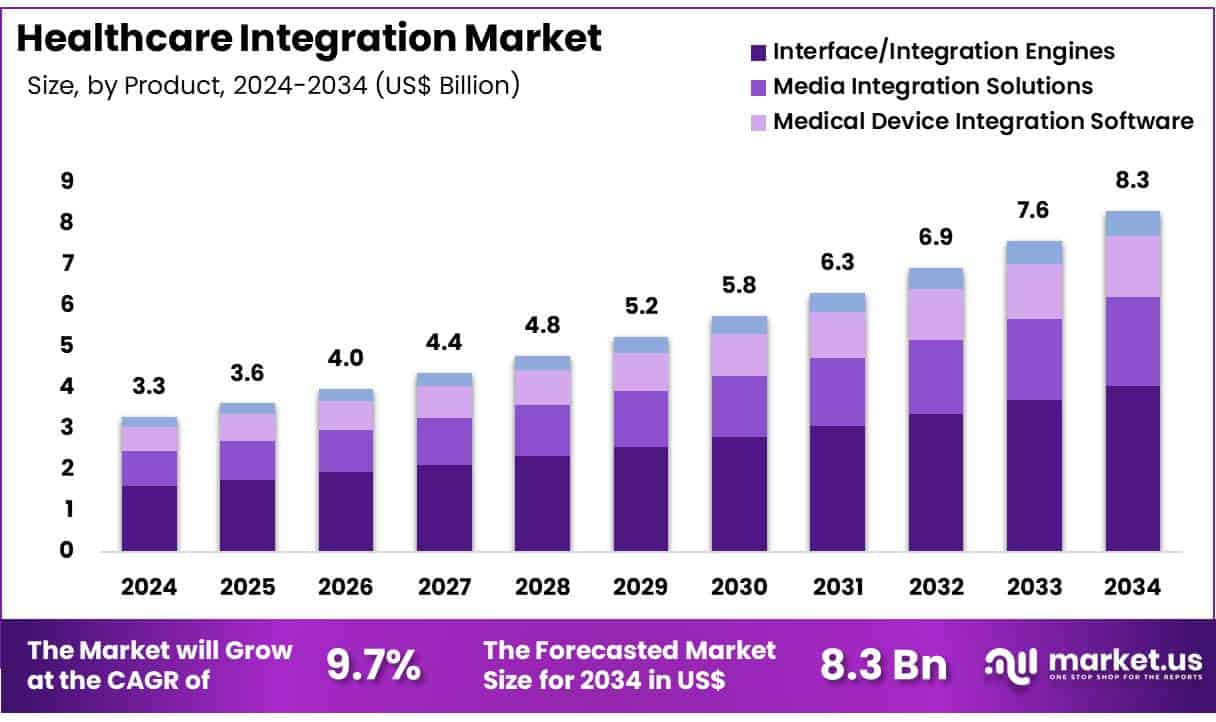
Global Healthcare Integration Market size is expected to be worth around US$ 8.3 Billion by 2034 from US$ 3.3 Billion in 2024, growing at a CAGR of 9.7% during the forecast period 2025 to 2034. North America led the market, achieving over 41.5% share with a revenue of US$ 1.4 Billion.
Healthcare systems worldwide are increasingly turning to healthcare integration to enhance patient care, operational efficiency, and data interoperability. By enabling seamless data exchange across hospitals, laboratories, pharmacies, and insurance providers, integrated healthcare solutions are reshaping how medical services are delivered and coordinated.
Healthcare integration refers to the process of combining diverse health information systems, electronic health records (EHRs), and clinical workflows into a unified platform. This approach supports timely access to accurate patient data, reduces duplication of services, minimizes medical errors, and promotes continuity of care. Integration is also a foundational component of value-based care models, population health management, and real-time clinical decision-making.
The shift toward integrated platforms is being driven by global policy initiatives such as the U.S. 21st Century Cures Act and the European eHealth Digital Service Infrastructure (eHDSI), which emphasize interoperability and secure health data sharing. Additionally, the rise in chronic conditions, aging populations, and increased demand for digital health solutions are creating urgent needs for system-wide integration.
As healthcare providers strive to improve patient outcomes while optimizing resources, healthcare integration stands at the center of digital transformation. Organizations adopting interoperable systems are better positioned to deliver coordinated, personalized, and efficient care across the entire patient journey.
Click here to get a Sample report copy @ https://market.us/report/healthcare-integration-market/free-sample/
Key Takeaways
- In 2023, the global healthcare integration market was valued at USD 3.3 billion and is projected to reach approximately USD 8.3 billion by 2033, expanding at a compound annual growth rate (CAGR) of 9.7% during the forecast period.
- By Product Type, the market is segmented into interface/integration engines, media integration solutions, medical device integration software, and others. Among these, interface/integration engines emerged as the leading product category, accounting for 48.7% of the total market share in 2023, owing to their critical role in enabling seamless data exchange across health IT systems.
- In Terms of Services, the market is categorized into implementation & integration, consulting, support & maintenance, and training & education. The implementation & integration services segment dominated the market with a 52.3% share, reflecting the increasing demand for system-wide deployment and interoperability solutions in healthcare settings.
- By End User, the market includes hospitals, clinics, diagnostic centers, laboratories, and others. Hospitals held the largest revenue share at 55.6% in 2023, driven by large-scale adoption of integrated health information systems to support clinical efficiency and patient care coordination.
- Regionally, North America led the global healthcare integration market, capturing 41.5% of total revenue in 2023, supported by advanced digital infrastructure, regulatory mandates, and strong investment in healthcare IT.
Segmentation Analysis
- Product Segment Analysis: In 2023, interface/integration engines dominated the product segment with a 48.7% market share. These engines facilitate real-time interoperability among EHRs, laboratory systems, and medical devices, making them essential for modern healthcare operations. Demand is rising due to the need for streamlined workflows, regulatory compliance, and scalable data exchange. The growing use of cloud computing and API-based architectures, combined with advanced features like analytics and automated routing, continues to drive adoption of these integration platforms.
- Services Segment Analysis: Implementation and integration services led the services segment with a 52.3% share, driven by the need for expert deployment of complex healthcare IT solutions. These services ensure interoperability across fragmented systems through tailored implementation strategies and workflow alignment. Rising healthcare IT investments and digital transformation efforts are reinforcing this demand. As regulatory pressures for secure data exchange increase, healthcare providers are turning to specialized service partners to reduce downtime and maximize return on integration investments.
- End User Segment Analysis: Hospitals accounted for 55.6% of the market in 2023, emerging as the largest end-user group. The segment’s dominance is attributed to hospitals’ increasing reliance on integrated systems to manage complex clinical data across departments. Integration enhances coordination, improves outcomes, and supports real-time decision-making. Policy incentives for meaningful health IT use and the shift toward value-based care are further driving hospital adoption. Cloud-based solutions and standardization frameworks are simplifying implementation, making hospitals key contributors to overall market expansion.
Market Segments
By Product
- Interface/Integration Engines
- Media Integration Solutions
- Medical Device Integration Software
- Others
By Services
- Implementation & Integration
- Consulting
- Support & Maintenance
- Training & Education
By End User
- Hospitals
- Clinics
- Diagnostic Centers
- Laboratories
- Others
To Purchase this Premium Report @ https://market.us/purchase-report/?report_id=149165
Regional Analysis
In 2023, North America emerged as the dominant region in the global healthcare integration market, accounting for a substantial 41.5% revenue share. This leadership is driven by strong regulatory support, widespread adoption of Electronic Health Records (EHRs), and ongoing initiatives to promote interoperability across healthcare systems.
The U.S. Department of Health & Human Services (HHS) and the Office of the National Coordinator for Health Information Technology (ONC) have implemented policies to enhance data sharing. The 21st Century Cures Act, with its emphasis on open APIs, has significantly advanced real-time health data exchange. High EHR adoption rates among U.S. office-based physicians provide a critical foundation for deploying advanced integration technologies.
Looking ahead, the Asia Pacific region is projected to register the highest compound annual growth rate (CAGR) during the forecast period. This rapid growth is fueled by increasing government investments in digital health infrastructure, national health information exchanges, and efforts to expand universal health coverage.
Countries such as India, China, and Australia are implementing large-scale digitization initiatives aimed at improving care delivery and access. Moreover, a surge in healthcare collaborations and partnerships is driving demand for integration platforms that can ensure seamless communication and coordination among diverse healthcare providers across the region.
Key Players Analysis
Leading players in the healthcare integration market are driving growth through strategic investments in interoperability technologies, global expansion, and collaborative partnerships. These organizations are increasingly focused on developing scalable integration platforms that support seamless data exchange across varied healthcare systems, enabling real-time decision-making and improved care coordination.
To strengthen market position, companies are prioritizing enhanced security protocols and regulatory compliance, addressing rising concerns around data privacy and system interoperability. Continued investment in research and development enables the integration of AI and cloud-based solutions, improving platform flexibility, service efficiency, and analytics-driven outcomes.
Cerner Corporation stands out as a prominent market player, specializing in health information technology solutions, including electronic health records (EHRs) and interoperability services. Established in 1979, Cerner operates in over 35 countries, delivering systems that support clinical workflow optimization, population health strategies, and patient engagement initiatives.
Its technology enables healthcare providers, payers, and patients to share data securely and effectively. Through a commitment to innovation and data-driven platforms, Cerner continues to support healthcare organizations in achieving integrated, coordinated, and high-quality care delivery across multiple settings and geographies.
Market Key Players
- Allscripts Healthcare, LLC
- Cerner Corporation
- CipherHealth Inc
- Epic Systems Corporation
- Infor
- InterSystems Corporation
- Oracle
- Orion Health
Market Dynamics
- Market Driver: The primary driver of the healthcare integration market is the increasing adoption of Electronic Health Records (EHRs) and the need for seamless data exchange among healthcare providers. Rising patient volumes and the demand for coordinated care compel providers to adopt integrated systems that enhance clinical efficiency. Government mandates, such as the U.S. 21st Century Cures Act, further reinforce interoperability, pushing healthcare institutions toward advanced integration platforms to support timely, secure, and accurate health information sharing.
- Market Trend: A key emerging trend in the healthcare integration market is the integration of cloud-based technologies and artificial intelligence (AI) into interoperability platforms. Cloud solutions enable scalable and cost-efficient data sharing, while AI enhances automation, analytics, and decision support. This shift allows healthcare systems to manage increasing data volumes, improve operational efficiency, and personalize patient care. The trend toward digital health transformation, including telehealth and remote monitoring, is accelerating the adoption of intelligent, cloud-enabled integration tools.
- Market Opportunity: A significant opportunity lies in the expansion of healthcare integration solutions in emerging markets, particularly in Asia Pacific and Latin America. Governments in these regions are investing in national digital health infrastructure and universal health coverage initiatives. As healthcare providers seek to modernize legacy systems and improve care access, the demand for integration platforms that connect disparate systems is rising. Vendors have the chance to deliver localized, scalable, and regulatory-compliant solutions tailored to evolving healthcare needs.
Conclusion
The global healthcare integration market is undergoing transformative growth, driven by increasing EHR adoption, regulatory mandates, and the rising need for real-time, interoperable healthcare systems. With a projected value of USD 8.3 billion by 2033, the market presents strong opportunities across services, products, and regions especially in Asia Pacific.
Key players are advancing through innovation in AI and cloud-based platforms, ensuring secure and efficient data exchange. As healthcare systems worldwide prioritize coordinated, value-based care, integrated digital infrastructures will remain essential to improving outcomes, reducing operational complexity, and enhancing overall healthcare delivery on a global scale.
View More Reports:
Generative AI in Pharmaceutical Market to Reach US$ 40.88 Billion by 2034
Generative AI in Pharmaceutical Market to Reach US$ 40.88 Billion by 2034
Tissue Engineering for Wound Care Market To Grow at 16.2% CAGR
Tissue Engineering for Wound Care Market To Grow at 16.2% CAGR
Environmental Health and Safety (EHS) Software Market Eyes US$ 99.8 Bn Milestone by 2034
Environmental Health and Safety (EHS) Software Market Eyes US$ 99.8 Bn Milestone by 2034



