

Overview
Global Health IT Security Market size is expected to be worth around US$ 67.3 Billion by 2034 from US$ 16.5 Billion in 2024, growing at a CAGR of 15.1% during the forecast period 2025 to 2034. In 2024, North America led the market, achieving over 39.9% share with a revenue of US$ 6.6 Billion.
The global healthcare sector is increasingly prioritizing Health IT Security as a critical component of digital transformation. With the rise in cyberattacks targeting hospitals, clinics, and health systems, protecting electronic health records (EHRs), connected medical devices, and patient data has become a strategic imperative.
Health IT Security involves implementing comprehensive measures, including firewalls, data encryption, identity access management, intrusion detection systems, and secure cloud infrastructure. These solutions ensure data confidentiality, integrity, and availability across healthcare networks. The adoption of advanced technologies such as AI-driven threat detection, blockchain, and zero-trust architecture is further reinforcing system defenses.
Government mandates like the U.S. HIPAA Security Rule and the European Union’s GDPR are compelling healthcare organizations to invest in robust cybersecurity frameworks. Breaches not only risk regulatory penalties but also compromise patient trust and care continuity. According to the U.S. Department of Health and Human Services, over 88 million healthcare records were exposed in breaches in 2023 alone.
The market is witnessing heightened investment from both public and private sectors to strengthen IT infrastructures. Cloud-based Health IT Security platforms, in particular, are gaining traction due to their scalability, real-time monitoring, and compliance support. As healthcare continues its digital evolution, Health IT Security will remain pivotal in ensuring safe, resilient, and compliant care delivery environments.
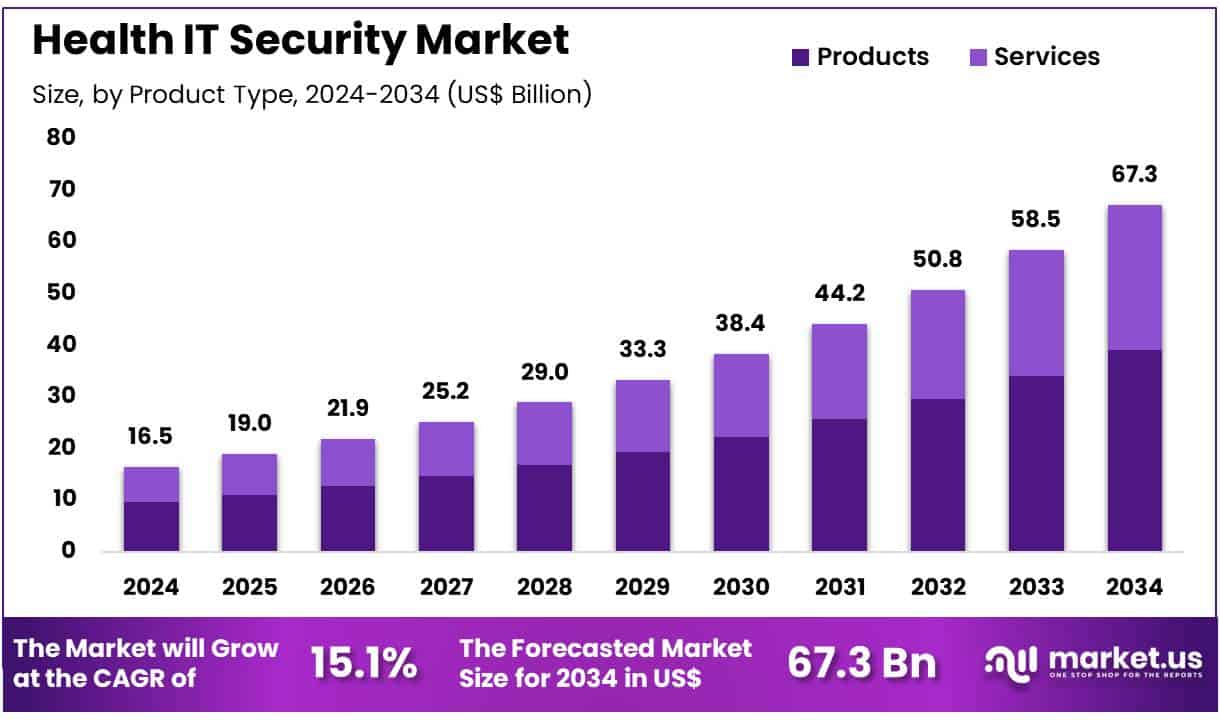
Click here to get a Sample report copy @ https://market.us/report/health-it-security-market/free-sample/
Key Takeaways
- In 2023, the global Health IT Security market generated revenue amounting to US$ 16.5 billion, and is projected to expand at a compound annual growth rate (CAGR) of 15.1%, reaching approximately US$ 67.3 billion by 2033.
- Based on product type, the market is categorized into products and services. Among these, the products segment dominated in 2023, accounting for a market share of 58.2%.
- By deployment mode, the market is segmented into on-cloud and on-premises solutions. The on-cloud deployment model emerged as the leading segment, capturing 62.5% of the total market share in 2023, owing to its scalability and real-time threat monitoring capabilities.
- With respect to application, the market is segmented into network security, application security, endpoint security, and content security. Network security held the largest revenue share, contributing 44.5%, reflecting the increasing need for secure communication infrastructure across healthcare institutions.
- In terms of end-user, the market is bifurcated into healthcare facility providers and healthcare payers. Healthcare facility providers accounted for the dominant share, holding 59.3% of the market in 2023, driven by the growing emphasis on safeguarding hospital IT systems and patient data.
- Geographically, North America led the global market, securing a market share of 39.9% in 2023, supported by regulatory enforcement and high cybersecurity adoption across healthcare systems.
Segmentation Analysis
- Product Type Analysis: In 2023, the products segment dominated the Health IT Security market, capturing 58.2% share. This growth is driven by rising demand for advanced cybersecurity tools such as firewalls, encryption technologies, and intrusion detection systems. The surge in cyber threats targeting healthcare systems and increasing reliance on IoT in clinical settings are prompting providers to invest in robust product-based solutions. Additionally, compliance with regulations like HIPAA is accelerating the adoption of security products across healthcare facilities.
- Deployment Mode Analysis: The on-cloud deployment segment led the market with a 62.5% share in 2023, driven by healthcare organizations migrating to cloud environments for cost efficiency and accessibility. Cloud-based solutions offer scalable, real-time protection and secure data collaboration, making them ideal amid the rise in telehealth and remote work. The availability of healthcare-specific cloud security features and increasing data volumes further support the growth of this segment, as providers seek enhanced security and regulatory compliance.
- Application Analysis: Network security emerged as the leading application area in 2023, accounting for 44.5% of the market share. The segment is gaining traction due to the rising frequency of cyberattacks, including ransomware, on healthcare networks. As healthcare infrastructure becomes increasingly digital and interconnected, secure network architectures are vital to prevent unauthorized access. The proliferation of IoT devices and cloud-based data exchanges further necessitate advanced network security to maintain patient privacy and data integrity.
- End-User Analysis: Healthcare facility providers led the end-user segment in 2023, with a 59.3% market share. Hospitals, clinics, and care centers are prioritizing health IT security to protect sensitive patient data and meet regulatory standards. With the continued shift toward electronic health records (EHR) and digital healthcare delivery, the demand for comprehensive security frameworks has intensified. The growing risk of cyberattacks and the adoption of cloud technologies are expected to further boost security investments by healthcare providers.
Market Segments
Product Type
- Products
- Antimalware and Antivirus
- Risk and Compliance Management Solutions
- Intrusion Detection/ Intrusion Prevention Systems
- Identity and Access Management Solutions
- Firewalls and Unified Threat Management Solutions
- Encryption and Data Loss Protection Solutions
- Services
- Consulting
- Managed Security Services
- Others
Deployment Mode
- On-cloud
- On-premises
Application
- Application Security
- Network Security
- Endpoint Security
- Content Security
End-user
- Healthcare Facility Providers
- Hospitals
- General Physicians
- Others
- Healthcare Payers
To Purchase this Premium Report @ https://market.us/purchase-report/?report_id=144853
Regional Analysis
North America dominated the global Health IT Security market in 2023, capturing a revenue share of 39.9%. This leadership is attributed to heightened cyber threats, regulatory compliance mandates, and accelerated healthcare digitization. According to the U.S. Department of Health and Human Services, healthcare data breaches rose by 25% between 2022 and 2024, emphasizing the need for enhanced cybersecurity frameworks.
The 2023 HIPAA updates have further pushed healthcare providers to strengthen data protection systems. Additionally, the Office of the National Coordinator for Health IT recorded a 15% increase in EHR adoption, while telehealth usage surged by 30%, driving demand for secure infrastructure. Major providers have responded with substantial investments, including a US\$ 500 million cybersecurity upgrade by a leading U.S. health system.
In contrast, Asia Pacific is projected to witness the highest CAGR over the forecast period. Countries like India and Australia have enacted stricter data protection laws, such as India’s Digital Personal Data Protection Act (2023). WHO data indicates a 20% increase in healthcare cyberattacks in the region, prompting urgent security investments. Governments in China and Japan are also enhancing funding for EHR expansion and healthcare cybersecurity, positioning the region for rapid market growth.
Key Players Analysis
Leading companies in the Health IT Security market are prioritizing technological innovation, regulatory alignment, and strategic partnerships to maintain competitive advantage and foster market expansion. A primary focus lies in the development of advanced cybersecurity solutions, including AI-powered threat detection, real-time data encryption, and automated incident response, aimed at countering increasingly sophisticated cyber threats in the healthcare sector.
These players are also enhancing their portfolios by offering integrated security platforms that address the diverse needs of hospitals, outpatient clinics, and large health systems. Strategic alliances with healthcare providers and IT firms have played a crucial role in boosting solution adoption and expanding regional presence. Moreover, targeting emerging markets with rapidly developing digital health ecosystems presents substantial growth potential.
Palo Alto Networks, based in Santa Clara, California, is recognized as a global leader in cybersecurity, with tailored solutions for the healthcare industry. The company provides a broad suite of services including next-generation firewalls, cloud-based threat intelligence, and secure access technologies, designed to meet the rigorous standards of healthcare data protection.
With a strong emphasis on HIPAA compliance, proactive threat mitigation, and industry collaborations, Palo Alto Networks continues to strengthen its position as a prominent player in the global Health IT Security market.
Market Key Players
- Trend Micro Incorporated
- Symantec Corporation
- Northrop Grumman
- McAfee, LLC
- Intel Corporation
- IBM
- Cisco Systems
- AO Kaspersky Lab
Market Dynamics
- Market Driver: The primary driver of the Health IT Security market is the rising incidence of cyberattacks on healthcare systems, which demand robust data protection. Healthcare organizations face increasing threats to electronic health records (EHRs), medical devices, and patient databases. Regulatory mandates such as HIPAA and GDPR further compel providers to invest in cybersecurity infrastructure. As digital health platforms expand and remote care becomes more prevalent, the need for advanced, secure IT systems continues to accelerate market demand.
- Market Trend: A key trend shaping the Health IT Security market is the adoption of AI and machine learning-based threat detection systems. These technologies offer real-time analytics, anomaly detection, and predictive threat response, significantly enhancing cybersecurity posture. Integration of AI with cloud platforms, secure data sharing networks, and automated incident reporting is gaining traction across hospitals and health networks. Additionally, the convergence of health IT with IoT and smart medical devices is driving demand for more intelligent and scalable security solutions.
- Market Opportunity: Emerging economies present significant opportunities for Health IT Security vendors due to the rapid digitization of healthcare systems. Countries across Asia Pacific, Latin America, and the Middle East are investing in electronic health records, telemedicine platforms, and mobile health applications. However, infrastructure gaps and increasing cyber threats create a growing demand for scalable, affordable, and compliant cybersecurity solutions. Vendors that offer localized support, cloud-based deployment, and regulatory-aligned technologies stand to benefit significantly from these high-growth markets.
Conclusion
The global Health IT Security market is poised for substantial growth, driven by rising cyber threats, regulatory mandates, and the rapid digitalization of healthcare systems. With increasing adoption of EHRs, telehealth services, and IoT devices, healthcare providers are investing in advanced cybersecurity frameworks to protect sensitive data and ensure compliance.
North America leads the market, while Asia Pacific is expected to witness the fastest growth. Innovation in AI-driven threat detection, cloud-based platforms, and strategic partnerships among key players will continue to shape the future landscape of secure, resilient healthcare IT infrastructure worldwide.
View More Reports:
Healthcare Interoperability Solutions Market to Hit USD 14.7 Billion by 2034
Healthcare Interoperability Solutions Market to Hit USD 14.7 Billion by 2034
Electrophysiology Market Set for 15.2% CAGR Through 2034
Radiology Information Systems Market To Reach USD 3.6 Billion By 2034
Radiology Information Systems Market To Reach USD 3.6 Billion By 2034



