
Overview
Global Radiology Information Systems Market size is expected to be worth around US$ 3.6 Billion by 2034 from US$ 1.4 Billion in 2024, growing at a CAGR of 9.8% during the forecast period 2025 to 2034. In 2023, North America led the market, achieving over 41.2% share with a revenue of US$ 0.6 Billion.
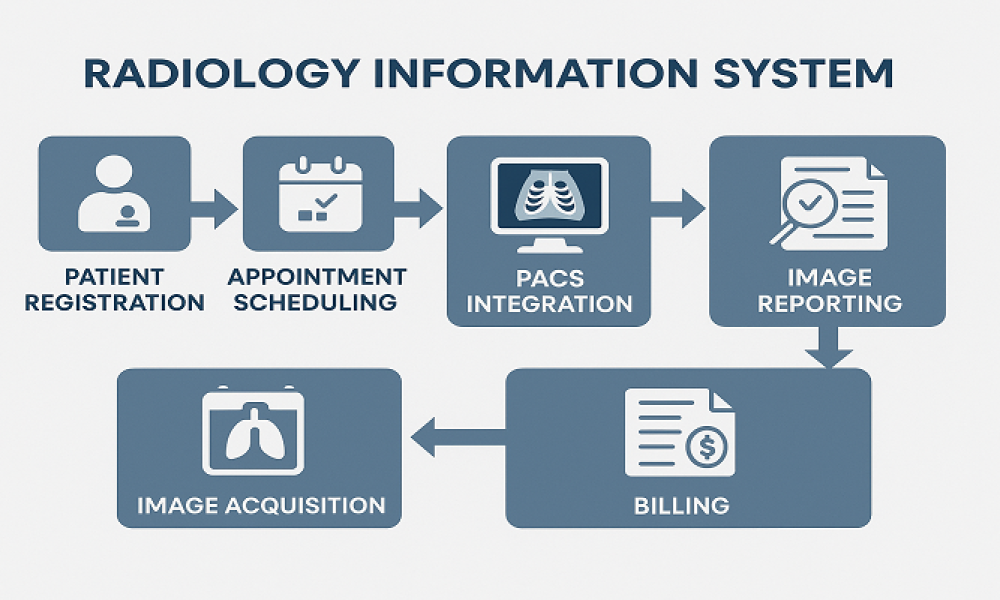
Radiology Information Systems (RIS) are integral to the efficient management of medical imaging data and workflows within healthcare institutions. These specialized software platforms are designed to streamline radiology operations by facilitating patient registration, scheduling, tracking, image reporting, and billing processes. By providing a centralized database, RIS ensures seamless communication between radiologists, technicians, and administrative personnel, thereby improving diagnostic accuracy and operational efficiency.
RIS is often integrated with Picture Archiving and Communication Systems (PACS) and Hospital Information Systems (HIS) to support end-to-end imaging workflows. This integration allows real-time access to patient imaging history and diagnostic reports, enhancing clinical decision-making and reducing repeat procedures. The system also supports regulatory compliance and data security standards, ensuring safe storage and retrieval of sensitive patient information.
With the increasing demand for digital health solutions and growing imaging volumes, hospitals and diagnostic centers are increasingly adopting RIS to reduce administrative burdens and enhance patient care delivery. Modern RIS platforms also offer advanced analytics, artificial intelligence integration, and cloud-based deployment, allowing scalable and remote access functionalities.
As radiology continues to play a critical role in disease diagnosis and treatment monitoring, the adoption of efficient RIS solutions is expected to grow, driven by the global emphasis on healthcare digitization and workflow automation across imaging departments.
Click here to get a Sample report copy@ https://market.us/report/radiology-information-systems-market/free-sample/

Key Takeaways
- In 2024, the global radiology information systems (RIS) market generated a revenue of USD 1.4 billion and is projected to reach approximately USD 3.6 billion by 2033, expanding at a compound annual growth rate (CAGR) of 9.8% over the forecast period.
- By product type, the market is segmented into integrated RIS and standalone RIS, with integrated RIS dominating the segment in 2023, accounting for a substantial 68.5% market share, owing to its compatibility with hospital information systems and PACS platforms.
- Based on deployment mode, the market is categorized into web-based, on-premise, and cloud-based systems. Among these, the web-based deployment model held the largest share in 2023, representing 57.2% of the global market, supported by its cost-effectiveness and ease of accessibility.
- In terms of end-users, the RIS market is segmented into hospitals & clinics, outpatient department (OPD) clinics, and others. The hospitals and clinics segment emerged as the leading contributor, capturing 74.6% of the total market share, driven by higher imaging volumes and institutional investments in digital infrastructure.
- Regionally, North America led the global RIS market in 2023, securing a 41.8% share, supported by advanced healthcare infrastructure, high adoption of digital health solutions, and strong regulatory frameworks.
Segmentation Analysis
- Product Type Analysis: In 2023, the integrated RIS segment led the market with a 68.5% share, driven by rising demand for interconnected healthcare systems. These solutions enable seamless integration with EHR and PACS platforms, enhancing data sharing, workflow efficiency, and diagnostic accuracy. The integration of AI-driven diagnostics and real-time reporting tools is also supporting growth. As hospitals prioritize system interoperability and clinical efficiency, the adoption of integrated RIS solutions is expected to increase steadily.
- Deployment Mode Analysis: Web-based RIS accounted for 57.2% of the market share, supported by the increasing adoption of digital healthcare and remote access solutions. These platforms offer greater flexibility, scalability, and lower upfront IT costs. Their ability to support telemedicine and remote consultations has made them particularly valuable for healthcare providers. With ongoing digital transformation and the need for real-time data access, demand for web-based RIS is projected to grow, aided by simplified maintenance and mobile-friendly features.
- End-user Analysis: The hospitals and clinics segment held a dominant market share of 74.6% in 2023, reflecting their role as primary adopters of RIS technologies. These facilities handle high imaging volumes and require efficient diagnostic systems to improve care quality and reduce patient wait times. Continued investments in health IT infrastructure, combined with the push for faster diagnostics and enhanced patient management, are expected to drive RIS adoption in hospitals and clinics over the coming years.
Market Segments
Product Type
- Integrated RIS
- Standalone RIS
Deployment Mode
- Web-based
- On-premise
- Cloud-based
End-user
- Hospitals & Clinics
- Outpatient Department (OPD) Clinics
- Others
To Purchase this Premium Report@ https://market.us/purchase-report/?report_id=142986
Regional Analysis
North America led the global radiology information systems (RIS) market in 2023, capturing a revenue share of 41.8%. The region’s dominance is primarily driven by the widespread adoption of integrated RIS solutions, which enhance radiology workflows and improve data management. The increasing shift toward cloud-based deployments has supported scalability, remote access, and reduced IT costs, prompting healthcare institutions across the U.S. and Canada to invest in RIS.
The presence of key healthcare IT vendors, such as IBM and Cerner Corporation, has further contributed to innovation and advanced solution adoption. Additionally, rising healthcare expenditure, strong regulatory frameworks, and government initiatives promoting digital transformation have strengthened market growth. Integration with electronic health records (EHRs) has improved interoperability and clinical outcomes across hospitals.
Asia Pacific is projected to register the fastest compound annual growth rate (CAGR) during the forecast period. This growth is attributed to the rapid adoption of integrated RIS solutions in countries such as China, India, and Japan. Factors such as rising healthcare investments, growing demand for diagnostic imaging, and government support for health IT infrastructure are driving adoption. Strategic collaborations with global technology providers and increasing deployment of AI-enabled imaging systems are expected to accelerate RIS penetration across the Asia Pacific region.
Key Players Analysis
Leading companies in the radiology information systems (RIS) market are driving growth through continuous technological advancement, strategic collaborations, and global market expansion. These players prioritize the integration of artificial intelligence (AI), cloud-based architectures, and interoperability enhancements to improve diagnostic precision, workflow efficiency, and patient data management.
To remain competitive, companies are expanding their product portfolios to deliver end-to-end radiology solutions that align with healthcare providers’ needs. Strategic partnerships with hospitals, academic institutions, and health organizations are enabling broader adoption of RIS platforms and accelerating innovation cycles. Moreover, market leaders are increasingly targeting emerging economies where rising investments in healthcare infrastructure are creating demand for advanced diagnostic systems.
Cerner Corporation stands out as a key player in this domain. Based in North Kansas City, Missouri, Cerner specializes in health information technology, with a strong focus on electronic health record (EHR) systems and radiology software. The company’s integrated RIS solutions are designed to optimize imaging workflows, enable real-time data access, and support clinical decision-making. Cerner continues to expand its global footprint through acquisitions and alliances, aiming to strengthen its technological capabilities and provide scalable solutions tailored to modern healthcare environments.
Market Key Players
- RadNet
- Oracle
- Mckesson Corporation
- IBM
- General Electric Company
- Epic Systems Corporation
- DeepHealth
Market Dynamics
- Market Driver: The primary driver of the radiology information systems (RIS) market is the rising demand for efficient diagnostic imaging management in hospitals and clinics. Increasing imaging volumes and the need to streamline radiology workflows are compelling healthcare providers to adopt RIS platforms. Integration with electronic health records (EHRs) enhances patient data accessibility, reduces administrative burden, and improves clinical decision-making. This shift toward digital healthcare infrastructure is accelerating RIS deployment globally, especially in high-volume healthcare settings.
- Market Trend: A key trend shaping the RIS market is the integration of artificial intelligence (AI) and machine learning capabilities into radiology workflows. AI-powered RIS platforms can assist in real-time image interpretation, automate reporting, and detect anomalies with greater accuracy. Additionally, the adoption of cloud-based and web-based deployment models is increasing, offering scalability and remote access. These technological advancements are transforming radiology departments, enabling faster diagnosis, enhanced data analytics, and improved interoperability across healthcare systems.
- Market Opportunity: Significant growth opportunities exist in emerging economies due to rising healthcare investments and digital transformation initiatives. Countries in Asia-Pacific, Latin America, and the Middle East are expanding imaging infrastructure and adopting health information systems to meet rising diagnostic demands. Government-backed healthcare reforms and public-private partnerships are encouraging the implementation of RIS in both public and private sectors. Vendors focusing on affordable, scalable, and cloud-based solutions stand to benefit from the increasing demand in these developing markets.
Conclusion
The global radiology information systems (RIS) market is poised for sustained growth, driven by increasing imaging volumes, digital healthcare transformation, and advancements in AI and cloud technologies. Integrated RIS platforms are becoming essential for hospitals and clinics seeking improved efficiency, data management, and diagnostic accuracy.
North America leads in adoption, while Asia Pacific presents robust growth opportunities due to rising healthcare investments. As demand for scalable, interoperable, and patient-centric radiology solutions increases, key market players are expected to focus on innovation, strategic partnerships, and expansion into emerging markets to strengthen their global presence.
View More Reports:
Bioanalytical Testing Services Market Eyes USD 11.5 Bn Milestone
Bioanalytical Testing Services Market Eyes USD 11.5 Bn Milestone
Healthcare Interoperability Solutions Market to Hit USD 14.7 Billion by 2034
Healthcare Interoperability Solutions Market to Hit USD 14.7 Billion by 2034
Electrophysiology Market Set for 15.2% CAGR Through 2034



