
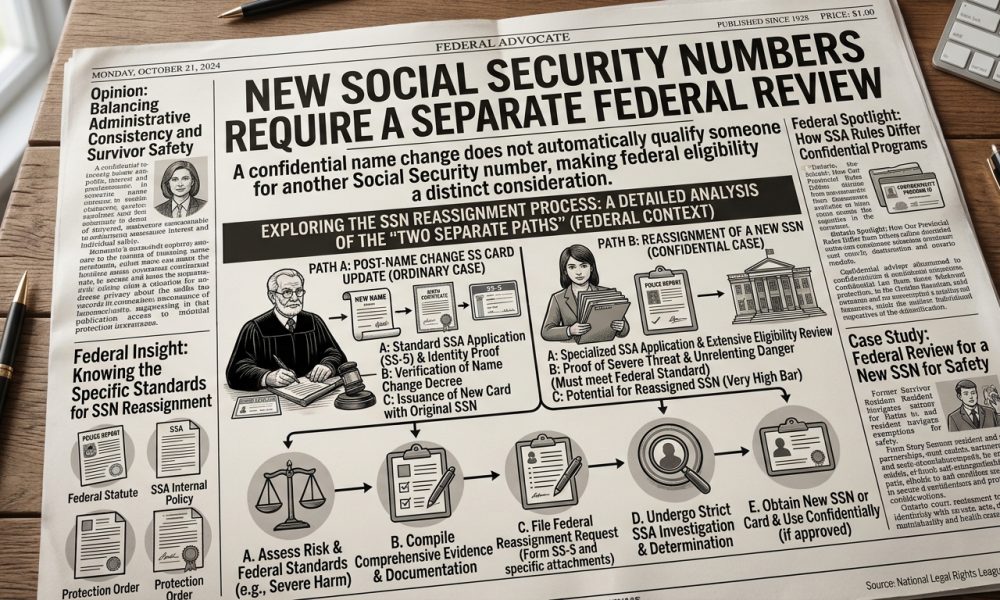
An authorized legal name change, confidential court proceeding, or protected residential address does not automatically qualify an individual for another Social Security number, because the Social Security Administration maintains separate eligibility requirements for cases involving serious harassment, abuse, identity theft, and other exceptional circumstances.
WASHINGTON, DC, October 25, 2026: American citizens and other eligible individuals who legally change their names for personal safety, identity theft recovery, or confidential relocation may discover that obtaining a different Social Security number requires a separate federal review.
Although courts can authorize legal name changes and state agencies can provide certain confidentiality protections, the Social Security Administration generally retains an individual’s original identifying number unless the person establishes eligibility under one of its limited exceptions.
The distinction is particularly significant for survivors of domestic violence, stalking, and serious harassment, whose efforts to establish safer circumstances may involve updated Identification documents, protected addresses, and continuing concerns about misuse of personal Information.
Federal officials must evaluate the specific circumstances supporting a new number while preserving accurate employment, financial, and benefits records, meaning that a different identifier is neither an automatic consequence of a name change nor a complete replacement for existing legal history.
A Legal Name Change Usually Preserves the Existing Number
When an individual legally changes a name following marriage, divorce, a court order, or another recognized event, the Social Security Administration generally updates its records and issues a corrected card displaying the new legal name.
The replacement card ordinarily continues displaying the same nine-digit Social Security number, allowing existing employment histories, earnings Information, benefit records, and other legitimate administrative connections to remain associated with the same individual.
This procedure differs from assigning a completely new number, which requires evaluation under separate federal rules and cannot be justified merely by presenting an otherwise valid court order recognizing a changed name.
For survivors pursuing confidential name changes, understanding this distinction early can prevent unnecessary administrative expectations while allowing them to coordinate accurate Identification and appropriate privacy safeguards across government systems.
Federal Rules Recognize Exceptional Circumstances
According to the Social Security Administration’s official guidance on requesting a new number, the agency may assign another identifier in rare circumstances involving continuing identity theft, serious harassment, abuse, domestic violence, or threats to personal safety.
Other recognized circumstances include problematic sequential numbers assigned to family members, situations involving more than one person using the same number, and documented religious or cultural objections to particular digits.
These categories create a limited administrative framework rather than an unrestricted opportunity to choose a different number, making the applicant’s documented circumstances central to the agency’s decision.
The SSA generally assigns one number to an individual throughout life, using that identifier to maintain accurate earnings records and administer benefits across periods of employment, retirement, or disability.
Domestic Violence Survivors May Qualify for Consideration
Individuals experiencing domestic violence may have compelling reasons to seek additional Identification protections, particularly when an abusive person has misused personal Information or continued threatening conduct after a separation.
Social Security recognizes harassment, abuse, and life-endangering circumstances as possible grounds for assigning a different number. Still, applicants must provide evidence supporting the situation rather than relying exclusively on a name-change order.
The agency’s specialized domestic violence guidance also warns that requesting another number is a significant decision because existing employment, medical, financial, and government records may remain associated with the previous identifier.
Survivors should therefore evaluate the potential benefits and administrative complications with qualified support, recognizing that a new number can be one component of Protection without guaranteeing complete personal anonymity.
Stalking and Serious Harassment Require Individual Assessment
Persistent stalking or serious harassment can create circumstances in which an individual believes that continued use of an existing Social Security number contributes to threats or ongoing personal vulnerability.
The SSA reviews qualifying harassment and life-endangering situations through its established process, requiring applicants to explain the circumstances and provide evidence of the problems they continue to experience.
Not every unwelcome contact or ordinary privacy concern establishes eligibility, because the agency must determine whether the request falls within an authorized exception to its general one-number policy.
An individualized assessment helps distinguish serious documented risks from unsupported assumptions, while allowing applicants to describe their circumstances through the appropriate administrative channels.
Identity Theft Can Also Support a Different Number
Identity theft creates a separate basis for requesting another Social Security number when someone’s existing identifier has been misused, and corrective efforts have failed to resolve ongoing disadvantages.
The SSA states that victims should first try to address the problems resulting from misuse, because exposure or theft of personal Information does not automatically require a different number.
Applicants seeking relief under this category must show continuing difficulties with the original number, distinguishing unresolved harm from incidents already corrected through ordinary recovery procedures.
The distinction matters because assigning another number without addressing fraudulent accounts or inaccurate financial records may create additional administrative complications while leaving earlier identity theft problems unresolved.
Recent Reporting Illustrates Wider Identity Exposure Risks
Concerns about the security of government-issued identity Information intensified following reports describing alleged large-scale exposure of personal documents through criminal marketplaces and other unauthorized Information sources.
In September 2026, Reuters reported that the FBI was investigating allegations involving millions of American and Canadian driver’s license records, after researchers identified documents apparently offered through a dark-web marketplace.
The reporting concerned driver’s license Information rather than confirmed wholesale exposure of Social Security numbers, but it illustrated broader risks associated with compromised Identification records and their potential misuse.
Importantly, a publicized data breach does not automatically qualify someone for a new Social Security number, since the SSA applies its own criteria based on documented misuse, ongoing harm, and other recognized circumstances.
An Exposed Number Does Not Automatically Qualify for Replacement
A person may discover that an existing Social Security number appeared in a data breach without establishing that someone actually used the Information to obtain credit, claim benefits, or commit another fraudulent act.
The distinction matters because the SSA generally requires more than evidence of possible exposure when evaluating identity-theft-based requests, especially when no continuing disadvantage has been established.
Consumers facing suspected misuse may need to pursue appropriate fraud reporting, account corrections, and credit protections while determining whether the circumstances justify seeking a different federal identifier.
Do not treat obtaining another number as the first or inevitable response to every breach notification, especially when other measures can address immediate risks without disrupting legitimate records.
Applicants Must Arrange a Federal Appointment
The Social Security Administration instructs individuals seeking a different number to contact the agency and schedule an appointment so a representative can explain the eligibility requirements and evaluate the applicant’s circumstances.
This process is separate from routine requests for corrected Social Security cards, which may follow different procedures depending on the individual’s situation and available services.
During the appointment, applicants should be prepared to establish the reason for seeking another number and provide the identifying Information and documentation required for federal review.
An agency representative can also explain potential consequences before issuing a new number, helping applicants understand why a different number may complicate records maintained under the existing identifier.
Identity, Age, and Citizenship Evidence Remain Necessary
Applicants requesting a different Social Security number must provide proof of identity, age, and U.S. citizenship or qualifying immigration status, along with evidence relevant to the circumstances supporting their request.
Acceptable documentation depends on federal requirements, and the agency may need original documents or copies certified by the issuing Authority rather than ordinary photocopies.
Individuals who have legally changed their names must also demonstrate the change using appropriate records, allowing the SSA to establish continuity between earlier and current identifying Information.
These requirements preserve the accuracy of the federal Identification system while allowing eligible applicants to seek special consideration without inventing personal histories or presenting inconsistent documentation.
Evidence of Abuse Can Take Different Forms
The SSA’s guidance for domestic violence victims identifies several possible forms of supporting evidence, including police records, protective orders, medical documentation, and Information from organizations familiar with the individual’s circumstances.
The appropriate evidence depends on the applicant’s situation, and a federal representative may explain what documentation is needed to establish the applicable harassment, abuse, or life-endangerment grounds.
Survivors may face genuine difficulties obtaining records when threatening circumstances have disrupted access to personal belongings, official documents, or institutions connected with an abusive relationship.
Qualified survivor advocates and legal representatives can help individuals understand documentation requirements while ensuring sensitive Information is shared through appropriate, authorized channels.
Confidential Court Orders Have a Separate Function
A sealed or confidential name-change proceeding may protect Information linking a person’s former and current names, especially when public court records could raise legitimate safety concerns.
However, a sealing order does not itself establish that the individual qualifies for another Social Security number, because federal eligibility depends on the independently recognized circumstances and supporting evidence.
The applicant may need to provide authentic legal documents showing the name change while separately explaining the harassment, abuse, identity theft, or other circumstances relevant to the number request.
This distinction helps preserve meaningful court confidentiality without treating judicial Protection of public records as automatic approval for a different federal identifier.
Address Confidentiality Programs Do Not Change Social Security Numbers
State address confidentiality programs generally allow qualifying survivors to use substitute mailing addresses for specified government transactions, reducing unnecessary disclosure of their actual residential locations.
These programs can provide valuable privacy protections, but participation does not automatically make someone eligible for a new Social Security number or change federal records without the required administrative review.
An applicant may qualify for an authorized substitute address while retaining the original number, just as an individual approved for a different number may still require separate residential confidentiality protections.
The appropriate measures depend on the individual’s circumstances because legal names, federal identifiers, and residential addresses involve distinct administrative systems with different purposes and eligibility conditions.
A Different Number Can Complicate Employment Histories
Social Security numbers track earnings histories that support retirement, disability, and other federal benefit calculations, so accurate continuity matters, especially when the SSA assigns another identifier.
An individual who begins using a different number may need to ensure that employers have accurate Information for authorized payroll reporting while preserving the appropriate connection to legitimate earlier earnings.
The agency maintains internal procedures for handling records associated with different numbers, but applicants should not assume that every external employer or administrative system will automatically recognize the change.
Careful planning can reduce discrepancies affecting employment verification, wage reporting, and future benefit administration while maintaining appropriate confidentiality concerning the reasons for the federal Identification update.
Existing Credit Records May Not Transfer Automatically
Credit reports and financial histories may be associated with an individual’s existing name, Social Security number, addresses, and other identifying details collected during earlier banking and borrowing relationships.
Receiving another number does not automatically merge every credit file into a single updated record, which can create difficulties when lenders or financial institutions review historical Information.
The SSA warns that obtaining a different number may affect a person’s ability to interact with businesses and agencies, making these practical consequences relevant to the decision.
Applicants should seek appropriate financial advice when needed and avoid assuming a new identifier will instantly create a complete credit history or automatically resolve outstanding identity theft disputes.
Financial Obligations Continue Under a New Identifier
A different Social Security number does not extinguish debts, cancel contractual obligations, erase criminal proceedings, or eliminate tax responsibilities that remain legally associated with the individual.
Banks and other regulated institutions may require authentic Information connecting prior and current records to meet customer Identification requirements or maintain accurate ownership and transaction histories.
The federal number assignment process addresses qualifying administrative and safety circumstances rather than creating an entirely separate legal person with no connection to earlier lawful activities.
Individuals seeking Protection should therefore distinguish legitimate confidentiality from efforts to misrepresent identity or evade responsibilities that remain enforceable regardless of the assigned identifier.
Government Benefits Require Careful Record Continuity
People receiving Social Security benefits or participating in other government assistance programs may have extensive records tied to their original number, including claims histories and prior administrative decisions.
The SSA maintains procedures to address situations where individuals with different assigned numbers need continuity of benefit records, especially when earlier claims remain relevant.
An authorized number change should therefore be coordinated with the agency to protect legitimate benefits rather than treated as an independent action that automatically updates every related government program.
Accurate documentation helps prevent avoidable interruptions and ensures that the individual continues receiving services for which they remain eligible under applicable federal or state requirements.
Medical Records Can Remain Associated With Earlier Identifiers
Healthcare providers, insurers, and administrative organizations may maintain historical Information under a patient’s earlier name or identifying number, making continuity important for treatment, insurance claims, and access to essential records.
A different Social Security number does not automatically change every medical record, and individuals may need to provide appropriate documentation when seeking corrections to legitimate patient Identification Information.
Handle sensitive records according to applicable healthcare privacy rules, especially when a survivor’s safety concerns warrant restricting unnecessary access.
Maintaining reliable medical histories remains important because privacy protections should not inadvertently interfere with continuity of care or the Information needed for appropriate treatment.
Children May Have Separate Eligibility Considerations
Parents or guardians seeking different Social Security numbers for children must establish the relevant eligibility circumstances and provide documentation demonstrating their Authority to act on the children’s behalf.
The agency may request evidence concerning custody or responsibility, together with documents establishing each child’s identity, age, citizenship, or qualifying immigration status under the applicable procedures.
A parent’s legal name change or receipt of a different Social Security number does not automatically mean that every child in the household receives a different number.
Where family safety concerns affect several individuals, qualified legal assistance can help identify which applications may be appropriate while preserving compliance with existing custody arrangements and judicial orders.
Private Identity Services Cannot Authorize Federal Number Changes.
Individuals considering lawful identity changes may seek help with documentation, privacy planning, and international requirements, especially when multiple government agencies or institutions must update identifying Information.
Amicus International Consulting discusses related administrative and identity considerations through its New Identity Services, which prospective clients should evaluate alongside independent legal advice and authentic government procedures.
However, private advisers cannot independently assign Social Security numbers, override federal eligibility standards, or guarantee the agency will approve another identifier without the evidence the law requires.
Legitimate professional assistance should support accurate documentation and authorized applications rather than suggesting that payment of a service fee creates a new federal identity or eliminates existing records.
A New Number Does Not Guarantee Complete Privacy
Even when the SSA approves a different number, historical Information may remain associated with earlier records maintained by banks, employers, courts, healthcare providers, government agencies, and other institutions.
The federal assignment does not necessarily remove previous identifying Information from commercial databases or prevent unauthorized disclosure through systems that operate independently of the Social Security Administration.
Consequently, applicants should view the number change as a specialized measure for qualifying circumstances, not a guarantee that their historical identity becomes impossible to establish.
Effective privacy planning can involve separate protections concerning residential Information, court records, financial security, and institutional disclosures, each governed by its own legal requirements.
Name Changes Should Be Coordinated Before Number Requests
The SSA’s domestic violence guidance advises individuals who expect to change their legal names to complete that process before applying for a different Social Security number.
This sequence lets the agency review the applicant’s current legal name and supporting evidence during the specialized federal review, reducing administrative complications associated with repeated Identification changes.
Nevertheless, the right timing depends on personal safety, access to documents, and the availability of legally authorized procedures, so individualized guidance matters when circumstances are unusually complicated.
Applicants should distinguish this administrative recommendation from a universal requirement to obtain a name change before every qualifying number request, because the agency recognizes other grounds for assigning different identifiers.
Alternative Identity Theft Protections Remain Important
People experiencing financial identity theft may benefit from credit freezes, fraud alerts, corrected credit reports, and legitimate account security measures regardless of whether the SSA ultimately approves another number.
These protections address particular risks associated with unauthorized borrowing or misuse of financial Information, while federal number replacement remains subject to its own exceptional eligibility requirements.
A new number does not automatically correct fraudulent accounts created earlier, so continued attention to legitimate recovery procedures matters when prior misuse has affected the person’s financial records.
Applicants should therefore evaluate available remedies based on the actual harm involved rather than assuming a different federal identifier is the only effective response.
Federal Approval Depends on Evidence, Not Personal Preference
A person may reasonably prefer greater confidentiality after a difficult experience. Still, the SSA generally does not assign another number solely because the individual wants more privacy or to simplify a name change.
The agency must evaluate whether the documented circumstances meet its recognized criteria, considering the evidence supporting allegations of continuing identity theft, serious harassment, abuse, or other eligible conditions.
This review preserves a consistent federal Identification system while allowing exceptions when continued use of the original number creates documented problems.
Applicants should provide truthful Information and follow authorized procedures rather than relying on commercial promises that persuasive wording alone can establish eligibility.
The Future of Federal Identity Protection Requires Accurate Records
As government Identification and financial services become increasingly digital, concerns about compromised personal Information will continue creating questions about when exceptional Social Security number assignments are appropriate.
Federal rules nevertheless distinguish routine name corrections from requests for another identifier, reflecting the importance of accurate lifetime earnings records, legitimate identity verification, and continuity across benefit systems.
For survivors and identity theft victims, an informed decision requires understanding both the potential protections and the administrative complications associated with replacing a number used throughout earlier employment and financial activities.
The strongest approach combines an official eligibility review, appropriate documentation, qualified assistance when needed, and realistic expectations about the Information that remains associated with the individual’s prior records.
Separate Federal Review Protects Both Identity and Record Continuity
A confidential name change can support an individual’s privacy while allowing government agencies and other authorized institutions to recognize the same person under updated identifying Information.
A different Social Security number involves an additional federal decision, requiring proof of qualifying circumstances and consideration of the effects on historical records, financial services, employment Information, and benefits administration.
Recognizing this distinction helps survivors pursue meaningful protections without assuming a state court order automatically creates eligibility for another federal number or severs all ties to earlier documentation.
Ultimately, new Social Security numbers require a separate federal review because an authorized name change and a different federal identifier serve different administrative purposes, making documented eligibility, accurate records, and realistic privacy expectations essential to lawful identity Protection.




