
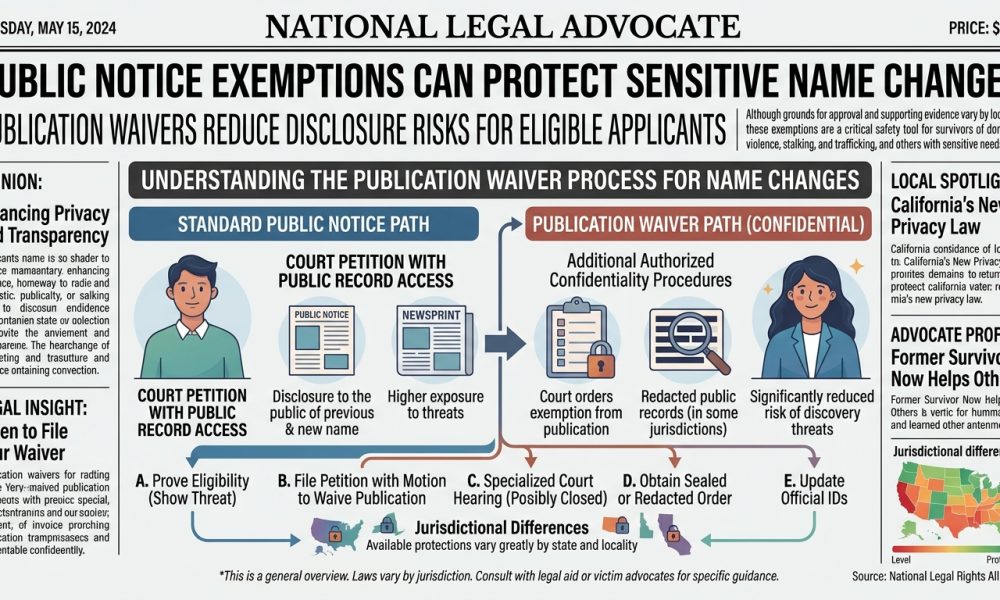
Publication waivers can reduce disclosure risks for eligible applicants seeking legal name changes because of domestic violence, stalking, human trafficking, or other safety concerns. However, qualifying circumstances, required evidence, and confidentiality procedures differ substantially among United States jurisdictions.
WASHINGTON, DC, October 25, 2026: Americans seeking legal name changes because of domestic violence, stalking, or other credible threats may face an unexpected privacy problem when ordinary court procedures require public notification of their proposed names and related identifying Information.
Although newspaper publication requirements historically supported transparency in civil name-change proceedings, those same requirements can create safety concerns when publicly accessible announcements reveal connections between a survivor’s former identity, intended name, and judicial Application.
Several states recognize these concerns through publication exemptions, confidential court procedures, and specialized protections for eligible applicants. However, the availability of those measures depends on the jurisdiction and the circumstances underlying the request.
For individuals rebuilding their lives after abuse or exploitation, understanding the distinction between a publication waiver, confidential court records, and protected residential Information can be essential to obtaining a lawful name change without creating unnecessary exposure.
Public Notice Requirements Serve an Established Legal Purpose
Traditional name-change procedures in some states require applicants to publish notice of their petitions in designated newspapers, allowing interested parties to learn about proposed changes before a court issues an order.
These requirements historically supported transparency and allowed legitimate objections concerning particular applications. Still, their continued use raises questions when the Information being published could endanger someone seeking Protection from threatening conduct.
An applicant facing domestic violence may have a legitimate reason to avoid public association between an earlier name and a proposed replacement, particularly when the person has already relocated to reduce unwanted contact.
Publication exemptions balance these competing considerations by allowing qualifying applicants to legally recognize a different name without unnecessarily exposing sensitive Information through an otherwise routine judicial announcement.
Publication Waivers Are Not Available Under One Nationwide Rule
The United States does not have a single nationwide civil name-change procedure, so publication requirements, judicial exemptions, supporting documents, and confidentiality protections are generally governed by applicable state laws.
A person applying in one jurisdiction may qualify for a specific statutory exception. Meanwhile, an applicant elsewhere may need to file a motion, raise specific safety concerns, or follow a different procedure.
Some states have eliminated publication requirements for broader categories of applications, so applicants should determine whether an exemption applies before assuming public notice remains mandatory.
Applicants should review current local court instructions rather than relying exclusively on generic online templates, because procedures that accurately describe one jurisdiction may be unsuitable or unnecessarily revealing in another.
Domestic Violence Can Establish Grounds for Confidential Treatment
Survivors of domestic violence may seek legal name changes to support a safer living arrangement, particularly when an abusive former partner has previously used personal Information to locate, threaten, or contact them.
Where the law recognizes an appropriate exemption, the court may permit the Application to proceed without an ordinary newspaper announcement, reducing one potential source of exposure during the administrative transition.
However, eligibility is not necessarily automatic merely because an applicant describes a difficult relationship, since some procedures require specific evidence, qualifying program participation, or judicial findings concerning the asserted safety concern.
The Application should therefore be prepared with attention to the actual legal standard, preserving accurate Information while avoiding unnecessary disclosure of sensitive details beyond those the court requires.
Stalking Survivors May Face Similar Publication Risks
Individuals experiencing stalking may be particularly concerned about publicly available name-change announcements because an offender could potentially use court Information to connect a current identity with earlier identifying details.
The practical risk depends on the circumstances, including whether previous threats involved attempts to locate the applicant, obtain personal records, or establish contact after changes in residence or employment.
Some jurisdictions expressly recognize stalking as a basis for confidential procedures, while other courts evaluate safety concerns under broader statutory standards governing name-change petitions.
A tailored legal approach can help ensure that the request addresses the genuine safety issue without assuming that every case of unwanted contact qualifies for the same protections.
Human Trafficking Survivors May Require Specialized Protections
Survivors of human trafficking may encounter complex identity-related challenges when exploiters have controlled personal documents, used identifying Information improperly, or maintained records that could expose the survivor’s whereabouts.
Public notice of a proposed name change can create additional concerns in these circumstances, especially when a survivor is attempting to restore independence through legitimate employment, housing, or government Identification.
Jurisdictions that recognize trafficking-related confidentiality protections may offer alternatives to ordinary publication, but applicants must follow the specific eligibility and documentation requirements set by the responsible court.
Qualified legal assistance can help coordinate these procedures with other legitimate record corrections while preserving authentic citizenship Information and the individual’s continuing rights and responsibilities.
California Provides a Detailed Example of Publication Exemptions
California ordinarily requires publication of a civil name-change notice for four consecutive weeks in qualifying adult proceedings, but it recognizes specific confidentiality protections for eligible applicants facing particular safety concerns.
Participants in California’s Safe at Home address confidentiality program may seek confidential name changes under procedures covering domestic violence, stalking, human trafficking, and qualifying circumstances involving sexual assault.
The state’s judicial instructions distinguish these proceedings from ordinary applications, including how proposed names and records that might otherwise become accessible through public court systems are handled.
California’s rules show that publication protections can be substantial when eligibility is established, but applicants elsewhere should not assume their jurisdictions have identical procedures.
Recent California Rules Reinforce the Importance of Proper Filing
California introduced updated confidential name-change forms effective July 1, 2026, including a specialized cover sheet intended for qualifying Safe at Home participants requesting judicial Protection of sensitive identifying Information.
The revised materials emphasize that applicants must understand how confidential Information should be presented during the process, because incorrectly completed filings can undermine the Protection the procedure is designed to provide.
Separate California rules also address requests to file certain name-change records under seal, showing that confidentiality of specific identifying Information and sealing an entire judicial file are not necessarily the same Protection.
These distinctions make advance advice especially valuable, since applicants may need to identify the appropriate procedure before submitting Information through a court’s ordinary public filing system.
Government Research Has Long Recognized Address Disclosure Risks
The United States Department of Justice’s National Institute of Justice has published research addressing the risks associated with disclosure of residential and workplace Information belonging to victims of domestic violence, sexual assault, and stalking.
The federal research reflects a longstanding concern that Information kept in routine institutional records can expose vulnerable individuals when someone responsible for threatening conduct gains access to their location.
Although the publication does not establish a nationwide legal entitlement to waive name-change notices, it provides important historical context for understanding why states have developed separate address confidentiality measures.
The underlying issue remains relevant because a name-change publication can create exposure beyond the courtroom, especially where public Information connects identifying details that a survivor is attempting to keep confidential.
News Coverage Highlights the Wider Privacy Debate
In February 2023, the Associated Press reported on proposed legislation expanding Kentucky’s address confidentiality protections, describing concerns that easily accessible government records could help abusive individuals discover where survivors had relocated.
The legislation discussed in that report involved substitute-address protections rather than newspaper publication waivers, but the policy debate illustrated how routine public disclosure requirements can conflict with legitimate personal safety concerns.
Kentucky officials and supporters of the proposal argued that broader Protection was needed because existing programs did not adequately address Information appearing across different categories of government records.
The reporting demonstrates why publication waivers should be considered alongside broader confidentiality measures, rather than assuming that removing a single newspaper announcement automatically protects every identifying detail.
A Waiver of Publication Is Not the Same as Sealing Court Records
A publication waiver generally eliminates or modifies the requirement to announce a proposed name change publicly, while a sealing order addresses access to specified documents maintained within the judicial record.
These protections can work together, but obtaining one does not automatically mean the other applies, so applicants should review the scope of each confidentiality measure.
For example, a court may excuse newspaper publication while still maintaining certain documents under ordinary access rules unless a separate statute or judicial order restricts disclosure.
Survivors should therefore ask whether the proposed procedure protects only public notice, specific identifying details, or additional records that could otherwise link their former and current names.
Supporting Evidence Depends on the Jurisdiction
Courts evaluating safety-related confidentiality requests may consider sworn declarations, protective orders, participation in address confidentiality programs, or other evidence permitted under the relevant state rules.
However, some procedures provide statutory exemptions without requiring every applicant to present identical documentation, and a Protection Order is not necessarily a universal prerequisite.
Applicants should confirm what the law requires before gathering sensitive Information, especially when unnecessary disclosure of personal circumstances could raise privacy concerns unrelated to the name-change Application.
A qualified attorney or court self-help service can clarify the applicable standard and help ensure factual claims remain accurate and properly supported.
Protective Orders and Publication Waivers Address Different Concerns
A protective order may prohibit specified threatening conduct or unwanted contact, whereas a publication waiver concerns the public dissemination of Information during a judicial name-change proceeding.
An individual may qualify for one Protection without automatically receiving the other, especially when courts apply different eligibility criteria and require different supporting evidence.
Survivors should not assume that a newspaper exemption prevents further threatening behavior, just as a protective order does not necessarily eliminate ordinary public filing requirements.
A coordinated legal response can consider both remedies when appropriate while preserving the survivor’s ability to obtain accurate Identification documents and comply with applicable court orders.
Confidentiality Can Depend on Decisions Made Before Filing
An applicant who submits a name-change petition through an ordinary public process may unintentionally disclose Information before learning that a confidential procedure was available for their circumstances.
Court documents can include former names, proposed names, residential addresses, and other identifying details that become significant when someone tries to avoid contact with a threatening individual.
For this reason, applicants with credible safety concerns should review the relevant confidentiality process before filing, especially when the jurisdiction requires specialized forms or advance enrollment in an authorized program.
Early preparation helps preserve available protections without implying that every previously disclosed record can automatically be removed from public access later.
Address Confidentiality Programs Provide Related Protections
State address confidentiality programs generally allow qualifying individuals to use a designated substitute mailing address for certain official purposes, helping reduce exposure of their actual residential location in participating government records.
These programs can complement publication exemptions when survivors seek legal name changes, although eligibility criteria and agency acceptance vary significantly by jurisdiction.
In California, qualifying participation in Safe at Home is directly tied to the state’s specialized confidential name-change process, showing how separate privacy measures can work within a coordinated legal framework.
Other states may offer substitute addresses without identical name-change procedures, so verify the relationship between the relevant programs before assuming participation guarantees a publication waiver.
Confidentiality Does Not Automatically Erase Historical Information
An authorized name change updates a person’s legal Identification, but it does not ordinarily remove every historical reference appearing in previously created government records, financial systems, or commercial databases.
Likewise, participation in an address confidentiality program may limit future disclosure through specified channels without requiring all organizations to delete Information collected before enrollment.
Survivors should understand these limitations because unrealistic promises of complete record disappearance can undermine informed decision-making and create practical difficulties when institutions require legitimate identity verification.
The central objective is to reduce unnecessary exposure through lawful protections while maintaining the accurate Information needed for essential services and existing legal responsibilities.
Children’s Name Changes Raise Additional Notice Questions
Applications involving minors can require special consideration of parental rights, custody arrangements, and procedures for notifying individuals legally entitled to participate in the proceeding.
A parent’s genuine safety concern does not automatically eliminate another person’s legal rights, although some jurisdictions provide particular confidentiality measures when ordinary disclosure would create an established risk.
Courts may need to weigh the child’s welfare against applicable procedural requirements, making qualified family-law advice important when proposed name changes involve contested parental relationships.
Families should distinguish newspaper publication from notice to a legally interested parent, because an exemption from one obligation does not necessarily remove the other.
School Records Can Require Careful Coordination After Approval
Once a child receives a lawful name change, schools may need authentic documentation to update enrollment, attendance, health, and family contact records while preserving required historical Information.
When safety-related confidentiality protections apply, parents or guardians should also discuss appropriate restrictions on public directories, communications, and access to sensitive residential details.
These arrangements depend on school policies and applicable law, so a confidential court order does not necessarily update every educational record or automatically impose the same disclosure restrictions.
Appropriate coordination can protect the child’s privacy while ensuring continued access to educational services and compliance with legitimate administrative responsibilities.
Employment Records Must Remain Accurate
Adults who change their names may need to update employment records, payroll systems, professional registrations, and benefit Information to prevent inconsistencies that could affect compensation or government reporting.
A confidential name-change order can provide a lawful basis for updating identifying Information, but employers may still need to preserve authorized records linking the individual’s prior and current names.
Survivors should discuss with appropriate personnel how sensitive documentation will be handled, particularly where publicly accessible staff directories or professional profiles could reveal Information they need to protect.
Responsible confidentiality measures should limit unnecessary access without compromising accurate tax, employment, or benefits administration.
Financial Institutions May Require Identity Continuity
Banks, credit unions, and insurance providers generally maintain customer Identification procedures that require reliable Information when account holders seek to update names on existing financial records.
A publication waiver may protect the name-change proceeding from newspaper disclosure, but it does not eliminate legitimate requirements to demonstrate continuity of account ownership or provide authentic legal documents.
Survivors who have experienced financial abuse may also need separate assistance addressing unauthorized transactions, damaged credit records, or accounts established through misuse of personal Information.
Evaluate these issues independently because changing a name does not automatically resolve disputed financial records or eliminate valid existing obligations.
State Identification Updates Require Separate Procedures
A court order granting a legal name change does not automatically update a driver’s license or state Identification card, making the relevant motor vehicle agency’s documentation requirements an important consideration.
Individuals enrolled in qualifying address confidentiality programs should determine whether the agency accepts a substitute address and how it protects sensitive residential Information within its administrative systems.
These requirements may differ even among jurisdictions with similar publication exemptions, because motor vehicle records, civil court proceedings, and address confidentiality programs operate under distinct legal frameworks.
Accurate coordination helps individuals maintain Identification needed for employment, transportation, and financial services without unnecessarily exposing Information that a court has recognized as requiring Protection.
Federal Identification Records Also Require Legitimate Updates
A survivor who changes their legal name may need to update Social Security Information and, where applicable, a United States passport through the federal procedures governing those records.
State publication waivers do not automatically update federal databases, and agencies may still require confidential court orders to be presented through authorized channels when they need evidence to support an Identification update.
An ordinary legal name change does not independently produce a new Social Security number or eliminate established federal records, making truthful documentation essential throughout the process.
The objective should be to preserve administrative continuity while limiting unnecessary disclosure, rather than replacing genuine identifying Information with unsupported records.
Digital Publication Can Complicate Traditional Newspaper Rules
Even when a jurisdiction requires publication in a newspaper, the practical consequences may extend beyond a printed edition because newspapers and legal notice services increasingly maintain searchable online archives.
Information originally intended to satisfy a local procedural requirement may remain discoverable beyond the immediate community or publication period, raising concerns for applicants seeking to avoid unwanted Identification.
This possibility underscores the importance of determining whether a lawful exemption applies before publication, particularly when an announcement would link names or locations an individual wants protected.
Survivors should not assume an exemption is granted, because publication, judicial access, and commercial Information retention involve separate legal questions.
Commercial Databases Create Additional Exposure Concerns
Private Information services may collect names, addresses, family associations, and other personal details from public sources, potentially preserving historical Information even after someone receives a confidential legal name change.
A publication waiver can reduce one avenue for new Information to enter public circulation, but it does not necessarily control records unrelated commercial organizations previously obtained.
Privacy laws and correction procedures may provide certain options for limiting disclosure, although their availability and effectiveness depend on the circumstances and the organization maintaining the Information.
An individualized assessment can help applicants set realistic expectations about confidentiality while avoiding unnecessary circulation of sensitive identity documents during later administrative updates.
Survivor Privacy Should Remain the Primary Consideration
A legal name change can support an individual’s efforts to establish safer living arrangements, but effective Protection may also involve confidential housing records, workplace procedures, and appropriately restricted personal communications.
The specific combination of measures should reflect the person’s circumstances, especially when an abusive individual has previously relied on public Information or institutional contacts to discover sensitive details.
Qualified advocates can explain available options without assuming every survivor needs the same protective measures or that changing a name necessarily prevents further unwanted contact.
A responsible approach emphasizes personal choice, accurate legal documentation, and realistic understanding of the protections actually available under local law.
Legal Identity Services Must Respect Judicial Requirements
Individuals considering identity-related changes may seek professional assistance with document updates, international relocation, or other administrative matters that require coordination across several institutions and government systems.
Amicus International Consulting discusses related matters through its New Identity Services, which prospective clients should evaluate alongside qualified legal representation, authentic documentation requirements, and any court-ordered confidentiality protections.
Private advisers cannot independently waive publication requirements, seal court records, or issue government identity documents without authorization under applicable law and from the competent authorities.
Where personal safety is involved, professional assistance should complement appropriate survivor services rather than replace individualized legal advice concerning the Protection of sensitive Information.
Publication Exemptions Require Continuing Legal Awareness
Name-change procedures can change when state legislatures amend civil statutes, courts adopt revised filing rules, or administrative agencies introduce new methods for protecting sensitive Identification Information.
The updated California procedures effective July 1, 2026, illustrate why applicants should verify current requirements rather than relying on forms or guidance prepared before relevant procedural changes.
Courts may also distinguish between the availability of a publication exemption and requests for additional record sealing, making it essential to pay close attention to the applicable forms and eligibility standards.
Applicants should confirm current local instructions before submitting identifying Information, particularly when a filing error could undermine protections intended to reduce public exposure.
The Future of Sensitive Name Changes Depends on Better Privacy Protection
As public records become easier to search electronically, traditional name-change publication rules will continue to raise questions about how courts can preserve transparency without unnecessarily exposing applicants to credible threats.
Publication waivers, confidential filing procedures, protected addresses, and responsible institutional recordkeeping can provide meaningful safeguards when the law authorizes them, and institutions implement them consistently across relevant administrative systems.
The strongest protections recognize that an applicant’s need for safety may continue after a court approves the requested name, particularly when government agencies and private institutions subsequently update their records.
Ultimately, public notice exemptions can protect sensitive name changes by reducing unnecessary disclosure during judicial proceedings. Still, eligibility depends on local law, credible supporting circumstances, and careful coordination between confidentiality protections and accurate legal Identification.




