
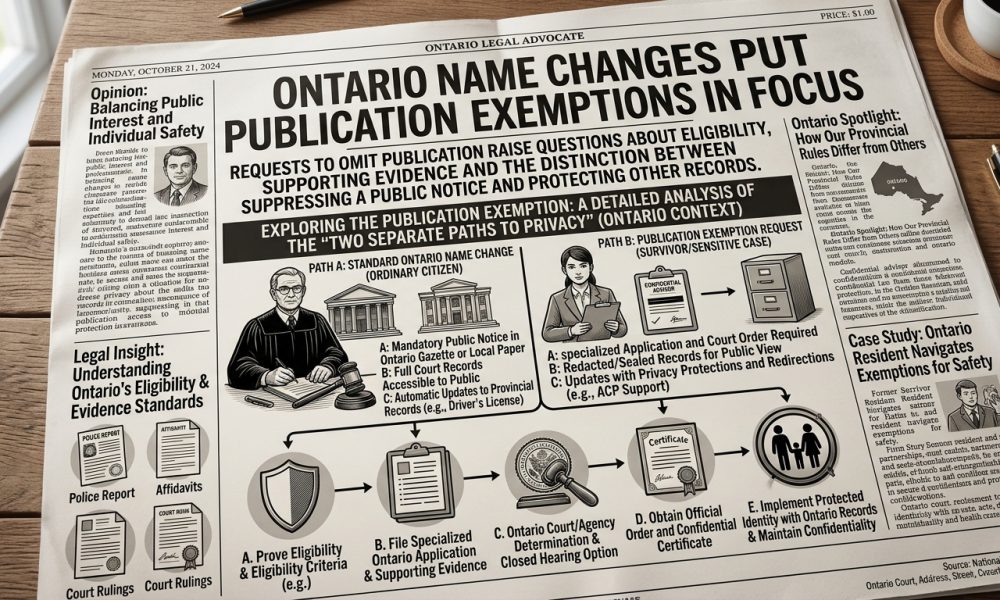
Requests to omit publication of legal name changes in Ontario raise important questions about eligibility, supporting documentation, personal safety, and the distinction between preventing an announcement in The Ontario Gazette and protecting Information maintained in other government or commercial records.
WASHINGTON, DC, October 25, 2026: Ontario residents seeking legal name changes may face significant privacy concerns because the province ordinarily publishes registered changes in The Ontario Gazette. This official online publication can reveal connections between an individual’s former and newly recognized legal names.
Although Ontario’s Change of Name Act makes publication the general rule, exemptions apply in defined circumstances, including qualifying requests involving transgender or Indigenous individuals and cases the Attorney General certifies as necessary to prevent significant harm.
These protections are particularly relevant to people facing domestic violence, stalking, threats, discrimination, or other circumstances in which public disclosure of a name change could create serious personal consequences beyond the ordinary administrative requirements of updating Identification.
For applicants considering a confidential name change, understanding the difference between an ordinary non-publication request and the broader protections of an Attorney General certification is essential to making informed decisions about privacy and documentation.
Ontario’s Name-Change System Generally Requires Publication
Ontario’s Change of Name Act establishes a formal administrative framework that allows qualifying residents to apply to change their legal names, subject to eligibility requirements, supporting documentation, and review by the Office of the Registrar General.
Under the ordinary procedure, the Office of the Registrar General publishes a registered name change in The Ontario Gazette, creating an official notice that identifies the relationship between the person’s former legal name and the newly registered name.
Because the Gazette is now published online, these notices may be accessible beyond the immediate community, so applicants should understand publication requirements before submitting an Application.
The requirement reflects longstanding administrative practices intended to maintain transparent identity records, but Ontario law also recognizes that disclosure can create legitimate safety and privacy concerns for particular applicants.
Non-Publication Is an Exception Rather Than the General Rule
Ontario provides specific exceptions to the ordinary publication requirement, but applicants should not assume that every name-change Application qualifies for confidentiality simply because the individual prefers greater personal privacy.
The current rules allow qualifying transgender individuals and First Nations, Inuit, or Métis applicants to request non-publication through the designated administrative process when submitting their applications.
A separate statutory mechanism allows the Attorney General, or an authorized representative, to certify that a change of name is intended to prevent significant harm to the person concerned.
These protections apply under different legal conditions, so identify the applicable category before preparing forms or assuming what Information will remain confidential.
Transgender Applicants Have a Recognized Non-Publication Option
Ontario regulations permit applicants to request that a registered name change not appear in The Ontario Gazette when the individual whose name is being changed is transgender at the time of Application.
The province provides a designated Request for Non-Publication form, which must accompany the legal name-change Application and identify the qualifying circumstances supporting the request under the applicable regulation.
This mechanism recognizes that public association between a person’s former and current names can disclose sensitive personal Information, even when the name change itself is entirely lawful.
However, applicants should distinguish omitting a Gazette notice from comprehensive confidentiality across government systems, because other records may remain subject to separate statutory access and disclosure rules.
First Nations, Inuit, and Métis Applicants Have Similar Publication Protections
Ontario also allows First Nations, Inuit, and Métis individuals to request that a legal name change not be published, recognizing that the circumstances surrounding names and identity can involve important cultural and personal considerations.
The same prescribed non-publication form covers this category, allowing qualifying applicants to identify their eligibility when submitting the required documents to the Office of the Registrar General.
These provisions may apply when individuals reclaim traditional Indigenous names, but the government’s separate fee-waiver arrangements and cultural naming procedures should not be confused with the publication exemption itself.
An applicant seeking several forms of administrative accommodation should examine each requirement individually and submit documentation on publication, fees, and vital records through the appropriate official process.
The Attorney General Can Certify Significant Harm
Ontario’s Change of Name Act establishes a separate confidentiality mechanism when the Attorney General, or a person authorized by the Attorney General, certifies that a proposed change is intended to prevent significant harm.
Section 8(2) also requires certification that the prescribed police records check has been reviewed, distinguishing this statutory Protection from an ordinary non-publication request based on transgender or Indigenous status.
When the statutory conditions are satisfied, the Act provides protections extending beyond omission from The Ontario Gazette, including sealing the Application and restricting specified registration and notification practices.
Applicants considering this procedure should obtain appropriate legal advice because the relevant certification depends on a defined statutory threshold, not an unrestricted right to confidential processing.
Significant Harm Requires Individual Consideration
The statutory language focuses on preventing significant harm, so the applicant’s actual circumstances matter when determining whether Ontario law may make the specialized confidentiality mechanism available.
People facing domestic violence, stalking, credible threats, or related safety concerns may have reasons to explore this process. However, a difficult personal situation alone does not guarantee certification.
The appropriate supporting Information depends on the circumstances and the guidance provided by the responsible authorities, so avoid unsupported claims or unnecessary disclosure of sensitive Information.
Ontario directs individuals seeking Information about the significant-harm certification to the Attorney General’s office, reinforcing that this specialized process should be distinguished from the ordinary non-publication form.
The Ordinary Waiver and Significant-Harm Certification Differ
A conventional non-publication request prevents the designated Gazette announcement when the applicant qualifies under the relevant regulation. Still, it should not automatically be understood as sealing every associated government record.
The significant-harm certification described in Section 8(2) establishes additional statutory measures, including particular restrictions on notification and the handling of specified records maintained by the Registrar General.
Where the applicant’s birth was registered in Ontario, the Act also addresses the original birth registration and the creation of a new registration reflecting the legally changed name.
These distinctions matter for privacy planning because preventing one public announcement and obtaining a broader statutory confidentiality arrangement involve different legal requirements and administrative consequences.
News Reporting Shows Why Publication Matters
Public disclosure of name changes has drawn attention across Canada, particularly where official gazettes have historically published identifying details that individuals wanted to keep private for safety or to avoid discrimination.
In April 2014, Global News reported on Quebec’s decision to stop publishing residential addresses of transgender people seeking name changes, illustrating broader concerns about sensitive Information appearing in government publications.
The reporting also identified Ontario’s earlier recognition of transgender status as a basis for avoiding name-change publication, demonstrating that provincial governments have developed different approaches to protecting sensitive identity Information.
Although that report describes historical developments rather than Ontario’s entire current statutory framework, it provides useful context for understanding why publication exemptions remain significant within Canadian privacy discussions.
The Ontario Gazette Is Now an Online Publication
The Ontario government confirms that The Ontario Gazette is now published online, meaning that ordinary notices can potentially be consulted without visiting a physical office or obtaining a printed government publication.
For individuals seeking to limit unnecessary public exposure, this accessibility changes the practical significance of an announcement because people outside the applicant’s immediate community can encounter digital records.
An applicant should therefore investigate the availability of lawful non-publication before completing the relevant submission, rather than assuming that a routine administrative notice will attract little public attention.
The objective is not to conceal Information from authorities lawfully entitled to it, but to understand whether the province recognizes circumstances in which public dissemination is unnecessary or potentially harmful.
Applications Require Accurate Forms and Supporting Information
Ontario allows adult name-change applications to begin through an online preparation process or paper forms, but applicants must follow the prescribed submission requirements and provide the necessary supporting documents.
The process may require Identification, statutory declarations, relevant consents, and police record checks, depending on the applicant’s circumstances and the applicable provisions of provincial law.
Individuals requesting non-publication under the regulatory exceptions must include the designated form with their name-change Application, rather than assuming that a general explanation of privacy concerns will substitute for prescribed documentation.
Careful preparation can reduce administrative delays and help applicants distinguish the evidence needed for an ordinary name change from the additional requirements for specialized confidentiality Protection.
The Non-Publication Form Covers Defined Eligibility Categories
Ontario’s prescribed Request for Non-Publication in The Ontario Gazette form asks applicants to identify the qualifying circumstances under which the person whose name is being changed is transgender or First Nations, Inuit, or Métis.
The form distinguishes adult applications from requests involving children, reflecting that someone may submit an Application lawfully on behalf of another individual.
Applicants must complete the relevant declaration accurately, because the form is an official government document and expressly warns against deliberately providing false Information.
People whose principal concern involves significant harm should investigate the separate Attorney General certification procedure rather than assume that the prescribed form includes a general safety-risk category.
Police Record Requirements Remain Relevant
Ontario’s formal name-change process can involve police record checks, and the significant-harm certification provision specifically requires reviewing the prescribed check before the Attorney General completes the certification.
These requirements demonstrate that publication confidentiality does not necessarily eliminate legitimate government verification, even when public disclosure of the resulting name change is restricted.
Applicants should review the current instructions carefully to understand when conditional verification may be requested, rather than relying on informal advice.
A legally authorized confidentiality measure protects Information under statutory conditions without exempting the applicant from every eligibility or Identification requirement imposed by the province.
Publication Exemptions Do Not Automatically Change Other Records
Preventing publication in The Ontario Gazette does not necessarily update existing records held by financial institutions, employers, schools, professional associations, or other organizations operating independently from the Registrar General.
These institutions may continue maintaining Information under the applicant’s former name until the applicant provides authentic documentation through the administrative procedure governing that relationship.
The distinction matters when an individual expects public non-publication to eliminate historical references elsewhere, even if those references were collected through entirely separate legal or commercial processes.
Effective privacy planning therefore requires understanding the legal effect of the publication exemption while separately examining the procedures for updating other records where appropriate.
Government Identity Documents Require Separate Updates
Once Ontario approves a legal name change, the individual may need to update provincial Identification, such as a driver’s license, health card, or Ontario Photo Card, using appropriate supporting documents.
Federal records, including Canadian passports and certain Identification or tax administration systems, may be governed by additional requirements independent of the province’s name-change publication rules.
Applicants should maintain accurate Information and use recognized evidence of the change, ensuring that official records identify the same individual even when an earlier name remains relevant to historical documentation.
A publication exemption does not create a new citizenship or establish an unrelated legal identity because the change concerns the lawful recognition of the person’s updated name under applicable legislation.
Survivor Safety May Require Additional Privacy Measures
Someone seeking a name change because of domestic violence or stalking may face disclosure concerns involving residential addresses, shared financial accounts, employment directories, and earlier institutional records.
A Gazette exemption can reduce one avenue of public exposure, but it does not address every source of Information a threatening individual might try to obtain.
Qualified legal professionals and survivor-support organizations can explain which protections apply under Ontario law while considering the individual’s circumstances and safety needs.
The appropriate response may involve several coordinated administrative and legal measures rather than reliance on a single non-publication decision as a comprehensive privacy solution.
Sealed Registrar Records Have a Specific Statutory Purpose
Ontario’s significant-harm provisions require special treatment of the Application and related registration Information when the Attorney General certifies that the statutory conditions are satisfied.
Those protections are more extensive than simply excluding a notice from the Gazette, showing that the legislature recognized circumstances that require stronger confidentiality within the provincial vital-statistics system.
Nevertheless, the certification’s legal effect should be interpreted according to the statute and official documentation, not expanded into assumptions about unrelated government or private databases.
Applicants should also distinguish statutory Protection of Registrar General records from the sealing of independent court proceedings, which may be governed by entirely different legislation or judicial rules.
Historical Information Can Remain Outside the Protected System
Commercial Information providers, archived websites, professional directories, and older public records may contain personal Information acquired before an individual completes a lawful name change or obtains non-publication Protection.
An exemption concerning The Ontario Gazette does not necessarily impose deletion obligations on every independent organization that previously collected the applicant’s identifying Information.
Some records may qualify for correction or other privacy remedies under applicable law, but whether those procedures are available depends on the institution, the Information involved, and the relevant legal framework.
Applicants should therefore distinguish between preventing new publication and removing historical Information, and avoid unrealistic expectations that approval of one provincial Application automatically erases earlier public or commercial records.
Children’s Name Changes Involve Additional Considerations
Ontario has separate rules for applications to change a child’s legal name, including eligibility, consent, and notice requirements that can differ from those for adults.
Parents or other authorized applicants seeking non-publication must identify the child’s qualifying circumstances under the applicable form, rather than assuming that an adult’s personal eligibility automatically extends to another family member.
When family safety concerns are involved, legal advice may also be necessary on parenting arrangements, custody-related obligations, and how to handle Information affecting the child’s welfare.
A publication exemption should not be confused with permission to disregard another person’s lawful parental rights or existing court orders governing decisions about a child.
Traditional Indigenous Name Reclamation Has Additional Significance
Ontario recognizes the importance of traditional Indigenous names and provides specific procedures to help eligible individuals and families reclaim names connected to cultural identity and historical experiences.
The province also maintains fee-waiver provisions for eligible residential school survivors and their families, though applicants should confirm how these arrangements apply to the specific records being amended.
Non-publication is one part of this framework, allowing qualifying First Nations, Inuit, and Métis applicants to request that the Gazette not announce a registered name change.
These measures should be understood in light of their legal purposes, including recognizing cultural identity, ensuring accurate civil registration, and respecting personal Information.
Gender Identity Privacy Remains a Distinct Concern
Ontario’s non-publication rules recognize that publicly linking former and current names may disclose sensitive personal Information about transgender individuals seeking Identification consistent with their gender identity.
The prescribed exemption allows qualifying applicants to request non-publication during the name-change process without having to meet the separate significant-harm certification standard.
This distinction matters because gender identity privacy and Protection from serious threats can involve different statutory pathways, even though some individuals may experience overlapping concerns.
Applicants should use the procedure that matches their circumstances and seek qualified assistance when multiple forms of administrative Protection may apply.
Canadian and American Name-Change Rules Should Not Be Confused
Ontario’s administrative procedures differ substantially from name-change practices in many American states, where courts may handle petitions under separate rules on publication, sealing, and judicial findings.
The Oregon Department of Justice’s guidance on confidential legal name changes illustrates this difference by describing a specific pathway for eligible participants in Oregon’s Address Confidentiality Program.
Oregon’s guidance also explains the limitations of confidential name changes as a personal safety measure, reinforcing that lawful administrative protections do not necessarily prevent disclosure through unrelated Information sources.
The comparison helps international readers understand that a procedure available in one jurisdiction does not automatically create rights or exemptions under Ontario law.
Cross-Border Relocation Introduces Additional Documentation Questions
An Ontario resident considering relocation within Canada or internationally may need to establish that institutions operating under different provincial or national Identification requirements recognize a legal name change.
A properly issued name-change certificate may support updates to passports, banking records, immigration documentation, and professional registrations, although each institution can require its own authorized evidence.
Failing to publish an Ontario Gazette notice does not, by itself, authorize residence in another country or eliminate restrictions imposed by immigration authorities, courts, or other competent institutions.
Cross-border planning should therefore distinguish the lawful change of a name from nationality, residence status, passport eligibility, and the separate privacy protections available in the intended destination.
Private Identity Services Must Respect Government Authority
Some individuals seeking confidential identity changes also consider professional assistance with document coordination, lawful international relocation, and the administrative consequences of adopting a legally recognized name.
Amicus International Consulting discusses related matters through its New Identity Services, which prospective clients should evaluate alongside independent legal advice, genuine government procedures, and their individual confidentiality requirements.
Private advisers cannot independently grant an Ontario publication exemption, certify significant harm under the Change of Name Act, or create authentic government records without the authorization required by law.
Any professional arrangement should prioritize accurate documentation and lawful privacy protections over promises that a different name automatically eliminates historical records or ongoing legal responsibilities.
A Publication Waiver Is Not a Guarantee of Complete Anonymity
Ontario’s publication exemptions can provide meaningful Protection by preventing disclosure of a registered name change through a specific official publication. Still, their effectiveness must be understood within the limits of applicable law.
The ordinary regulatory exemption and the significant-harm certification procedure offer different levels of confidentiality, so applicants must understand exactly which protections apply.
Neither process should be represented as guaranteeing that all historical records, financial obligations, institutional files, or Information collected by unrelated organizations will disappear.
A realistic approach focuses on protecting sensitive Information where legally authorized while maintaining accurate records necessary for essential services and legitimate government administration.
Current Processing Requirements Can Affect Planning
Ontario’s public guidance identifies a standard Application fee of $137 for an adult name change, subject to applicable exceptions and separate provisions for qualifying name-reclamation applications.
The province also warns that change-of-name applications may take up to twenty-four weeks to process, so individuals coordinating ID updates or other time-sensitive administrative requirements should plan accordingly.
Applicants should confirm current processing Information before making commitments that depend on approval, because government processing periods can change and a request for non-publication does not independently guarantee expedited handling.
Careful preparation should include obtaining current forms, identifying the appropriate confidentiality procedure, and arranging any necessary supporting documents before the Application enters the provincial administrative system.
The Future of Ontario Privacy Protection Depends on Clear Distinctions
Ontario’s publication framework shows the ongoing challenge of balancing accurate public administration with legitimate personal safety and privacy interests when individuals seek legally recognized name changes.
The regulatory exceptions for transgender and Indigenous applicants, along with the separate significant-harm certification procedure, show how the province has established different protections for different circumstances.
For applicants, the central task is understanding eligibility, the scope of non-publication, the availability of stronger statutory confidentiality, and the continuing existence of Information maintained outside the protected process.
Ultimately, Ontario name changes put publication exemptions in focus because omitting a notice from The Ontario Gazette can reduce unnecessary disclosure. At the same time, broader privacy Protection depends on the precise legal procedure, supporting circumstances, and records involved.




