
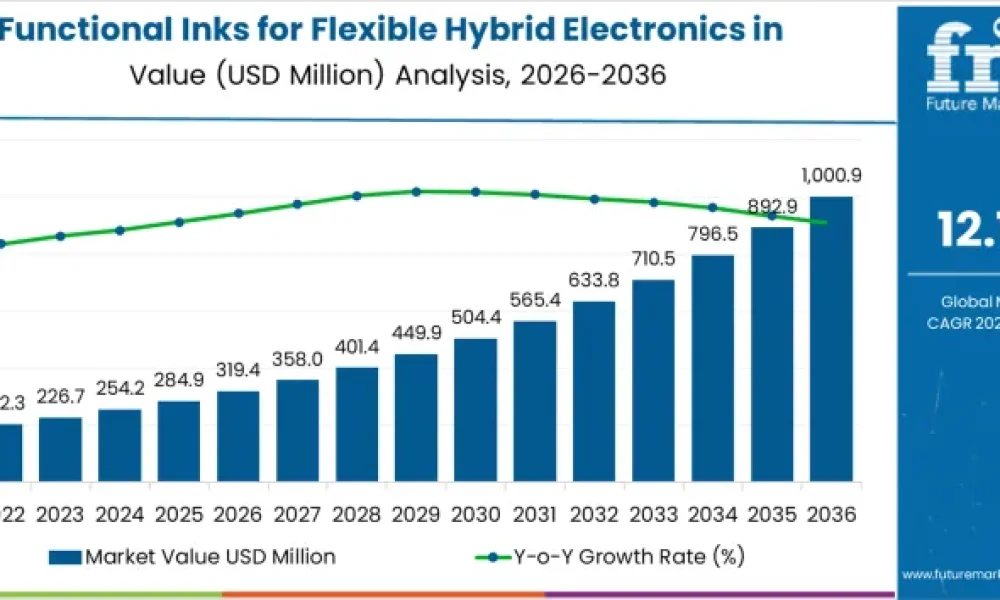
The global functional inks for flexible hybrid electronics (FHE) in automotive interiors market is set to expand from USD 319.4 million in 2026 to USD 1,002.1 million by 2036, achieving a strong compound annual growth rate (CAGR) of 12.10%. This surge reflects the automotive sector’s pivot toward lightweight, interactive interiors powered by printed electronics. Functional inks enable seamless integration of touch sensors, flexible displays, heating elements, and ambient lighting, transforming cabins into smart, user-centric environments that prioritize connectivity, comfort, and efficiency.
As vehicles evolve into mobile tech hubs, these inks—printed onto flexible substrates like films and fabrics—deliver durable conductive traces, dielectric layers, and sensing capabilities. The shift to electric vehicles (EVs) and connected mobility amplifies demand, with OEMs embedding FHE to cut weight, enhance aesthetics, and support multifunctional surfaces. Conductive silver inks lead at 38% share, prized for superior conductivity, adhesion, and reliability in high-stress automotive conditions.
Segmentation Underscores Application and Material Leadership
By ink type, conductive silver inks command 38% dominance, outpacing copper, carbon-based, and dielectric variants. Their high electrical performance suits circuits in dashboards, seats, and controls, enduring flex cycles and thermal shifts. Applications tilt toward touch sensors and controls at 42% share, fueling interactive HMIs in infotainment and steering interfaces. Flexible displays, ambient lighting, and heating elements follow, enabling energy-efficient, customizable designs that blend form and function.
This segmentation highlights FHE’s versatility: printed electronics merge with conventional components for scalable production via inkjet, screen, and aerosol jet processes. As cabins demand haptic feedback and embedded intelligence, functional inks bridge innovation with manufacturability.
Get access to comprehensive data tables and detailed market insights — request your sample report today!
Regional Growth Spotlights Asia-Pacific Momentum
Asia-Pacific and North America spearhead expansion, with China at 13% CAGR driven by EV dominance, smart manufacturing, and policies backing green tech. Its OEMs pioneer FHE for digital cockpits, leveraging cost-effective scaling. The USA grows at 11.7% CAGR, propelled by EV incentives, connected vehicle mandates, and advanced material R&D for premium interiors.
South Korea (11.9% CAGR) excels via Hyundai and Kia’s smart mobility push, integrating inks for touch displays and sensors. Germany (11.2% CAGR) harnesses Volkswagen, BMW, and Mercedes-Benz innovation for sustainable electrification. Japan (10.8% CAGR) advances through precision electronics heritage, focusing on durable, high-res FHE for autonomous-ready cabins. Brazil trails at 9.4% but gains from EV infrastructure upgrades.
These patterns reveal strategic hotspots: regions with robust automotive clusters and EV adoption outpace others, where infrastructure lags constrain rollout.
Drivers, Trends, and Dynamics Fuel Acceleration
Core drivers include lightweighting for range extension, cockpit digitalization, and consumer demands for intuitive interfaces. Functional inks enable direct printing on curved surfaces, slashing assembly costs and enabling customization. EV proliferation demands efficient, flexible components for battery-adjacent electronics, while regulatory pushes for safety and sustainability elevate printed solutions.
Emerging trends redefine the landscape. Eco-friendly, silver-free formulations cut costs and environmental footprints, blending conductivity with sensing or storage. Multifunctional inks support haptic surfaces and energy-harvesting layers. Digital printing hybrids boost precision and throughput, accelerating prototypes to production. Supplier-OEM collaborations fast-track commercialization, aligning inks with automotive lifecycles.
Market dynamics center on FHE’s role in seamless integration: from dashboard sliders to seat-embedded controls, inks deliver robustness under vibration, humidity, and UV exposure. Rising smart surface adoption—think illuminated trims and adaptive lighting—positions functional inks as enablers of premiumization.
Competitive Strategies Emphasize Performance and Compatibility
Key players vie on material durability, print compatibility, and customization. DuPont deploys advanced conductive and dielectric inks for roll-to-roll processes, optimizing adhesion for HMI and sensors. Henkel AG & Co. KGaA offers versatile silver, carbon, and dielectric portfolios, stressing thermal stability and automotive-grade reliability.
Heraeus Holding GmbH specializes in high-resolution systems for miniaturized touch and capacitive apps, ensuring consistent performance. Sun Chemical Corporation tailors pigments for aesthetic-functional duality in lighting and displays. NovaCentrix innovates low-temperature sintering inks, enabling energy-efficient, high-speed production.
Competition sharpens around process versatility, lifecycle endurance, and EV alignment, with vendors showcasing data on conductivity retention, flex fatigue, and integration with existing toolchains.
This market’s 12.10% trajectory signals transformative potential: functional inks unlock next-gen interiors, from immersive displays to intuitive controls, amid EV and autonomy waves. Navigating high-growth regions, material shifts, and supply chain dynamics demands precise intelligence.
Why Choose FMI: Empowering Decisions that Drive Real-World Outcomes: https://www.futuremarketinsights.com/why-fmi
About Future Market Insights (FMI)
Future Market Insights, Inc. (FMI) is an ESOMAR-certified, ISO 9001:2015 market research and consulting organization, trusted by Fortune 500 clients and global enterprises. With operations in the U.S., UK, India, and Dubai, FMI provides data-backed insights and strategic intelligence across 30+ industries and 1200 markets worldwide.



