
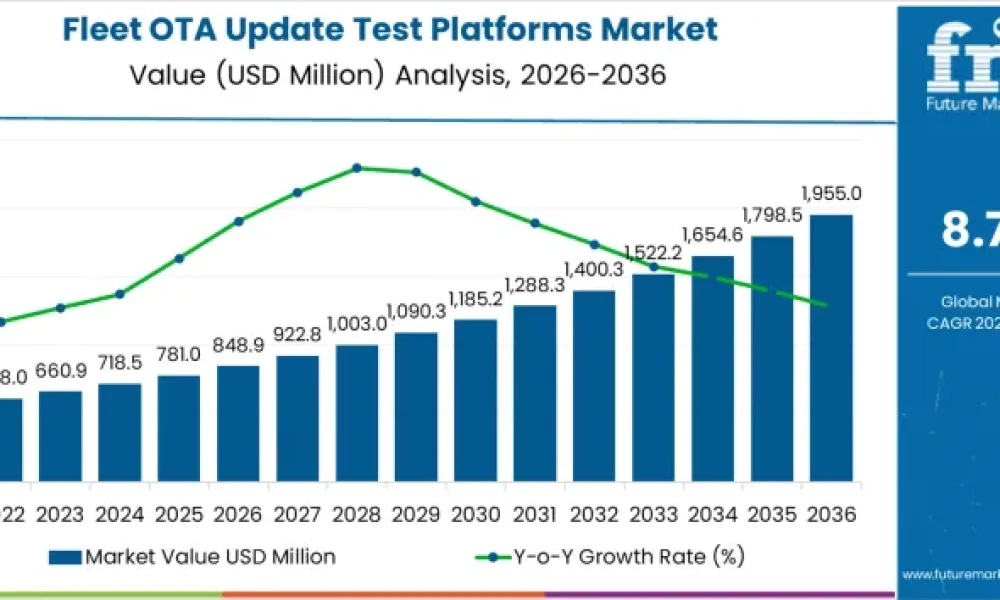
The global fleet OTA update test platforms market, valued at USD 848.9 million in 2026, is forecasted to reach USD 1,956.6 million by 2036, expanding at a compound annual growth rate (CAGR) of 8.70%. This growth reflects the automotive sector’s accelerating pivot to software-defined vehicles, where over-the-air (OTA) updates are indispensable for enhancing safety, performance, and compliance across passenger, commercial, and specialty fleets. As vehicle architectures grow increasingly complex with ADAS, infotainment, telematics, and electrification, robust test platforms emerge as critical enablers, validating update integrity, security, and seamless ECU integration prior to deployment.
These platforms simulate real-world conditions via hardware-in-the-loop (HIL), cloud-based environments, and AI-driven analytics, mitigating risks of errors, cybersecurity breaches, and downtime. OEMs and fleet operators leverage them to deploy updates at scale—fixing bugs, introducing features, and ensuring regulatory adherence—without physical interventions, yielding substantial cost efficiencies and operational uptime.
Passenger Vehicles Command 52% Share, OEMs Drive 44% of Demand
Passenger vehicles dominate with 52% market share, propelled by pervasive connected technologies and consumer expectations for continuous enhancements in infotainment, autonomous capabilities, and powertrain optimization. Frequent OTA cycles address evolving regulations and user demands, positioning this segment as the primary growth engine. Light commercial vehicles trail, followed by heavy trucks/buses and off-highway/specialty vehicles, where adoption lags due to less frequent updates and simpler software stacks.
OEMs lead customer demand at 44%, investing heavily in platforms that manage diverse models, versions, and compliance needs. Their focus on scalable, secure testing supports long-term vehicle lifecycle management, creating high entry barriers for newcomers while fostering stable revenue through extended contracts. Fleet operators complement this, prioritizing solutions that minimize maintenance costs and maximize fleet productivity.
Get access to comprehensive data tables and detailed market insights — request your sample report today!
Key Dynamics: Connectivity Boom Meets Security Imperatives
Market expansion hinges on the proliferation of connected, software-reliant vehicles requiring periodic OTA interventions for ADAS refinements, telematics upgrades, and electrification support. Test platforms address core challenges: validating updates across heterogeneous ECUs, protocols, and scenarios while upholding cybersecurity standards. Innovations like AI, machine learning, digital twins, and cloud integration accelerate testing cycles, enabling predictive error detection and virtual rollouts.
Yet, restraints persist—high infrastructure costs for HIL setups, testing complexities across configurations, talent shortages in software validation/cybersecurity, and regional regulatory variances. Overcoming these demands platforms with CI/CD pipelines, threat modeling, and standards compliance, positioning early adopters for competitive advantage in software-defined mobility.
Regional Growth Leaders: China Tops at 10.1% CAGR
China spearheads expansion at 10.1% CAGR, fueled by EV proliferation, autonomous tech acceleration, and smart city initiatives. Automotive giants scale OTA testing for massive fleets, aligning with national innovation mandates. Brazil follows at 9.4%, driven by connected vehicle modernization, telematics growth, and urban mobility investments amid EV/autonomous shifts.
The USA achieves 8.2% growth via EV/autonomous adoption, telematics advancements, and innovation ecosystems emphasizing real-time validation. South Korea records 8.1%, propelled by Hyundai/Kia-led EV/connectivity pushes and smart city integrations. Germany sustains 7.8% through premium OEMs like Volkswagen, BMW, and Mercedes-Benz advancing electrification, sustainability, and connected architectures.
These trajectories highlight a global transition: fleets demanding resilient OTA ecosystems to support uptime, security, and feature evolution amid regulatory pressures and cost imperatives.
Competitive Arena: Integration, Security, and Scalability Define Leadership
Leading players differentiate via deep automotive integration, cybersecurity focus, and end-to-end validation. Vector Informatik excels with protocol-native suites for update delivery, rollback, and diagnostics. dSPACE offers HIL-OTA hybrids, streamlining simulation-to-deployment workflows.
ETAS (Bosch) leverages OEM heritage for ECU-centric secure updates, ensuring network reliability. Elektrobit and Wind River emphasize cybersecurity resilience with analytics-driven impact assessment. Siemens Digital Industries Software pioneers model-based digital twins for pre-physical testing.
KPIT and Luxoft target software-defined vehicles with cloud CI/CD pipelines. HARMAN integrates telematics testing, while Argus Cyber Security prioritizes threat modeling and secure delivery. Competition centers on flexibility, compliance (e.g., automotive OTA standards), and scalability for diverse fleets—key to capturing OEM/fleet contracts.
As automotive paradigms shift toward perpetual connectivity and software dominance, fleet OTA update test platforms stand as foundational infrastructure. Stakeholders must prioritize solutions balancing innovation, security, and efficiency to navigate this high-stakes evolution.
Why Choose FMI: Empowering Decisions that Drive Real-World Outcomes: https://www.futuremarketinsights.com/why-fmi
About Future Market Insights (FMI)
Future Market Insights, Inc. (FMI) is an ESOMAR-certified, ISO 9001:2015 market research and consulting organization, trusted by Fortune 500 clients and global enterprises. With operations in the U.S., UK, India, and Dubai, FMI provides data-backed insights and strategic intelligence across 30+ industries and 1200 markets worldwide.



