
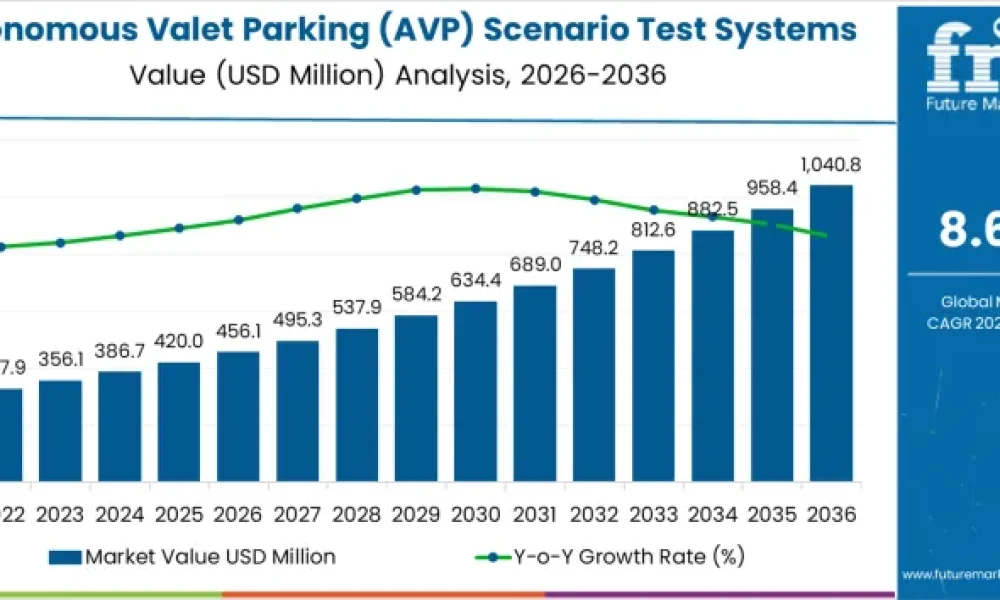
The global autonomous valet parking (AVP) scenario test systems market stands at USD 456.1 million in 2026, forecasted to expand to USD 1,040.8 million by 2036, achieving a compound annual growth rate (CAGR) of 8.60%. This sustained expansion reflects intensifying requirements for high-fidelity simulation platforms validating self-parking technologies across complex urban environments, sensor fusion challenges, and regulatory safety benchmarks.
AVP systems enable vehicles to navigate, position, and secure themselves without human input, relying on LiDAR, radar, cameras, and AI-driven perception stacks. Automakers and mobility providers deploy scenario test systems to replicate tight multi-level garages, dynamic pedestrian flows, occluded sensors, and adverse weather, ensuring compliance with emerging standards from bodies like Euro NCAP and NHTSA. Capital-intensive development—encompassing AI scenario generation, hardware-in-the-loop (HIL) integration, and digital twins—demands selective investment strategies focused on scalability and rapid validation cycles.
Dominant Market Segments
Closed-track proving grounds command 34% market share, offering controlled replication of real-world parking dynamics for repeatable safety assessments and edge-case exploration. These facilities simulate crowded lots, valet handoffs, and emergency maneuvers, enabling precise quantification of system latency and decision reliability. Structured parking facilities, virtual simulation-in-the-loop (SIL), and hybrid environments follow, prioritizing cost-efficient scalability from virtual permutations to physical proofs.
Original equipment manufacturers (OEMs) drive 46% of demand, mandating comprehensive test suites to certify AVP integration within production vehicles. Passenger vehicles lead vehicle-type demand, reflecting consumer-oriented Level 4 autonomy priorities in urban fleets. These segments underscore a shift toward hybrid workflows blending millions of simulated miles with targeted real-world trials, reducing physical test costs by up to 70% while accelerating time-to-market.
Asia Pacific emerges as the premier growth region, propelled by dense urbanization and smart infrastructure rollouts. Test systems here emphasize high-volume scenario libraries tailored to regional parking norms, from narrow Asian alleys to expansive airport forecourts.
Get access to comprehensive data tables and detailed market insights — request your sample report today!
Regional Growth Trajectories
China spearheads expansion at 10% CAGR, fueled by state-led smart city mandates, electric vehicle dominance, and vast testbeds validating AVP in megacity congestion. Government initiatives integrate AVP with high-speed rail hubs and residential complexes, demanding platforms that handle pedestrian density, e-scooter interference, and multilingual signage perception. Brazil follows at 9.2%, leveraging EV adoption and urban renewal projects to test AVP resilience in informal lots and flood-prone terrains.
The USA advances at 8.3%, anchored by Silicon Valley innovation and airport trials, where systems verify FAA-aligned detect-and-avoid protocols amid baggage tugs and ground crew. The UK records 8.1% growth through smart motorway extensions and London garage pilots, focusing on wet-road traction and cyclist prioritization. Germany sustains 8% CAGR via precision engineering at Wolfsburg and Stuttgart, integrating AVP with Industry 4.0 factories for just-in-time parking simulations.
These markets highlight capital intensity: upfront investments in GPU clusters and sensor rigs yield extended ROI through standardized compliance artifacts. Urban density amplifies demand for occlusion-handling algorithms and multi-agent coordination.
Strategic Growth Drivers
Rising OEM investments in Level 4 autonomy propel demand, as AVP serves as a gateway feature for consumer trust and fleet monetization. Urbanization strains traditional parking—global shortages exceed 20% in major cities—prompting AVP to reclaim 30% more space via perpendicular stacking and valet-to-spot transitions. Regulatory pressures enforce 99.999% safety margins, mandating verifiable test coverage across 10^9 scenario variants.
Simulation advancements dominate: digital twins now generate adaptive obstacles via generative AI, slashing physical miles by 90%. Cloud-orchestrated HIL/SIL pipelines enable global teams to stress-test localization in geofenced garages. Trends include scenario databases (e.g., Foretellix-style coverage metrics), cybersecurity injection for hacked sensor feeds, and V2X interoperability for choreographed bay assignments. Smart city tie-ins extend AVP to airport shuttles and hospital drop-offs, amplifying secondary demand from Tier-1s and regulators.
Challenges persist in return timelines—ROI materializes post-certification amid 3-5 year ramps—but modular platforms mitigate risks, allowing upgrades from SAE L2+ to full autonomy.
Competitive Landscape Analysis
dSPACE leads with scalable HIL platforms modeling sensor fusion and edge-case swerves, evidenced by deployments at BMW and Daimler proving grounds. IPG Automotive excels in CarMaker simulations replicating traffic micro-dynamics, linking seamlessly to radar/LiDAR truth data for AVP fidelity.
ANSYS integrates multiphysics twins capturing tire-road slip and thermal sensor drift, while Siemens Digital Industries Software unifies NX CAD with Simcenter for end-to-end workflows. Vector Informatik streamlines CAN/Ethernet validation for AVP stacks, emphasizing AUTOSAR compliance. AVL blends dynamometer bays with virtual traffic for propulsion-parking maneuvers.
Foretellix differentiates via measurable scenario databases, automating safety case generation for ISO 26262 ASIL-D. MathWorks accelerates via Simulink code-gen, automating controller handoff from desktop to deployment. TTTech Auto fortifies deterministic motion planning against latency spikes, and Hexagon (MSC Software) refines Adams physics for multi-body parking stresses.
Vendors compete on coverage depth—e.g., pedestrian jaywalking variants—and ecosystem lock-in, with partnerships like dSPACE-MathWorks bundling tools. Differentiation pivots to cloud scalability and regulatory reporting APIs.
Investment Imperatives and Future Outlook
AVP test systems bridge prototype risks to commercial fleets, quantifying mean-time-to-failure in occluded bays or vandal-prone zones. As 5G slices enable low-latency V2I for bay reservations, test platforms must evolve to federated learning, ingesting fleet data for over-the-air refinements. Capital selectivity favors vendors offering open APIs and retrofit kits, navigating interoperability mandates.
Standardization efforts—via ASAM OpenSCENARIO and C-V2X pilots—streamline procurement, while consortia like AVNU accelerate Time-Sensitive Networking for jitter-free commands. By 2036, AVP maturity will underpin robotaxi depots, reclaiming downtown footprints for green space.
The authoritative Autonomous Valet Parking Scenario Test Systems Market Report – 2026-2036, updated December 24, 2025, furnishes granular forecasts by test environment, customer type, vehicle segment, and 40+ countries across Asia Pacific, Europe, North America, Latin America, and Middle East & Africa. Profiling dSPACE, IPG Automotive, ANSYS, Siemens, Vector, AVL, Foretellix, MathWorks, TTTech Auto, and Hexagon, it dissects capital dynamics, trend trajectories, and competitive benchmarks to calibrate investments amid AVP’s commercial inflection.
Why Choose FMI: Empowering Decisions that Drive Real-World Outcomes: https://www.futuremarketinsights.com/why-fmi
About Future Market Insights (FMI)
Future Market Insights, Inc. (FMI) is an ESOMAR-certified, ISO 9001:2015 market research and consulting organization, trusted by Fortune 500 clients and global enterprises. With operations in the U.S., UK, India, and Dubai, FMI provides data-backed insights and strategic intelligence across 30+ industries and 1200 markets worldwide.



