
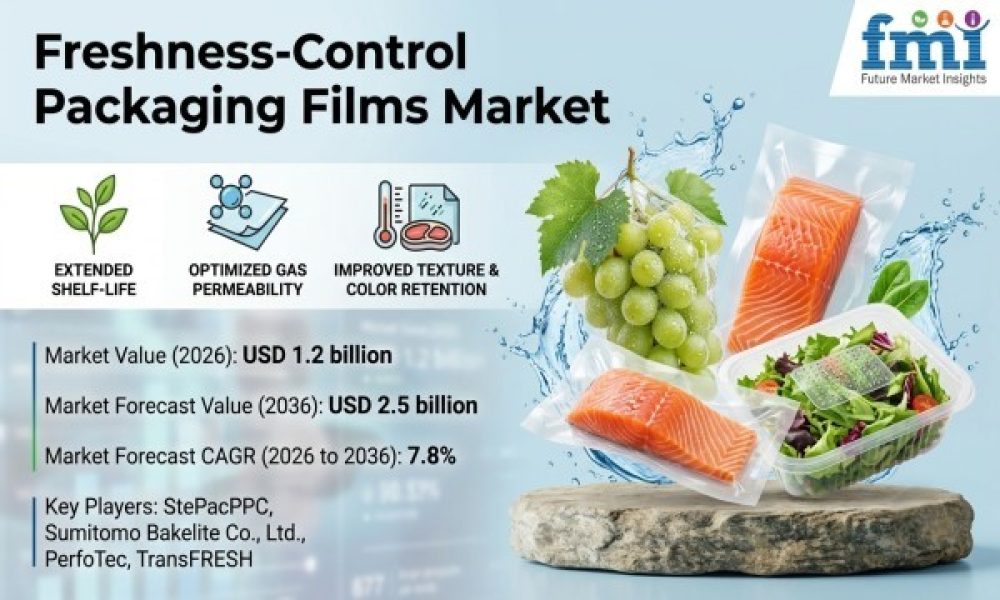
The global Freshness-Control Packaging Films Market is projected to grow from USD 1.2 billion in 2026 to USD 2.5 billion by 2036, registering a 7.8% CAGR during the forecast period, according to Future Market Insights. The market is being shaped by food-loss reduction, longer distribution routes and the need for packaging films that provide measurable control over gas exchange, humidity, ethylene, microorganisms or condensation.
Food-loss economics is giving processors a clearer reason to evaluate freshness-preservation technologies. The Food and Agriculture Organization reported in September 2025 that fruit and vegetables recorded a 25.4% food loss rate among major commodity groups. For food companies, the commercial question is increasingly whether additional packaging performance can reduce rejected cases, retail shrink and downgraded product enough to recover the film premium.
Get detailed market forecasts, competitive benchmarking, and pricing trends:
https://www.futuremarketinsights.com/reports/sample/rep-gb-34607
Distribution conditions also affect purchasing requirements. US processors emphasize avoided shrink across long distribution routes, while European retailers place greater weight on recycling evidence during package trials. Japan favors stable film specifications and detailed technical documentation, while Brazilian exporters require humidity and respiration control that can withstand extended ocean transport.
The commercial case is reinforced by the scale of unsold food. The USA Food Waste Pact reported 3.98 million tons of unsold retail food and USD 26.9 billion in lost sales during 2024. These conditions create opportunities for active and modified atmosphere packaging systems when shelf-life performance can be demonstrated under commercial operating conditions.
Modified Atmosphere Films Lead Technology Demand
Modified Atmosphere (MAP) Films are projected to account for 32.0% of technology demand in 2026. Their position reflects the need to control oxygen and carbon dioxide exchange around respiring foods.
MAP film qualification requires more than laboratory permeability data. Crop respiration, product weight, film area and route temperature exposure all affect the required gas balance. Commercial trials must also preserve antifog performance and seal strength on existing filling equipment.
StePacPPC reported in January 2026 that its Xtend MA/MH packaging protected dragon fruit during shipment to distant markets, highlighting the role of crop-specific permeability in long-distance produce distribution.
Polyolefin Structures Hold the Leading Material Share
Polyolefin (PE – PP) is estimated to account for 40.0% of the material category in 2026. Sealability, toughness and established converting capacity support its use across high-volume food-packaging operations.
Packaging producers can perforate or coextrude PE and PP structures to adjust gas and moisture transfer without requiring processors to replace familiar filling equipment. However, material simplification still needs to preserve antifog performance and seal strength.
Bags and Pouches Support Broad Format Adoption
Bags and Pouches are forecast to represent 36.0% of the format category in 2026. Their broad functional film area supports gas and moisture exchange while allowing packers to work with scalable product loads on established filling lines.
Export programs require additional evidence when temperatures and storage periods vary. TransFRESH (Hazel Technologies) reported in February 2025 that its BreatheWay solution protected melons during a 46-day Central America-to-Japan shipment and reduced defects compared with existing MAP bags.
Fresh Produce is expected to lead the application category with a 38.0% share in 2026, reflecting the continuing respiration of packed crops and the need to manage gas levels and condensation during distribution.
Qualification Remains a Key Conversion Barrier
Freshness-control film adoption depends on product-specific gas transfer, food-contact documentation and commercial line trials. Respiration changes with crop condition and temperature, making commercial validation essential before a new film specification can replace an established material.
Recyclability requirements add another consideration. Recycle-ready structures can create new revenue opportunities when they maintain gas balance, antifog behavior and sealing performance on existing equipment. In February 2025, Klöckner Pentaplast paired FlexiLid containing 30% post-consumer recycled content with a fully recycled PET tray during a Tesco and Hilton Foods pilot.
Analyst Perspective
“Package trials earn repeat orders by reproducing the product’s real respiration rate and temperature profile under commercial conditions. Suppliers that combine measurable shelf-life gains with stable seals and recyclable structures can defend a premium without forcing disruptive line changes.”
Nandini Roy Choudhury, Principal Consultant, Future Market Insights
Regional Growth Outlook
Country forecasts show different commercial conditions across major markets. Brazil is projected to record the highest CAGR among the profiled countries at 8.2%, followed by the United Kingdom at 7.7%, Germany at 7.6%, the United States at 7.2%, and Japan at 6.4%.
Brazil’s outlook reflects fruit-export requirements for humidity and respiration control. UK and German markets increasingly connect shelf-life performance with recyclability and migration requirements. US processors focus on avoided shrink and line performance, while Japanese buyers emphasize stable specifications and detailed technical files.
Competitive Landscape
The market includes crop-specific atmosphere specialists, global fresh-food film suppliers and recyclable barrier platforms. Notable companies profiled in the report include StePacPPC, Amcor, Sealed Air, Coveris, Sumitomo Bakelite Co., Ltd., PerfoTec, TransFRESH (Hazel Technologies) and Klöckner Pentaplast.
Recent developments include StePacPPC’s transition to FSSC 22000 Version 6 in May 2026, Amcor’s March 2026 production-line expansion in Italy for high-barrier recycle-ready films, and Sumitomo Bakelite’s P-Plus top seal entering commercial use for Seven Premium fresh pineapple packs in Japan.
Report Scope
The FMI study covers the Freshness-Control Packaging Films Market by technology, material, format, application, end use, sales channel and region. Technology segments include MAP, micro-perforated breathable, ethylene-scavenging, antimicrobial-active and humidity-control films. Material segments include polyolefin, PLA bio-films, cellulose, PET and others.
The report covers North America, Latin America, Western Europe, Eastern Europe, East Asia, South Asia and Pacific, and the Middle East and Africa. The forecast period is 2026 to 2036.
Dive Deeper into the Data—View the Full Report Here!
https://www.futuremarketinsights.com/reports/freshness-control-packaging-films-market
FMI Custom Research: Strategic Intelligence for Confident Decision-Making
In today’s rapidly evolving business environment, leadership teams need more than market data—they need clear, actionable intelligence tailored to their strategic objectives. FMI’s Custom Research solutions are designed around the specific business questions organizations need answered, enabling executives to evaluate growth opportunities, validate investments, assess competitive dynamics, and reduce uncertainty before making critical decisions. By combining deep industry expertise, primary research, and proprietary market intelligence, FMI delivers insights that help organizations move from assumptions to evidence-based strategies with greater speed and confidence.
Business Impact
FMI helps organizations transform market complexity into strategic clarity, enabling leadership teams to identify growth opportunities faster, optimize resource allocation, strengthen competitive positioning, and make high-stakes business decisions with confidence.
To explore how FMI Custom Research can support your strategic priorities, please connect with our team at – [email protected]
About Future Market Insights (FMI)
Future Market Insights, Inc. (FMI) is an ESOMAR-certified, ISO 9001:2015 market research and consulting organization, trusted by Fortune 500 clients and global enterprises. With operations in the U.S., UK, India, and Dubai, FMI provides data-backed insights and strategic intelligence across 30+ industries and 1200 markets worldwide.



