
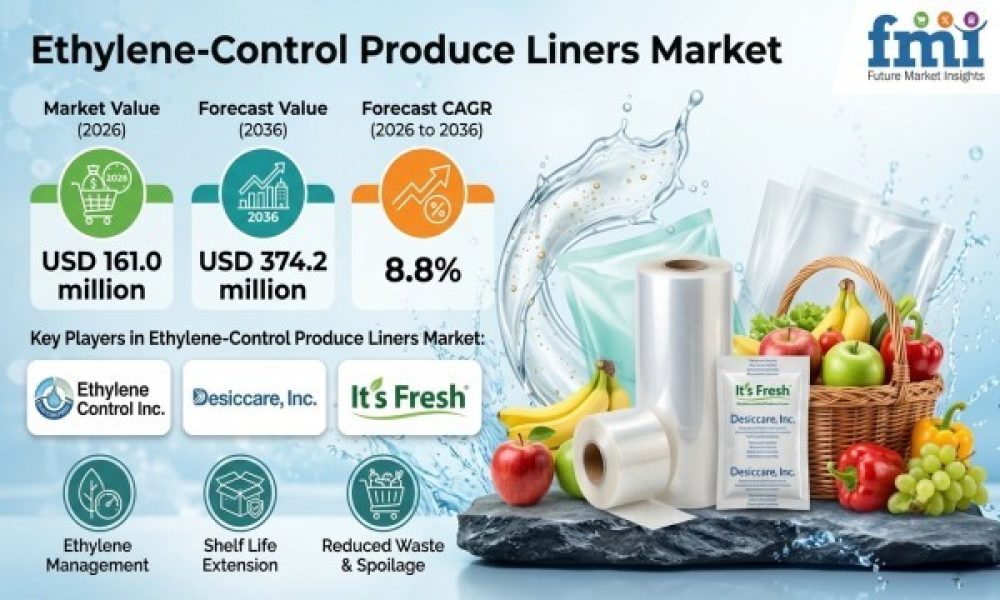
The global Ethylene-Control Produce Liners Market is projected to grow from USD 161.0 million in 2026 to USD 374.2 million by 2036, advancing at an 8.8% CAGR. Demand is being shaped by produce exporters seeking passive ripening control that can help preserve saleable quality during storage, ocean freight, and extended distribution.
Ethylene-control liners are increasingly being evaluated as part of broader produce packaging strategies. Their role is particularly relevant where uncontrolled ethylene can shorten destination selling windows and increase quality deductions.
The commercial case is also linked to food waste. WRAP reported in March 2025 that United Kingdom households discard more than 2.5 million tonnes of fresh fruit and vegetables annually. For produce suppliers, reducing avoidable deterioration can therefore become part of the wider discussion around packaging performance, material use, and product loss.
Get detailed market forecasts, competitive benchmarking, and pricing trends:
https://www.futuremarketinsights.com/reports/sample/rep-gb-34605
Longer Produce Routes Support Demand
The market is segmented across product type, substrate, function, produce type, end use, sales channel, and region.
KMnO4-Based Absorber Liners are projected to account for 30.0% of the market in 2026. Potassium permanganate oxidizes ethylene as porous carriers bring the gas into contact with the active medium. The established chemistry allows manufacturers to adjust media loading for cartons and transport units without requiring powered equipment.
Paper-Fiber is expected to lead the substrate category with a 36.0% share in 2026. The substrate works with established converting processes, including printing and die cutting, while providing structures that can hold absorbent layers and maintain airflow around the active medium.
Ethylene Adsorption is forecast to represent 44.0% of the function category in 2026. Its appeal lies in providing a defined control objective that can be evaluated through container readings and arrival-condition checks during commercial route trials.
Exporters and Sea Freight Form a Key End-Use Segment
Exporters-Sea Freight is expected to account for 34.0% of end-use demand in 2026. Ocean shipments can expose produce to long transit windows and port delays, increasing contact with accumulated ethylene.
Commercial qualification, however, remains crop-specific. Ethylene load can change with crop maturity, enclosed air volume, temperature, and airflow. Media that performs effectively under laboratory conditions may saturate earlier under warmer handling or restricted ventilation.
As a result, manufacturers need commercial route trials that reflect intended temperature, ventilation, shipment duration, firmness targets, weight loss, and visible defects.
Nandini Roy Choudhury, Principal Consultant at Future Market Insights, highlights the importance of connecting technical performance with commercial outcomes:
“Commercial trials earn repeat orders by connecting preserved arrival quality with fewer deductions per shipped unit. Manufacturers that define crop loading limits and disposal requirements reduce qualification risk for seasonal export programs.”
Brazil Records the Highest Profiled Country CAGR
The five profiled country markets show CAGRs ranging from 7.4% to 9.2% between 2026 and 2036.
Brazil is forecast to record the highest CAGR at 9.2%, followed by the United Kingdom at 8.7%, Germany at 8.6%, the USA at 8.1%, and Japan at 7.4%.
Brazil’s growth outlook reflects the importance of export-oriented fruit supply chains, where long ocean routes and variable port dwell times can increase the value of passive ethylene management.
The United Kingdom presents another important market context. WRAP reported in December 2025 that 81% of UK fresh produce was sold in plastic packaging compared with about 50% across the European Union. Suppliers therefore face a combined requirement to demonstrate product-loss reduction while addressing material reduction and disposal considerations.
In Japan, established cold-chain practices mean packaging changes require precise commercial evidence. The market is projected to expand at a 7.4% CAGR through 2036.
Multifunction Liners Create an Expansion Opportunity
The report identifies multifunction formats as a key opportunity. Combining ethylene control with moisture management or antimicrobial functions could allow one qualified liner to address several produce-pack requirements.
The opportunity is closely connected to converter capability. A multifunction liner must preserve gas contact with the active layer while managing liquid without slowing existing packing operations.
The competitive landscape includes Ethylene Control Inc., Desiccare, Inc., TransFRESH Corporation, It’s Fresh, AgroFresh, StePac, Sirane, and McAirlaid’s.
The market remains fragmented across direct ethylene-control specialists, integrated postharvest platforms, and absorbent or converted-liner manufacturers. Commercial route evidence, active-media containment, and crop-specific application knowledge remain central to supplier qualification.
Report Scope
The Ethylene-Control Produce Liners Market report covers North America, Latin America, Western Europe, Eastern Europe, East Asia, South Asia and Pacific, and the Middle East and Africa. More than 30 countries are included in the full assessment.
The market is evaluated by product type, substrate, function, produce type, end use, sales channel, and region. The forecast period covers 2026 to 2036, with revenue measured in USD million and CAGR in percent.
The research methodology combines primary and secondary research, market triangulation, market sizing and forecasting, and data validation. Primary research includes manufacturers, service providers, technology developers, distributors, end users, procurement teams, and subject-matter experts.
Dive Deeper into the Data—View the Full Report Here!
https://www.futuremarketinsights.com/reports/ethylene-control-produce-liners-market
FMI Custom Research: Strategic Intelligence for Confident Decision-Making
In today’s rapidly evolving business environment, leadership teams need more than market data—they need clear, actionable intelligence tailored to their strategic objectives. FMI’s Custom Research solutions are designed around the specific business questions organizations need answered, enabling executives to evaluate growth opportunities, validate investments, assess competitive dynamics, and reduce uncertainty before making critical decisions. By combining deep industry expertise, primary research, and proprietary market intelligence, FMI delivers insights that help organizations move from assumptions to evidence-based strategies with greater speed and confidence.
Business Impact
FMI helps organizations transform market complexity into strategic clarity, enabling leadership teams to identify growth opportunities faster, optimize resource allocation, strengthen competitive positioning, and make high-stakes business decisions with confidence.
To explore how FMI Custom Research can support your strategic priorities, please connect with our team at – [email protected]
About Future Market Insights (FMI)
Future Market Insights, Inc. (FMI) is an ESOMAR-certified, ISO 9001:2015 market research and consulting organization, trusted by Fortune 500 clients and global enterprises. With operations in the U.S., UK, India, and Dubai, FMI provides data-backed insights and strategic intelligence across 30+ industries and 1200 markets worldwide.



