
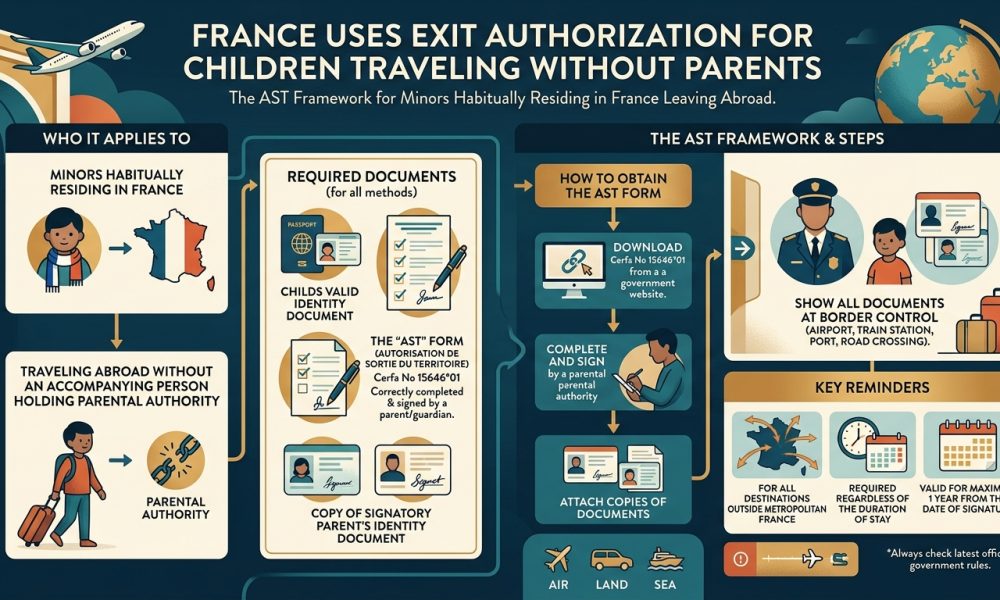
The AST framework covers minors who habitually reside in France and travel abroad without an accompanying person with parental authority.
WASHINGTON, DC, October 15, 2026 — France requires certain children traveling internationally without a parent or another person exercising parental authority to carry an official exit authorization, a child-protection procedure based on habitual residence and accompanying adults rather than French nationality alone.
The Authorization, known as the Autorisation de sortie du territoire (AST), is particularly important for families whose children live in France but travel internationally with grandparents, relatives, teachers, sporting organizations, or other adults who do not possess legal parental authority.
French government guidance confirms that the requirement also applies to foreign minors habitually residing in France, including qualifying American children, while exempting children who are accompanied by either parent or another person legally exercising parental authority.
The distinction matters because a child with a valid passport may still need additional documentation before leaving France, even when the destination allows entry without a traditional visa or other advance immigration authorization.
For American families living in France, internationally mobile households, and parents arranging travel for children, understanding the AST framework can help prevent departure complications and clarify how French rules differ from parental consent procedures in other countries.
France’s AST Framework Protects Children Traveling Internationally
France’s AST framework establishes a formal procedure for documenting Authorization when a child who habitually resides in the country leaves internationally without being accompanied by an individual legally entitled to exercise parental authority.
The requirement has applied under its modern framework since January 15, 2017, reflecting government efforts to strengthen safeguards against unauthorized international movement while preserving practical arrangements for legitimate family and educational travel.
According to France’s official Service Public guidance on the AST requirement, a minor living in France must carry the Authorization when traveling abroad without a parent or another person holding parental authority.
The requirement therefore depends on both residence and accompaniment, meaning neither nationality nor an otherwise valid travel document alone determines whether the Authorization must be presented.
This distinction helps explain why an American child residing in France can face a departure requirement that ordinarily would not apply to another American child visiting France temporarily.
Habitual Residence Is Central to Eligibility
France distinguishes children who habitually reside within its territory from minors who normally live elsewhere and are present in the country for a temporary visit or international transit.
A French child habitually residing in France generally falls within the AST framework when departing without an accompanying person exercising parental authority, even if the destination is another European country.
The same principle applies to an American or other foreign minor habitually residing in France, showing that the child’s immigration residence circumstances may matter more than the nationality printed in the passport.
Conversely, a French child ordinarily living abroad who visits France generally does not require an AST merely to leave the country after that temporary visit.
French authorities also exempt foreign children habitually residing abroad who visit or transit through France, so the measure does not automatically apply to every foreign minor passing through French territory.
Children Traveling With Either Parent Are Exempt
France’s official guidance expressly confirms that children accompanied by their father or mother do not require an AST solely because the other parent is absent from the journey.
The exemption applies even if the parents are separated or divorced, provided the accompanying parent has the relevant parental authority and no separate legal restriction prevents the proposed departure.
This is particularly important for American families living in France, because a mother traveling with her child to the United States does not ordinarily need an AST simply because the father remains in France.
The same principle applies to a father accompanying the child without the mother, subject to the individual’s legal parental authority and any restrictions established by a competent court.
However, the French AST exemption does not automatically remove consent requirements imposed by another country or invalidate existing custody orders governing international travel.
Legal Guardians Can Also Qualify for the Exemption
French law recognizes that individuals other than biological parents can exercise parental authority under legally established circumstances, including certain guardianship arrangements or decisions issued by competent judicial authorities.
A minor traveling with someone who legally exercises the relevant parental authority does not ordinarily require an AST merely because the accompanying individual is not the child’s mother or father.
However, the distinction between legal guardianship and informal caregiving is essential because a grandparent, family friend, or other relative does not automatically acquire parental authority by accompanying a child.
Families should therefore confirm whether the accompanying adult has the legal status required for the exemption, rather than assuming a close family relationship is sufficient.
If an adult’s legal authority arises from a court decision, supporting documentation may clarify the circumstances if questions arise during travel examinations.
Grandparents and Other Relatives May Trigger the Requirement
A child who habitually resides in France and travels internationally with grandparents, aunts, uncles, adult siblings, or other relatives generally needs an AST when those adults do not have parental authority.
The Authorization lets the person legally responsible for the child document permission for international departure, even when the accompanying adult is a trusted family member with an established relationship.
For example, an American child living in Paris who travels to the United States with grandparents may need an AST before leaving France, even if the child has a valid United States passport.
The requirement arises from the child’s habitual residence and lack of an accompanying holder of parental authority, not from any general restriction on American nationality.
Families should therefore distinguish legitimate family relationships from the specific legal authority recognized under the French departure procedure.
Unaccompanied Children Require Particular Preparation
Children who habitually reside in France and travel internationally without an adult exercising parental authority must carry the required Authorization, including in cases of independent travel and commercial airline unaccompanied-minor services.
The Authorization operates separately from airline supervision procedures, which may set age restrictions, Identification requirements, additional fees, and arrangements to transfer responsibility to adults at the destination.
A child may therefore meet an airline’s unaccompanied-travel rules while still needing French AST documentation to comply with the country’s departure requirements.
Similarly, a properly completed AST does not automatically establish that the child meets every commercial airline requirement or possesses the immigration documentation necessary to enter the destination.
Parents should coordinate the legal Authorization with transportation arrangements rather than treating either procedure as a substitute for the other.
The AST Uses a Standard Government Form
France administers the AST through an established government form, Cerfa No. 15646*01, which records Information identifying the child and the individual granting permission for international departure.
Families can complete the form electronically and print it, or obtain a blank copy for handwritten completion, allowing them to prepare the necessary Authorization without attending a routine government appointment.
An individual with the appropriate parental authority must complete and sign the declaration, and the accompanying documentation must be available when the child departs France.
The process usually does not require families to visit a town hall, prefecture, or police station to obtain official validation of the standard form.
This streamlined administrative approach distinguishes France’s framework from countries that require notarization, consular certification, or government-issued departure authorization for comparable journeys.
Only One Parent’s Signature Is Generally Necessary
French official guidance confirms that an AST normally requires the signature of one parent exercising parental authority, rather than automatically requiring signatures from both parents whenever they share responsibility.
This distinction applies to married parents and generally remains relevant following separation or divorce, where parental authority continues to be exercised jointly under the applicable legal arrangements.
When one parent alone has parental authority by court order, that parent must sign the Authorization because the other parent lacks the corresponding legal power.
French guidance recommends obtaining the other parent’s agreement where appropriate to reduce family disputes, but that recommendation should not be confused with a universal requirement for two signatures.
The rules remain subject to binding judicial restrictions and other protective measures that can prevent departure even if an AST is otherwise complete.
The Authorization Cannot Exceed One Year.
Parents and guardians preparing an AST can specify a period for a single journey or a longer period when repeated international travel is anticipated.
However, French government guidance limits the Authorization’s validity to a maximum of one year, preventing families from using a single declaration as indefinite permission for every future international journey.
A child who regularly travels with relatives or participates in organized activities may therefore benefit from an appropriately dated authorization covering several qualifying trips within the permitted period.
Families should nevertheless ensure that the stated validity corresponds with the actual travel arrangements and does not conflict with any change in parental authority or court-imposed restrictions.
An expired authorization cannot be treated as continuing indefinitely merely because the original parent or guardian remains willing to permit travel.
The Signatory’s Identity Document Must Accompany the Form
France requires the AST to include a readable photocopy of a valid identity document belonging to the parent or other individual who signed the Authorization.
Acceptable Identification documents vary by the signatory’s nationality, so American parents residing in France should review the applicable requirements before preparing the document.
The child’s passport or national identity card must also meet the standard travel requirements for the destination and the journey.
An AST does not independently establish nationality, substitute for a passport, or provide immigration permission for a foreign country requiring a visa or electronic Authorization.
Parents should therefore prepare the Authorization, supporting Identification copy, and the child’s individual travel documents as separate but complementary elements of the international departure process.
The AST Is Presented During Departure Examination
France requires the child to present the AST and accompanying documents during the relevant border departure examination, allowing authorities to assess whether the legal conditions governing the minor’s international movement are satisfied.
The child’s valid passport does not eliminate the requirement where the AST framework applies, because identity verification and Authorization to depart address different questions.
Airline personnel may also examine documents to determine whether passengers meet the legal conditions for international travel, although French border authorities administer the actual departure requirements.
Parents should ensure the child carries the original signed Authorization and any necessary supporting documents, rather than leaving them exclusively with an absent parent.
If the journey involves several countries, later destinations may require additional documentation under their immigration or child Protection rules.
French Rules Can Apply to Travel Within Europe
Families should not assume that traveling to another European country automatically removes the AST requirement, because French guidance addresses international departure rather than limiting the procedure exclusively to long-distance journeys.
A child who habitually resides in France and travels abroad without a holder of parental authority may therefore require an AST, even when the destination is another European Union member state.
However, the administrative procedures used to examine documents can differ between journeys crossing external Schengen borders and travel occurring within areas where routine internal border controls are generally absent.
The underlying legal obligation remains distinct from whether a particular journey involves an ordinary passport inspection at every point of departure.
Parents should therefore prepare the Authorization when required rather than interpreting the absence of routine internal border checks as a general legal exemption.
Overseas French Territories Introduce a Special Consideration
France’s official guidance identifies a particular circumstance involving travel between metropolitan France and French overseas departments or regions when the itinerary includes a stop in another country.
When a minor habitually residing in France undertakes such travel without an accompanying holder of parental authority, an international stopover can trigger the AST requirement even if the ultimate destination is French territory.
This distinction matters for families arranging flights with international connections rather than direct travel between metropolitan France and an overseas French destination.
The actual itinerary therefore matters because travel between two French locations can involve an international departure during a connection.
Parents should examine the full route rather than rely solely on the fact that the first and final destinations are both administratively part of France.
Court Restrictions Can Override an AST
An AST does not automatically permit departure when a child is subject to an opposition to leaving the territory or a judicial prohibition against international departure.
France distinguishes between an opposition à la sortie du territoire and an interdiction de sortie du territoire, both of which can restrict movement under the applicable legal procedures.
Where such a restriction applies, a standard authorization signed by one parent does not independently remove the prohibition or establish that the child’s international departure is lawful.
Depending on the nature of the restriction and the legal authority responsible for lifting it, additional judicial or formally recognized administrative steps may be necessary.
Families involved in custody disputes or other proceedings affecting travel should obtain appropriate legal advice rather than assuming that completing the AST form resolves every restriction.
Foreign Resident Children May Need Separate Return Documents
American and other foreign minors who habitually reside in France may face documentation questions about their ability to return after traveling abroad, particularly when an ordinary adult residence permit does not establish their residence status.
France maintains a separate document, the Document de circulation pour étranger mineur (DCEM), which can help qualifying foreign children demonstrate their right to return under the relevant immigration procedures.
This document performs a different function from an AST, because the AST addresses permission to leave France without parental accompaniment while the DCEM concerns aspects of returning to French territory.
A child may therefore need an AST to leave and separate documentation to re-enter, depending on nationality, residence status, and the applicable immigration arrangements.
Parents should distinguish departure consent from immigration permission to return, particularly where a child holds a non-European passport and resides in France.
Passport Information and Parental Consent Remain Separate
Modern passport systems increasingly incorporate enhanced Identification features to support examination of children’s identities and family relationships, but these technologies do not automatically establish consent for every international journey.
Amicus International Consulting explored a related distinction in Mexico’s Children’s Passports Include Parents’ Photos to Strengthen Travel Security, examining how parental Identification Information can supplement official travel documents issued to minors.
France’s AST system serves a different administrative purpose: it records permission from an individual exercising parental authority when a child habitually residing in France travels without that person accompanying the journey.
Even when a passport reliably establishes the child’s identity or identifies the parents, additional Authorization may still be required under the applicable departure legislation.
The distinction reinforces the importance of separating document Authenticity, evidence of parental relationship, legal guardianship, and permission for a particular international journey.
American Families Should Distinguish Residence From Tourism
An American child temporarily visiting France with relatives generally falls outside the AST requirement when the child’s habitual residence remains in the United States or another foreign country.
By contrast, an American child living and attending school in France can fall within the framework when departing with an adult who lacks legally recognized parental authority.
These circumstances demonstrate why two children holding identical American passports can face different departure documentation requirements depending on where they ordinarily live.
Families should therefore assess genuine habitual residence rather than rely solely on citizenship, the passport-issuing country, or the location from which an airline reservation was purchased.
Where residence circumstances are unusual or recently changed, official guidance or appropriate legal advice may help determine whether the AST requirement applies to the intended departure.
Conclusion: France’s Exit Authorization Depends on Residence and Accompaniment
France’s AST framework sets a specific international departure requirement for children who habitually reside in the country when they travel without a parent or another individual legally exercising parental authority.
The Authorization applies to qualifying French and foreign minors, including American children resident in France, while generally exempting children accompanied by either parent or another recognized holder of parental authority.
French procedures provide a standardized form, allow an authorization lasting up to one year, and ordinarily require only one legally authorized parent’s signature, along with a copy of the signatory’s acceptable Identification document.
However, the Authorization does not override judicial departure restrictions, replace the child’s passport, establish permission to enter foreign destinations, or resolve separate immigration requirements governing return to France.
For internationally mobile families, understanding these distinctions can prevent unnecessary paperwork and missed documentation requirements while supporting the child Protection purposes underlying France’s international departure authorization system.




