
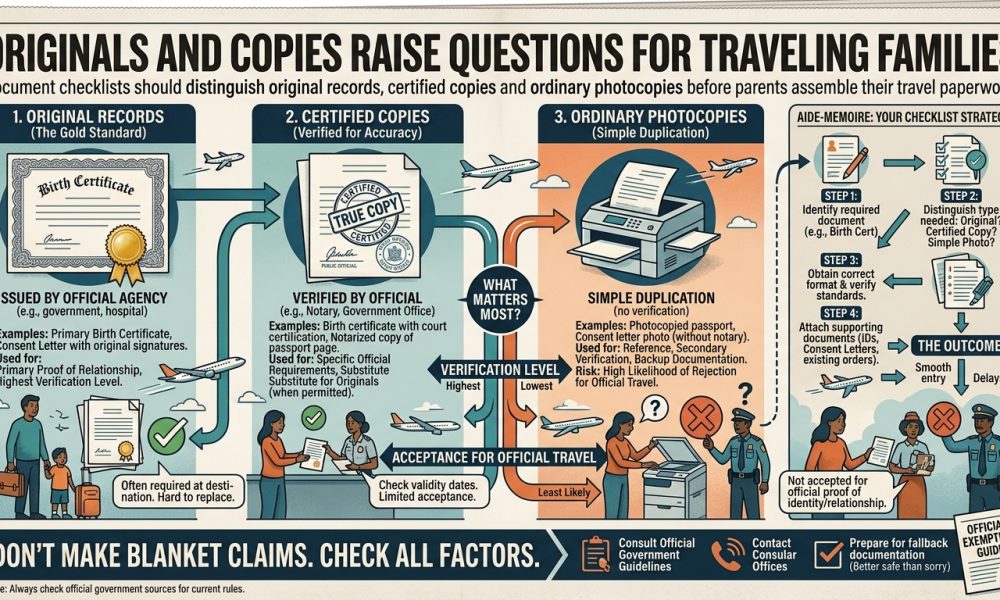
Document checklists should distinguish original records, certified copies, and ordinary photocopies before parents assemble their travel paperwork.
WASHINGTON, DC, October 15, 2026 — Parents preparing international travel documents for children may face different requirements for original records, certified copies, ordinary photocopies, and electronic documents, so they should determine which version authorities will accept.
Although passports generally must be presented as valid official travel documents, supporting records such as birth certificates, parental consent letters, custody judgments, adoption decrees, and guardianship documents can be subject to different documentary standards.
Official guidance from Canada, the United States, and France shows that governments distinguish between documents that establish identity, records that prove family relationships, and declarations that authorize a child to travel internationally without every legally responsible adult.
These distinctions matter most for families traveling with one parent, grandparents, school groups, or unrelated adults, especially when an international itinerary involves several countries with different child Protection and immigration procedures.
For American and Canadian families, understanding the differences between originals, certified copies, and ordinary photocopies can prevent unnecessary document-preparation expenses and reduce the risk that essential evidence will be deemed insufficient during departure or arrival examinations.
Original Documents and Copies Perform Different Functions
An original document is generally the record issued or executed through the procedure established by the responsible authority. A certified copy, by contrast, is a reproduction whose Authenticity has been formally attested through a recognized process.
An ordinary photocopy reproduces Information from another document without necessarily confirming that the reproduction is complete, accurate, or derived from an authentic original.
These distinctions matter because a government may expressly accept a photocopy for one administrative purpose while requiring a certified record or original signed declaration for another.
A child’s birth certificate, for example, may be acceptable as an ordinary supporting copy during some travel examinations but require an officially certified version when submitted for passport issuance or a formal immigration Application.
Families should therefore avoid assuming that every document must be presented in its original form or that a photocopy will satisfy all international authorities.
Passports Require Special Treatment
A passport is an official travel document that establishes identity and nationality, so presenting it is fundamentally different from submitting a photocopied birth certificate or other supporting family record.
Ordinary photocopies of passport Identification pages can help with reference, emergency replacement procedures, or certain administrative applications. Still, they generally cannot substitute for a valid passport during international air travel.
Electronic passports also contain physical and digital security features that an ordinary photocopy cannot fully authenticate, including elements designed to help officials detect alterations and verify the document’s legitimacy.
If a child has multiple citizenships, the family may need to determine which original passports to carry or present under the laws of the countries involved.
Parents should consequently distinguish supplementary Identification copies from the actual travel documents legally required for boarding and admission.
Canada Recommends Original Signed Consent Letters
Canada’s updated parental consent guidance provides a useful example of how governments distinguish original signed declarations from photocopied or electronically reproduced documents.
According to the Government of Canada’s official guidance on consent letters for children traveling abroad, an original signed letter is recommended because border officials may question the Authenticity of photocopies or digital versions.
The government emphasizes that Canadian law does not universally require consent letters. However, immigration officials, transportation personnel, and foreign border authorities may require consent letters and request evidence of permission for a child’s journey.
Canada also recognizes that digital signatures may be accepted in some circumstances, so a preference for an original signed letter should not automatically be treated as an absolute prohibition on electronic documentation.
The appropriate approach is to carry the most reliable form of the declaration while checking whether the destination imposes its own legal requirements.
A Signed Original Can Help Demonstrate Genuine Consent
An original signed consent letter provides a physical record of the declaration executed by the parent, guardian, or other individual possessing the relevant authority to approve the child’s journey.
Where the signature was witnessed or notarized, the original document may also contain additional Information identifying the witness and recording the circumstances in which the declaration was executed.
However, possession of an original signed letter does not, by itself, establish that the person signing has unrestricted parental authority or that every travel arrangement complies with applicable custody restrictions.
Similarly, a photocopy is not automatically fraudulent or legally useless merely because it reproduces a signed original, since acceptance depends on the relevant government’s procedures.
Families should distinguish the evidentiary advantages of an original signature from the separate legal question of whether the document establishes valid permission for the intended journey.
Birth Certificates May Be Accepted as Supporting Copies
Families often carry birth certificates during international family travel because they can help establish the legal relationship between a child and an accompanying parent whose surname differs from the child’s.
The United States Department of State recommends bringing a copy of each child’s birth certificate or other evidence of the relevant legal relationship during international travel.
This recommendation does not mean every American child must carry an original birth certificate when crossing an international border, especially when the destination does not require it.
However, formal applications for citizenship, passports, immigration benefits, or recognition of parentage may require an officially certified birth record rather than an ordinary photocopy.
Parents should therefore identify whether the birth certificate is being carried as optional relationship evidence or submitted to satisfy a mandatory government documentary requirement.
Certified Birth Certificates Are Not Simply Photocopies
An officially certified birth certificate is generally issued or authenticated by the responsible civil registration authority and provides recognized evidence of the record maintained in the government’s official register.
In the United States, families commonly obtain certified birth records from state or local vital records offices, depending on which jurisdiction registered the child’s birth.
These records may include official seals, signatures, security paper, or other prescribed certification features that distinguish them from ordinary photocopies made with household or office equipment.
A certified copy can therefore function as an official record even though it reproduces Information held in the civil registry rather than representing the first document created at birth.
Families should not confuse such certified records with photocopies independently stamped by an unrelated commercial provider, since the issuing authority’s certification is what gives the document its official character.
France Expressly Accepts a Photocopy of the Signatory’s Identification
France provides an example of a government expressly requiring a photocopy rather than the original Identification document belonging to the parent who signs a child’s international departure authorization.
Under France’s official guidance on the Autorisation de sortie du territoire, qualifying minors habitually residing in France must carry the signed AST form and a readable photocopy of an accepted identity document belonging to the person granting authorization.
The photocopy must include identifying Information such as the signatory’s name, photograph, signature, birth details, and relevant document issuance Information, allowing officials to link the signed authorization to the responsible individual.
This procedure shows why requiring the absent parent to surrender an original passport or national identity card is unnecessary under ordinary French AST rules.
However, the child must still possess the appropriate original travel document, and the photocopy of parental Identification does not replace the signed authorization.
Custody Orders May Require Certified Court Records
Families involved in separation, divorce, guardianship, or adoption proceedings may need to present court documents establishing who possesses the legal authority to approve international travel.
An ordinary photocopy of a custody Judgment can provide useful Background Information, but a government or court conducting a formal legal assessment may require an officially certified copy.
Certification ordinarily comes from the court or other competent authority that maintains the record, not from a parent independently confirming the photocopy appears accurate.
A judicial document may also contain amendments, conditions, or restrictions that are not apparent when only selected pages are reproduced.
Parents should therefore determine whether the receiving authority requires a complete certified Judgment, an ordinary copy for reference, or another legally recognized record.
Death Certificates and Adoption Records Have Separate Uses
A death certificate may help explain why one parent’s consent cannot be obtained, while an adoption decree can establish a child’s legal relationship with adoptive parents.
Canada recommends carrying a copy of a deceased parent’s death certificate in relevant international travel circumstances, illustrating how supporting family evidence may be useful without requiring families to carry every original civil registration record.
However, documents submitted to complete an adoption, obtain citizenship, or establish legal guardianship may require stricter certification than those used for ordinary travel.
The correct version depends on the document’s purpose and whether the receiving authority must formally recognize its legal effect.
Families should therefore preserve valuable originals while obtaining appropriate official copies whenever a foreign procedure expressly requires certified records.
Notarized Copies Are Not Always Certified Government Records
Notarization can establish that a notary performed a recognized act, but it does not necessarily transform an ordinary photocopy into an officially certified birth certificate or court Judgment.
Some jurisdictions permit notaries to certify particular copies, while others restrict that function or prohibit notarial certification of certain official vital records.
An overseas authority requesting a certified birth certificate may therefore reject a photocopy accompanied only by an unrelated notarial declaration.
Families should distinguish certification by the original issuing authority from notary verification, since these procedures may have different legal effects.
The safest approach is to obtain the exact document the receiving government requires rather than assuming additional stamps automatically increase its acceptability.
Electronic Copies Are Not Universally Accepted
Families increasingly store passports, consent letters, birth certificates, and court orders electronically, allowing important Information to remain accessible when physical documents are lost or unavailable.
Digital copies can be valuable in emergencies, but official acceptance depends on whether the relevant authority recognizes electronic documents or requires a physical original.
Some governments use electronic authorization systems that allow digital verification, while others require printed declarations with handwritten signatures or specifically certified records.
A photograph of a document displayed on a mobile telephone should therefore not automatically be treated as legally equivalent to the original.
Parents should also recognize that electronic access may become unavailable because of device problems, limited connectivity, or other practical disruptions during international travel.
International Authentication Adds Another Layer
Families presenting birth certificates, court records, or other public documents overseas may encounter additional requirements concerning apostilles or diplomatic legalization.
An apostille authenticates specified official signatures or seals under the applicable international Convention, but it does not independently certify that every statement in the underlying document is legally sufficient.
Similarly, a certified translation addresses language accuracy rather than the Authenticity of the original public record.
Some foreign procedures may therefore require a certified document, an apostille, and a translation, while others accept an ordinary copy without any of those additional formalities.
Families should confirm the destination’s requirements before purchasing multiple Authentication services that may not be necessary.
Children With Different Surnames May Need Relationship Evidence
A child whose surname differs from that of an accompanying parent may benefit from carrying a birth certificate, adoption record, or other document explaining the legally recognized relationship.
These differences commonly arise following marriage, divorce, adoption, or changes in family naming arrangements and should not automatically be interpreted as evidence of unauthorized international travel.
However, proof of relationship does not necessarily establish permission from another individual possessing parental authority, particularly where a court order governs international departure.
The appropriate documentation may therefore include a relationship record and a separate consent letter, depending on the destination and family circumstances.
Parents should distinguish the purpose of each document before determining whether an ordinary copy or certified version is necessary.
Passport Security Features Cannot Be Reproduced in Photocopies.
Electronic passports incorporate specialized security technologies intended to authenticate government-issued identity documents and support reliable Identification during international border examinations.
Ordinary photocopies cannot reproduce all of these protections, making them useful as supporting references but unsuitable as substitutes for the actual passport when formal document examination is required.
Some countries also incorporate additional family Identification Information into passports issued to children, enabling authorities to examine parental relationships through the official travel document.
Amicus International Consulting explored this development in Mexico’s Children’s Passports Include Parents’ Photos to Strengthen Travel Security, discussing the role of supplementary parental Information in child passport security.
However, parental details in a genuine passport do not automatically grant permission for a specific international journey or replace a separately required departure authorization.
Families Should Protect Originals Against Loss
Original passports, certified birth certificates, and judicial documents can be difficult or expensive to replace, especially when the issuing authorities are in another country.
Families should decide which records must remain physically accessible throughout the journey and which can be retained as supplementary copies.
Where a government accepts a photocopy, transporting the absent parent’s original Identification document may create unnecessary inconvenience or risk without improving compliance.
Parents should also avoid putting all essential documents in checked baggage if they may be needed at check-in, during immigration inspection, or in international transit.
Document preparation should balance accessibility, legal compliance, and Protection of sensitive records rather than assuming that carrying every original is always preferable.
Different Family Members May Need Separate Records
When several children travel together, parents should confirm whether the applicable government requires individual birth certificates, separate consent letters, or authorization documents identifying each minor.
Canada allows one consent letter for multiple siblings traveling together, but recommends separate letters when the children follow different arrangements during parts of their journey.
Other countries may require individual departure authorizations or different supporting documents based on age, citizenship, and accompanying adults.
A single photocopy of one parent’s Identification may therefore be acceptable under one procedure but insufficient under another requiring separate records for each child.
Families should organize documentation according to the actual requirements governing each traveler rather than assuming that one complete family file satisfies every administrative procedure.
Travelers Should Check the Receiving Authority’s Instructions
The most reliable document checklist starts with the destination, the child’s nationality and residence, the accompanying adult, and the legal purpose of each supporting record.
Parents should then determine whether the receiving authority requests an original, an officially certified copy, an ordinary photocopy, or an electronic document submitted through an authorized system.
The distinction matters when a document is needed for a formal immigration Application as submitted, rather than merely as recommended supporting evidence.
Families should also review requirements involving signatures, notarization, translation, apostilles, and validity periods when those formalities are expressly prescribed.
Official government instructions should determine what is necessary, while additional documents may be retained as reasonable precautions without being misrepresented as universal legal requirements.
Conclusion: The Correct Version Depends on the Document’s Purpose
Original records, certified copies, ordinary photocopies, and electronic documents serve different functions during international family travel, so it’s important to understand what each authority requires.
Canada’s preference for original signed consent letters illustrates the evidentiary value of authentic signatures, while France’s AST procedure expressly accepts a photocopy of the consenting parent’s recognized Identification document.
Birth certificates, custody judgments, and adoption records may have different certification requirements depending on whether you present them as supporting travel evidence or submit them for formal legal recognition.
For American and Canadian families, careful preparation means carrying original passports, obtaining officially certified records when required, and using copies when government procedures expressly permit them.
Ultimately, effective child travel documentation depends on the legal purpose and accepted form of each record, not on the blanket assumption that originals are always required or that photocopies are universally sufficient.




