
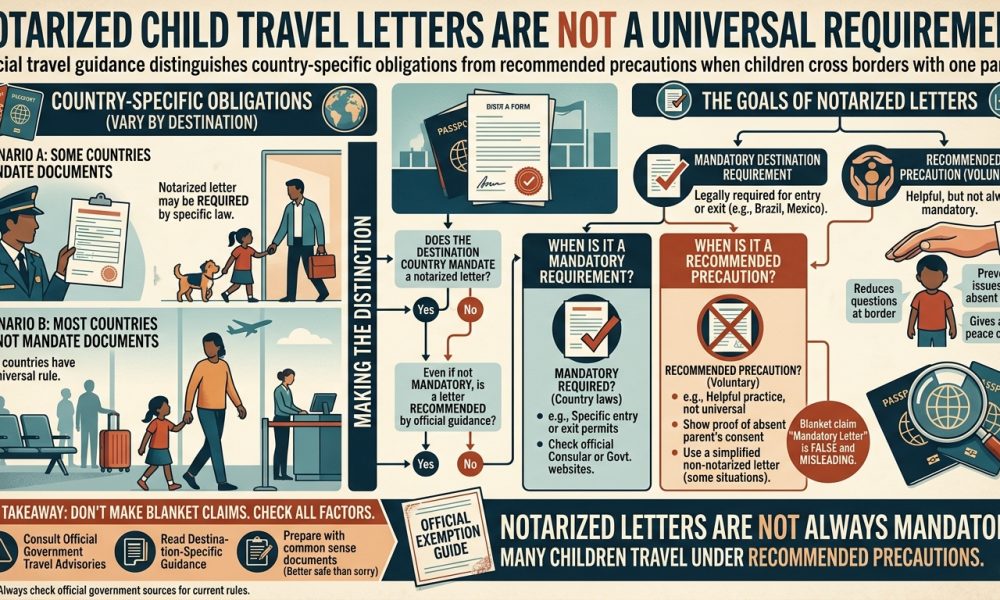
Official travel guidance distinguishes country-specific obligations from recommended precautions when children cross borders with one parent.
WASHINGTON, DC, October 15, 2026 — Parents traveling internationally with children often encounter conflicting advice about notarized consent letters, with some websites suggesting that any child accompanied by only one parent must carry written permission from the other parent, regardless of nationality, destination, or family circumstances.
Official government guidance presents a more nuanced picture, showing that parental travel consent requirements vary by the child’s citizenship, habitual residence, accompanying adult, destination, and any legal restrictions set by courts or other competent authorities.
The United States does not impose a general two-parent consent requirement for international departure. At the same time, Canada recommends written permission from absent decision-makers but does not make notarization universally compulsory under Canadian law.
France provides a contrasting example through its mandatory exit authorization framework for qualifying minors traveling without an individual exercising parental authority. However, its standard procedure does not require routine notarization or both parents’ signatures.
For internationally mobile families, understanding these distinctions can prevent unnecessary expenses and administrative complications while ensuring they obtain documents required by foreign governments before departure.
Parental Consent and Notarization Are Different Requirements
A parental consent letter records permission for a child to travel under specified circumstances, while notarization generally provides independent verification concerning the identity of the person signing the document.
The two concepts are related but not identical because a government may accept a simple signed declaration, require formal notarization, prescribe an official authorization form, or exempt a particular family arrangement from additional consent documentation.
Notarization also does not independently establish that the signatory possesses legal authority to approve the child’s journey, particularly where a custody order restricts international travel or assigns decision-making responsibility to another individual.
Similarly, a document signed before a notary in one country may not satisfy another jurisdiction’s requirements concerning translations, official legalization, government registration, or judicial permission.
Parents should therefore determine whether consent itself is required before examining whether the applicable law demands notarization or another prescribed method of authenticating that consent.
The United States Does Not Require Universal Two-Parent Consent
American parents should distinguish United States passport Application requirements from the country’s ordinary international departure procedures because the legal standards governing these two activities are not identical.
According to the U.S. Department of State’s official guidance on traveling internationally with minors, the United States does not generally require evidence that both parents have authorized a child’s international journey.
However, the department warns that foreign governments may require notarized consent from an absent parent, particularly where children travel with one parent, another adult, or without parental accompaniment.
The agency also advises families to carry evidence of their legal relationship with accompanying children to help officials resolve questions when parents and minors have different surnames.
This guidance shows why American families should investigate the actual rules governing their destinations rather than assuming United States departure practices set a universal international standard.
A Child’s Passport Does Not Automatically Establish Travel Permission
A valid United States passport identifies the child. It establishes the nationality recognized by the issuing government, but it does not necessarily demonstrate that every proposed international journey complies with applicable custody or parental consent requirements.
Passport issuance for children younger than sixteen ordinarily requires authorization from both parents or evidence of an accepted exception. However, these procedures address issuing the travel document rather than a particular journey.
For example, Form DS-3053 allows a non-applying parent to authorize passport issuance when that parent cannot attend the Application appointment. Still, the form does not grant universal permission for every future international trip.
A child can therefore possess a legitimately issued passport while remaining subject to a court order restricting travel or a foreign government’s specific departure authorization requirements.
Families should treat passport validity and legal permission to travel as separate questions, rather than assuming one automatically establishes the other.
Canada Recommends Consent Letters Without Universally Requiring Them
Canada provides an important example of a government recommending written parental permission while distinguishing that recommendation from a mandatory legal requirement applying to every international journey.
The Government of Canada’s official consent letter guidance confirms that Canadian law does not require a consent letter. However, border officials and transportation personnel may ask for evidence that a child’s journey has been authorized.
Canada recommends carrying a signed letter when a child travels alone, with one parent, with relatives, or with another adult who does not possess all relevant parental decision-making authority.
The recommendation can also apply when an existing parenting order addresses international travel, because foreign authorities may not immediately understand the legal significance of a Canadian family court decision.
However, additional consent should not be mistaken for a universal legal obligation, especially when doing so would be unsafe or conflict with an applicable court order.
Canadian Notarization Is Recommended Rather Than Universally Mandatory
Canada’s government strongly recommends having a notary public witness a parental consent letter, explaining that notarization may reduce questions about the Authenticity of the signature during border examinations.
However, Canadian law does not universally require notarization for every child travel consent letter, and government guidance recognizes that another adult may witness the signature.
The distinction matters because families may reasonably choose notarization as an additional precaution without incorrectly describing it as a mandatory condition for every international departure.
Some foreign governments nevertheless require notarized or officially authenticated documents, so a letter acceptable under Canadian guidance may not meet another country’s legally prescribed procedures.
Families should therefore determine whether the destination requires notarization rather than relying solely on recommendations from their country of residence.
France Uses a Mandatory Exit Form Instead of Routine Notarization
France illustrates a different approach because the country requires an Autorisation de sortie du territoire, or AST, when a minor habitually residing in France travels internationally without a parent or another person exercising parental authority.
The requirement applies to qualifying French and foreign children living in France, showing that habitual residence can matter more than passport nationality when determining the required departure documentation.
However, French authorities do not ordinarily require an AST when a child travels with either parent, even where the parents are separated or divorced, and only one accompanies the journey.
When an AST is necessary, an individual exercising parental authority must sign the official form, accompanied by the prescribed Identification documentation.
Routine notarization is not part of the standard French procedure, illustrating why a mandatory travel authorization should not automatically be described as a notarized consent letter.
France Generally Requires Only One Authorized Signature
France’s official AST guidance confirms that a single parent exercising parental authority can normally sign the declaration when an eligible child travels without a parent or guardian.
This arrangement differs from systems that require both parents’ consent in particular circumstances, showing that mandatory departure authorization procedures do not necessarily impose identical signature requirements.
Where parents are separated or divorced but continue exercising parental authority jointly, one parent’s signature generally satisfies the standard AST procedure. However, it may be advisable to obtain the other parent’s agreement.
If a court grants one parent exclusive parental authority, that parent has the power to execute the declaration under the relevant legal arrangements.
However, a judicial prohibition on international departure can override an otherwise completed AST, making it essential to distinguish ordinary administrative permission from binding restrictions imposed by a court.
South Africa Demonstrates the Importance of Legal Exemptions
South Africa once required extensive supporting documentation for many international journeys involving children, contributing to widespread claims that unabridged birth certificates and parental consent affidavits were universally mandatory.
However, the government introduced an important waiver in November 2019, removing routine requirements for birth certificates and parental consent affidavits for accompanied foreign children entering or departing under the relevant arrangements.
The exemption substantially changed the position for many American families visiting South Africa, particularly children traveling with one parent, grandparents, or another accompanying adult.
South African children and unaccompanied foreign minors remain subject to different documentation safeguards, while children requiring visas may have relevant supporting evidence examined during the Application process.
The example shows why older travel advice can remain technically accurate as historical Information while no longer describing the current requirements for a particular family.
Mexico Requires Formal Authorization in Specific Circumstances
Mexico provides another example of why parental consent requirements must be evaluated by nationality, residence status, and the adult accompanying the child, rather than based on assumptions about single-parent travel.
The country’s Formato de Salida de Menores, commonly known as Formato SAM, generally applies to qualifying Mexican minors and certain foreign-resident children departing without a parent or legally recognized guardian.
However, Mexican immigration guidance exempts qualifying children accompanied by either parent or a person with the necessary legal authority, meaning a mother or father traveling alone with their child generally does not need SAM.
Children traveling with grandparents, unrelated adults, or without accompaniment can face different authorization requirements, including official validation or recognized notarial or judicial alternatives.
Mexico’s framework therefore distinguishes ordinary parental accompaniment from circumstances that require evidence that another adult may travel with the child.
Parenting Orders Can Change the Legal Analysis
Parents who are separated or divorced should examine their existing parenting agreements and judicial orders before assuming that general immigration exemptions establish unrestricted permission to travel internationally.
A court may require advance notice, written agreement, judicial approval, or compliance with specific conditions regarding the destination, departure dates, or the child’s return.
The absence of a national requirement for a notarized consent letter does not override these restrictions, because family-law obligations and immigration documentation requirements serve different legal purposes.
Conversely, a parent with exclusive authority under a valid court decision may not need additional consent from someone who lacks the relevant decision-making rights.
Where a parenting order contains unclear provisions, qualified legal advice can help determine whether the contemplated journey falls within the parent’s existing authority.
Different Surnames Can Justify Additional Relationship Evidence
Parents and children may legitimately have different surnames after marriage, divorce, adoption, or other family circumstances, which can raise questions during travel document checks.
A birth certificate can help establish a parent-child relationship, while marriage certificates, adoption records, or legal name-change documents may provide additional context when needed.
However, evidence establishing a parental relationship is not necessarily equivalent to consent from another parent who possesses separate legal decision-making authority.
Likewise, different family names do not automatically mean a notarized letter is legally required under the immigration rules of every country.
Parents should distinguish records proving identity or relationship from documents granting permission for a particular journey, ensuring each record addresses the relevant authority’s question.
Grandparents and Unrelated Adults Face Different Considerations
A child traveling with grandparents, family friends, teachers, or another adult without parental authority may face documentation requirements that differ from those governing travel with either parent.
Some governments prescribe formal departure authorization when the accompanying adult is not a parent or guardian, even where the individual has a close family relationship with the child.
Other countries recommend a signed consent letter but do not universally require notarization, leaving families to decide whether the destination’s specific rules require additional Authentication.
Airlines may also impose requirements on the child’s age, supervision arrangements, and Identification of the adult responsible for receiving the minor.
Families should therefore examine the entire journey rather than assuming that permission acceptable to one transportation provider will automatically satisfy every immigration authority.
Dual Citizenship Can Create Unexpected Departure Requirements
Children with more than one citizenship may face requirements tied to a nationality not immediately apparent from the passport used for airline reservations.
Some countries require their citizens to use national passports when entering or leaving, while others apply special child-protection rules to nationals traveling without a parent.
An American child who also holds another citizenship may therefore face different requirements than an ordinary American tourist visiting the same destination.
Evaluate these circumstances based on the child’s legally recognized citizenship and any applicable residence arrangements, rather than selecting documentation solely to obtain a perceived exemption.
Parents should consult the appropriate government authority when multiple nationalities create uncertainty about the travel documents or authorizations required for departure.
Passport Security and Consent Documentation Have Distinct Functions
Modern electronic passports include identification and authentication features designed to establish the legitimacy of government-issued documents, while parental consent letters address whether a proposed journey has received the necessary legal authorization.
Some countries have also added parental identification Information to passports issued to children, giving immigration authorities supplementary Information about recognized family relationships.
Amicus International Consulting examined this development in Mexico’s Children’s Passports Include Parents’ Photos to Strengthen Travel Security, explaining how parental photographs and related Identification Information can strengthen the examination of children’s travel documents.
However, including parental Information in an authentic passport does not automatically establish that a particular international departure complies with applicable custody restrictions or consent requirements.
Passport Authentication, proof of parentage, legal guardianship, and authorization for international travel remain related but separate considerations.
A Notarized Letter May Not Be Sufficient Abroad
If a foreign government prescribes a specific child departure procedure, a standard notarized parental letter may not replace the document required under that country’s legislation.
France’s AST system, Mexico’s SAM procedure, and other nationality-specific departure arrangements illustrate how official authorization requirements can differ from informal letters prepared for international travel.
Certain jurisdictions may require a designated government form, validation by an immigration authority, evidence of guardianship, or a judicial decision permitting travel under particular circumstances.
A letter notarized in the United States or Canada may therefore offer useful supporting evidence without satisfying a mandatory foreign government procedure.
Families should identify the precise document the responsible authority requires rather than assuming notarization provides universal legal recognition.
Consent Does Not Automatically Authorize Permanent Relocation
Permission for a child to undertake a temporary international journey should not automatically be interpreted as authorization to establish permanent residence in another country.
Parents may approve a holiday or family visit while retaining legal rights concerning the child’s habitual residence, education, custody, and longer-term living arrangements.
This distinction matters when parenting orders govern relocation or require separate consent before a child can move internationally.
A notarized letter identifying specific travel dates may not establish permission for a substantially different journey or an indefinite change in residence.
Families considering international relocation should review the applicable family-law requirements separately from standard tourist entry and departure documentation.
Families Should Verify Requirements for Every Country Involved
A child may leave the United States without a universal two-parent consent requirement but subsequently encounter different rules when entering or departing another country.
Transit stops can also raise documentation questions, especially when an itinerary requires immigration clearance, an airport change, or an overnight stay outside secure international transit facilities.
Parents should therefore identify the departure country, destination, intermediate stops, nationality, habitual residence, and accompanying adults before determining which consent documents are necessary.
Official immigration guidance and foreign diplomatic missions should provide the primary reference for mandatory requirements, while airline policies should be examined as separate transportation conditions.
The goal is to carry accurate documents for the actual journey without treating optional precautions as universal legal obligations.
Conclusion: Notarization Depends on the Circumstances
Notarized child travel consent letters can provide valuable supporting evidence, but international governments do not universally require them whenever a child crosses a border with one parent.
The United States generally does not require two-parent consent for international departure. At the same time, Canada recommends written permission and notarization as precautions rather than imposing those measures universally under Canadian law.
France’s mandatory AST framework and Mexico’s SAM procedures show that some jurisdictions require more formal authorization for specified minors traveling without a parent or legal guardian.
For internationally mobile families, the central distinction is between a document recommended to reduce questions and an authorization legally required by the relevant destination or departure country.
Ultimately, responsible family travel preparation requires accurate Identification, compliance with custody arrangements, and careful verification of country-specific rules, not blanket claims about notarized consent letters.




