
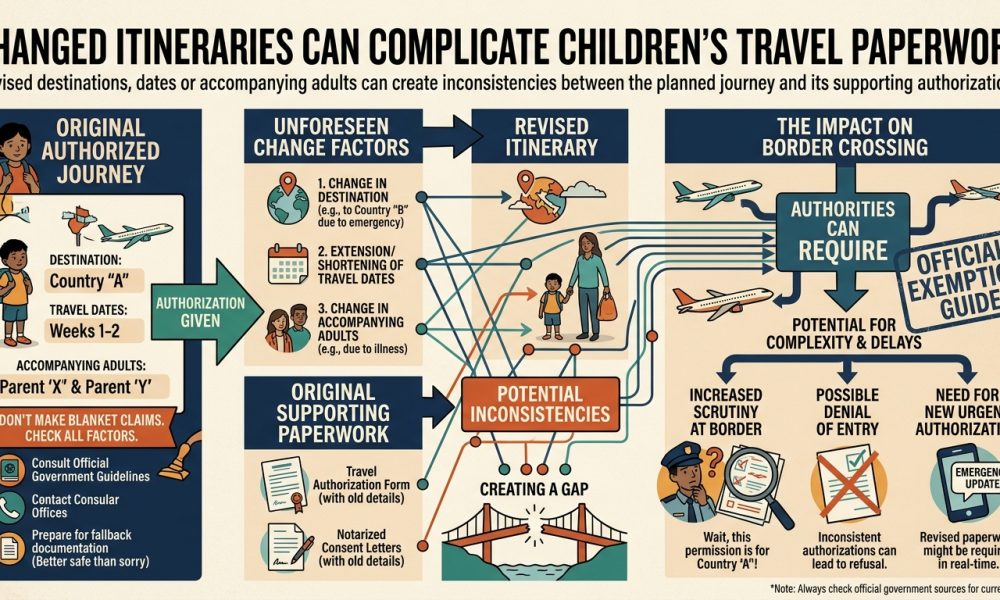
Changes to destinations, dates, or accompanying adults can create inconsistencies between the planned journey and the supporting authorization.
WASHINGTON, DC, October 15, 2026 — Families traveling internationally with children may need to review parental consent letters, departure authorizations, and supporting legal documents when flight schedules, destinations, travel dates, or accompanying adults change after the original journey has been approved.
Although ordinary itinerary adjustments do not automatically invalidate every child travel consent document, significant differences between the authorized arrangements and the journey actually undertaken can create questions concerning parental permission, legal responsibility, and compliance with foreign immigration requirements.
Government guidance from Canada, France, and Brazil shows that child travel documentation serves different purposes across jurisdictions, with some authorities recommending detailed written consent. In contrast, others require formal authorizations for specific travel circumstances.
These differences matter most when children travel with one parent, grandparents, school groups, or unrelated adults, because the accompanying person’s identity and the journey’s length may determine which documents are required.
For internationally mobile families, understanding when revised arrangements require updated paperwork can reduce avoidable complications while preserving the distinction between minor scheduling changes and modifications that materially alter the permission originally granted.
Child Travel Authorization Describes a Particular Arrangement
A parental travel consent letter generally records that an individual possessing the necessary legal authority has agreed to the child’s proposed journey, identifying the destination, accompanying adult, expected dates, and relevant parental contact Information.
These details help border officials and transportation personnel understand the circumstances under which permission was granted, particularly when the child travels without one or both individuals exercising parental responsibility.
If the itinerary changes later, the original authorization may no longer accurately reflect the arrangements the parent or guardian intended to approve.
However, the significance of the discrepancy depends on the document’s wording, the nature of the change, and the legal requirements of the countries involved.
Families should therefore avoid assuming either that every minor change requires a new notarized letter or that an earlier authorization automatically covers every conceivable modification.
Canada Recommends Identifying Dates and Destinations
Canada provides detailed guidance on the Information that should appear in a consent letter for children traveling without individuals with decision-making responsibility.
According to the Government of Canada’s official guidance on consent letters for children traveling abroad, recommended Information includes the child’s identity, the consenting adults’ contact details, the accompanying person’s identity, intended destinations, and specific travel dates.
The guidance also explains that Canadian law does not universally require a consent letter. However, border authorities and airline personnel may request evidence demonstrating that the journey has received appropriate permission.
This distinction matters because Canadian recommendations help families communicate their intentions without creating a single, legally prescribed authorization format for every international journey.
When dates, destinations, or accompanying adults change, parents should examine whether the existing declaration still clearly describes the permission they intended to give.
Departure Date Changes May Require Review
A departure date may change because an airline reschedules a flight, severe weather interrupts transportation, or the family chooses a different itinerary after completing its original travel arrangements.
Where a consent letter identifies a specific departure date, parents should consider whether the revised timing remains reasonably consistent with the authorized journey.
A short scheduling adjustment does not necessarily make the trip fundamentally different, especially when the destination, accompanying adult, and expected return arrangements remain largely unchanged.
Nevertheless, some government-issued authorizations have prescribed validity periods, so the actual departure date matters when deciding whether an existing permission still applies.
Families should check the governing rules rather than assuming the original parental agreement remains sufficient in every jurisdiction.
Return Dates Help Distinguish Temporary Travel From Longer Stays
An expected return date indicates when the child is expected to complete the authorized trip and resume their usual residence or parenting arrangements.
A parent may consent to a two-week vacation while withholding approval for a substantially longer absence that could affect education, shared parenting schedules, or the child’s habitual residence.
Extending a journey by several months can therefore raise legal questions different from those created by an airline delay lasting a few hours.
Canada recommends identifying the proposed trip’s duration to help officials determine whether the permission relates to a defined journey or another arrangement.
If the revised return date materially exceeds the originally authorized period, additional consent or legal review may be appropriate, particularly when a court order regulates international travel.
Changing Destinations Can Alter the Scope of Consent
A child may be authorized to visit one country but later be scheduled to travel through additional destinations, creating uncertainty about whether the original permission covers the revised itinerary.
For example, a parent who agrees to a vacation in Italy may not have authorized a separate journey to another country under substantially different circumstances.
Some general consent letters identify broad itineraries, while formal government-issued documents may specify particular destinations or periods during which international departure is permitted.
Parents should therefore check whether the changed destination remains within the authorization’s scope, rather than assuming all international travel is interchangeable.
The new destination may also impose separate child entry or exit requirements, so review documents even when the consenting parent approves the revised itinerary.
The Accompanying Adult Is Often a Critical Detail
The identity of the person accompanying a child can be especially important because government requirements frequently distinguish travel with a parent or legal guardian from journeys involving grandparents, teachers, relatives, or unrelated adults.
A letter authorizing a child to travel with the mother does not necessarily mean the child can instead depart with a grandparent or another person without parental authority.
Similarly, a document identifying a particular teacher may not appropriately describe a revised arrangement in which another school representative takes responsibility for the journey.
The change can affect both the required legal documentation and the practical arrangements for supervision, transportation, and communication with the consenting parent.
Parents should therefore pay particular attention to accompanying-adult substitutions rather than treating them as ordinary administrative changes comparable to adjusting a flight number.
France Provides an Example of Formal Authorization Periods
France requires an Autorisation de sortie du territoire, commonly known as an AST, when a minor habitually residing in France travels abroad without a parent or another individual legally exercising parental authority.
Under France’s official guidance on the AST procedure, the signing parent sets the authorization’s validity period, which may cover a specific journey or a longer interval but cannot exceed one year.
This arrangement shows why a revised departure date may be legally significant if it falls outside the authorization period.
However, a journey that remains within an appropriately granted period does not automatically require a new document just because an airline changes its flight schedule.
Families should distinguish the authorization’s legal validity from the specific itinerary described in separate travel bookings, while considering whether other material changes require additional permission.
France Exempts Travel With a Parent or Legal Representative
France’s AST framework also shows how changes in the accompanying adult can affect whether the authorization requirement applies.
A qualifying child who habitually resides in France generally does not need an AST when traveling internationally with either parent or another person exercising parental authority.
However, if that parent can no longer accompany the child and a grandparent or unrelated adult assumes responsibility, the journey may enter the category requiring an AST.
Conversely, a child originally scheduled to travel with a third party may no longer need the same authorization if the revised journey is undertaken with a parent possessing the necessary legal authority.
These distinctions show why a change in who accompanies the child can matter more legally than a minor adjustment to the flight itinerary.
Brazil’s Passport Endorsements Offer Different Travel Permissions
Brazil offers another example of how the scope of parental permission can affect the documentation needed when a child’s travel arrangements change.
The country’s Federal Police allows qualifying parents to request that international travel authorization be printed directly in a Brazilian minor’s passport, with permissions varying by the category selected during issuance.
One category allows the child to travel internationally with either parent, while another provides broader authorization permitting travel without parental accompaniment, subject to other applicable legal restrictions.
A passport issued without embedded authorization may require separate permission when the child travels without both parents, so the document’s contents matter when plans change.
Families should therefore examine the authorization already recorded in the passport before deciding whether a revised accompanying-adult arrangement requires additional paperwork.
A Parent-to-Grandparent Change Can Be Significant
Consider a Brazilian child originally scheduled to travel internationally with the mother under a passport endorsement authorizing travel with either parent.
If the mother subsequently becomes unavailable and the grandparents are asked to accompany the child instead, the original endorsement may not cover that arrangement because it authorizes travel with a parent rather than independently with third parties.
A broader authorization permitting unaccompanied international travel may address different circumstances, although airline procedures and destination-specific requirements remain separately relevant.
This example illustrates why families should examine the precise legal scope of the existing permission rather than relying only on the fact that the child’s passport remains valid.
If the revised journey falls outside the established authorization, the family should obtain the appropriate additional permission before attempting to depart internationally.
Airline Changes Can Affect Unaccompanied-Minor Arrangements
Travel changes involving children who fly without a parent can create additional complications because airlines often require advance arrangements that identify the adults responsible for departure and arrival.
A change in destination airport, connecting flight, or receiving adult may require updated airline Information, even when the parental consent document remains valid under the applicable immigration rules.
Airlines may impose age restrictions, supervision requirements, special service charges, and Identification procedures that operate independently of government-issued departure authorizations.
If a flight disruption changes the destination or requires overnight accommodation, the carrier may also need to coordinate the child’s care under its established procedures.
Parents should therefore distinguish amendments to the airline’s supervision arrangements from changes to legally required parental consent, ensuring that both remain consistent with the revised journey.
School Trips Can Require Updated Authorization Details
International school trips, sporting competitions, and cultural exchange programs frequently involve several children traveling under the supervision of teachers, coaches, or other designated adults.
When an organizer changes the destination, travel period, or supervising personnel, previously collected parental consent documents may no longer accurately describe the program that families originally approved.
Schools should therefore review whether the original consent covers the amended journey and whether any destination-specific immigration requirements have changed.
An organizational permission form may also serve purposes different from a government-required child departure authorization, so review both documents when significant arrangements change.
Parents and organizers should ensure that the adults responsible for the children are correctly identified and that emergency contact Information remains current throughout the revised itinerary.
Parenting Orders Can Limit Itinerary Flexibility
Separated or divorced parents may have parenting agreements or court orders specifying when a child may travel, which destinations are permitted, and whether advance notice or additional consent is required.
A change that may seem minor from an airline scheduling perspective can still affect the legal arrangements governing the child, especially when it overlaps with another parent’s scheduled parenting time.
Some orders require a particular return date, while others address international travel more broadly or restrict relocation without judicial permission.
A revised consent letter cannot automatically override these conditions, because the authority to change the journey depends on the actual terms of the order and applicable family law.
Parents should therefore review binding arrangements before agreeing to substantial itinerary amendments rather than assuming that an earlier travel letter grants unrestricted flexibility.
Changes Do Not Automatically Authorize International Relocation
A temporary travel consent letter ordinarily describes permission for a journey with an anticipated conclusion, rather than granting unlimited authority to change the child’s place of habitual residence.
Extending a family holiday into an indefinite stay abroad can involve questions concerning parental responsibility, custody, education, and international child Protection legislation.
One parent’s prior authorization of a vacation does not necessarily show agreement to permanent relocation or an open-ended absence.
This distinction matters when the original permission included specific travel dates and destinations, which may show the limited arrangement the parent intended.
Families considering a substantial change in residence should obtain appropriate legal authorization rather than assuming that an existing holiday letter covers the revised circumstances.
Dual Citizenship Can Introduce Additional Requirements
Children with more than one citizenship may face different departure rules when an itinerary change adds a country that recognizes them as its nationals.
For example, an American child who also holds Brazilian citizenship may face Brazilian child departure authorization requirements that differ from the ordinary procedures that apply to American visitors.
Similar distinctions can arise when children hold citizenship in another country that maintains special parental-consentor accompanying-adult requirements.
Changes in the countries entered or departed may therefore affect which national rules apply, even when the child’s identity documents and parental relationships remain unchanged.
Families should assess citizenship and habitual residence alongside the itinerary rather than assuming one passport provides the same permission throughout the journey.
Passport Security Cannot Establish the Scope of Consent.
Modern electronic passports include security features designed to authenticate the document and reliably link it to the individual presenting it during international border checks.
However, successful passport Authentication does not necessarily establish whether the child is authorized to travel with a particular adult or remain abroad for a revised period.
Some countries supplement passport Identification with parental Information or specific departure permissions, demonstrating that governments use different mechanisms to address family Identification and travel authorization.
Amicus International Consulting examined one such development in Mexico’s Children’s Passports Include Parents’ Photos to Strengthen Travel Security, explaining how additional parental Identification can support document examination.
Nevertheless, parental details in an authentic passport do not, by themselves, show that a parent approved every subsequent change to the child’s destination, travel dates, or accompanying adults.
Contact Information Becomes More Important After Changes
When travel arrangements change unexpectedly, accurate contact Information for parents or other individuals possessing decision-making responsibility can help airlines and relevant authorities seek clarification.
Canada recommends including the names and contact Information of consenting adults and accompanying persons in child travel consent letters to support communication when questions arise.
An outdated telephone number or email address may reduce a letter’s practical usefulness if the revised journey creates uncertainty about the permission originally granted.
However, contacting a parent does not necessarily replace formal authorization when the applicable country requires an officially validated departure permit or another prescribed document.
Families should maintain reliable communication arrangements while recognizing that telephone confirmation and legally valid consent can be different requirements.
Updated Letters Should Describe the Actual Journey
If a material change falls outside the original consent, a newly signed or properly updated document may provide clearer evidence of authorization for the revised trip.
The updated declaration should accurately identify the child, the consenting individual, the accompanying adult, the destination, and the intended departure and return dates.
Families should avoid altering an already signed document without proper authorization because such changes can create uncertainty concerning which Information the signatory genuinely approved.
Where notarization or official validation is legally required, the amended document may need to undergo the corresponding procedure rather than being treated as valid solely because the original was authenticated.
The objective is to accurately document genuine permission, not merely reproduce the appearance of paperwork associated with an earlier itinerary.
Not Every Change Requires a New Notarized Document
A delayed flight, revised hotel booking, or modest change in a connection does not automatically mean that every family must prepare an entirely new notarized child travel consent letter.
Whether updated documentation is necessary depends on the scope of the original consent, the child’s circumstances, and the requirements of the country responsible for examining the journey.
Some governments prescribe official authorization periods, while others recommend letters describing the travel arrangements without imposing a universal format or notarization requirement.
Families should therefore avoid both unnecessary formalities and assuming an earlier document remains sufficient, regardless of what has changed.
The proper question is whether the existing authorization still accurately and legally covers the journey now being undertaken.
Official Requirements Should Be Rechecked Before Departure
Families should verify the current child travel rules of the departure country, transit jurisdictions, and final destination whenever significant itinerary changes occur.
An additional destination can introduce different parental authorization, immigration, or passport requirements, while replacing a parent with another accompanying adult may change the relevant departure procedure.
The review should also consider court orders, guardianship arrangements, airline supervision policies, and any prescribed validity period appearing on an existing authorization.
If legal authority is disputed or circumstances are unclear, qualified family-law advice may be needed to determine whether the revised journey can proceed.
Careful preparation helps preserve legitimate flexibility while avoiding misunderstandings about who has authority to approve international movement involving a child.
Conclusion: Changed Plans Require Attention to the Permission Granted
Revised itineraries can complicate children’s international travel documentation when the new arrangements differ materially from the dates, destinations, or accompanying adults identified in an existing parental consent letter or official departure authorization.
Canada’s recommendations illustrate the importance of accurate travel Information, while France’s AST framework demonstrates how formal authorization periods can determine whether a revised departure remains covered.
Brazil’s passport-based travel permissions provide another example, showing that changing from a parent to a third-party accompanying adult can affect whether the existing authorization covers the journey.
For internationally mobile families, the appropriate response is to review the actual permission granted, distinguish minor scheduling adjustments from substantial changes, and obtain updated authorization when required.
Ultimately, clear and legally valid documentation helps establish that the child’s revised journey reflects the intentions of the individuals authorized to make decisions about international travel.




