
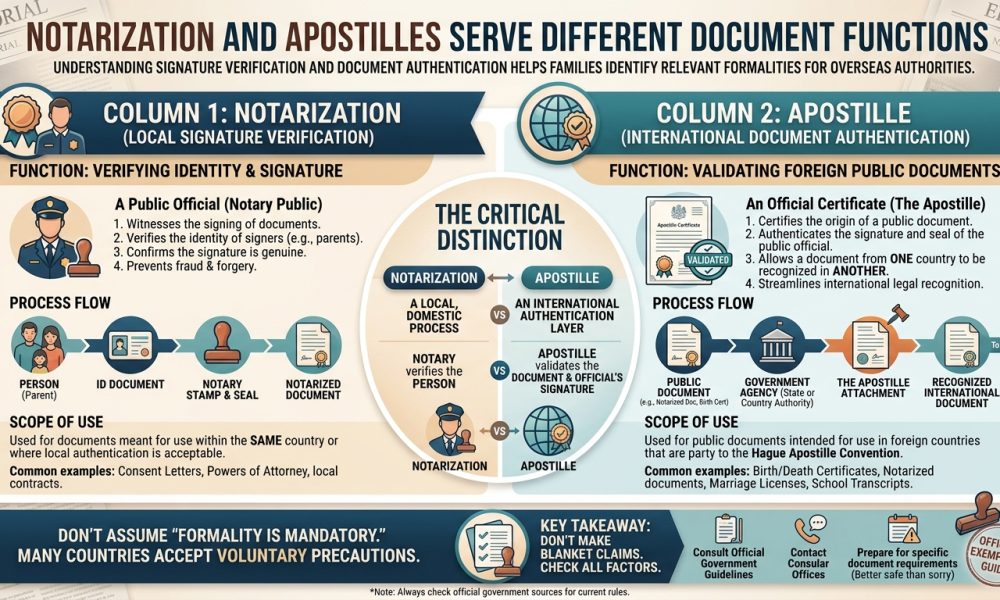
Understanding signature verification and document Authentication helps families identify the formalities an overseas authority requires.
WASHINGTON, DC, October 15, 2026 — American families preparing documents for international travel, foreign immigration applications, parental consent procedures, or overseas legal proceedings may encounter requests for notarization, apostilles, certified translations, and document legalization. However, these formalities serve different purposes and are not automatically interchangeable.
The distinction matters most when parents must present birth certificates, custody judgments, adoption records, guardianship documents, or written permission authorizing a child to travel internationally with another adult.
Official guidance from the United States Department of State and the Government of Canada shows that notarization can establish facts about a document’s execution, while an ap. At the same time, Authentication attests to specified official signatures, seals, or capacities for international use under the relevant treaty framework.
Neither procedure independently guarantees that a foreign government will accept the document, recognize the legal authority claimed by its signatory, or consider the proposed international journey lawful under applicable family and immigration legislation.
For internationally mobile families, identifying necessary formalities can prevent unnecessary expenses, rejected submissions, and misunderstandings about the legal significance of documents prepared for use outside their country of origin.
Notarization and Apostilles Address Different Questions
Notarization generally involves a notary public performing a legally recognized act, such as witnessing a signature, administering an oath, or certifying a statement, according to the applicable jurisdiction’s rules.
An apostille, by contrast, is a certificate issued by a competent authority that authenticates the origin of a qualifying public document for use in another country that is a party to the relevant international Convention.
These procedures may appear together when a privately signed parental consent letter is notarized, and the receiving foreign authority subsequently requires Authentication of the notarial act.
However, not every notarized document requires an apostille, and some public documents can receive apostilles directly without separate notarization.
Families should therefore start by identifying the document involved, the country that issued it, and the precise requirements of the foreign authority that will receive it.
A Notary May Verify the Execution of a Consent Letter
Parents arranging international travel for children sometimes obtain notarized consent letters to provide additional evidence that the individual identified as the signatory executed the permission declaration.
Depending on the jurisdiction and type of notarial act, the notary may verify identity, witness the signing, or take an acknowledgment confirming that the person executed the document.
The resulting notarial certificate records the prescribed act, helping another institution evaluate the circumstances in which the parental declaration was signed.
However, notarization does not ordinarily establish that every factual statement inside the letter is true or that the person signing possesses unrestricted authority to authorize the child’s international movement.
For example, a notarized declaration cannot override a binding custody Judgment requiring court approval before a minor may leave the country.
Canada Recommends Notarization but Does Not Universally Require It
Canada illustrates the difference between a recommended safeguard and a legal formality required for every international journey involving children.
According to the Government of Canada’s official guidance on child travel consent letters, written permission is recommended when a child travels without one or more individuals possessing decision-making responsibility.
The government strongly recommends that a notary public witness the signature but also recognizes that another adult may witness the declaration, because Canadian law does not universally require notarization.
Canadian authorities caution that foreign immigration officials and airlines may still require supporting consent documentation, while certain requirements governinforuthentication, and acceptance.
This distinction shows why families should not treat every Canadian parental consent letter as legally invalid simply because its signature is not notarized.
The Hague Apostille Convention Simplifies International Authentication
The 1961 Hague Apostille Convention establishes a standardized method for authenticating the origin of qualifying public documents intended for use between countries where the treaty applies.
Instead of requiring the traditional chain of diplomatic or consular legalization, the Convention permits a designated authority to issue an apostille confirming specified Information about the relevant official signature or seal.
Under the U.S. Department of State’s official document Authentication guidance, apostilles apply to qualifying documents intended for countries that are parties to the Convention. In contrast, separate Authentication procedures generally apply to other destinations.
The Convention can therefore simplify the international use of birth certificates, judicial records, notarial acts, and other eligible documents required for immigration or family-law purposes.
However, the receiving country must be one where the Convention applies in the relevant relationship, and the document must fall within the treaty’s scope.
An Apostille Does Not Certify Every Statement in a Document
One of the most important limitations concerns what an apostille actually verifies, because international Authentication should not be confused with government approval of the document’s underlying contents.
An apostille authenticates the origin of a public document by certifying the official signature, the signatory’s capacity, and, where applicable, the identity of the accompanying seal or stamp.
It does not independently establish that all statements contained in the underlying record are accurate, legally enforceable, or sufficient for the purpose intended by the person presenting it.
For example, an apostille attached to a notarized parental consent declaration can authenticate the relevant notarial act without establishing that the parent possesses unrestricted custody or relocation rights.
The foreign authority remains responsible for determining whether the document satisfies its substantive legal and administrative requirements.
Birth Certificates Often Follow a Different Procedure
Public authorities that maintain civil registration records generally issue birth certificates, so certified copies can qualify for international Authentication through the competent issuing jurisdiction.
In the United States, birth certificates are ordinarily state or local vital records, with the appropriate Authentication procedure depending on the state that issued the certified record.
A family presenting an American birth certificate overseas may therefore need an apostille from the relevant state authority rather than an additional signature witnessed by a notary.
The Department of State specifically cautions against unnecessarily notarizing certain original federal documents before Authentication, illustrating why document preparation should follow the issuing authority’s instructions.
Parents should obtain the correct certified record and confirm its Authentication requirements rather than assuming that every official document must first pass through a private notary.
Custody Orders May Require Authentication of Court Records
Custody judgments and parenting orders can become important during international travel when a parent needs to demonstrate exclusive decision-making authority, judicial permission, or restrictions affecting another parent’s involvement.
If a foreign authority requires an authenticated American court order, the family may need a certified copy issued by the appropriate court and authenticated under the relevant jurisdiction’s rules.
Notarizing a photocopy does not necessarily provide the same evidence as an official certified court record, particularly where the destination requires proof of the Judgment’s public origin.
An apostille can authenticate the qualifying court official’s signature or seal but does not independently expand the legal effect of the Judgment outside its issuing jurisdiction.
Families should therefore distinguish document Authenticity from the separate question of whether another country recognizes and gives effect to the court’s decision.
Adoption and Guardianship Records Can Involve Several Documents
International adoption and guardianship arrangements may require families to present multiple records establishing parentage, legal responsibility, and authority to travel with a minor.
These records can include certified court decisions, amended birth certificates, adoption decrees, or documents issued by agencies operating under national child Protection legislation.
Different documents may require different Authentication procedures because an official court record and a privately signed guardianship declaration do not necessarily have the same legal character.
When a foreign authority requests apostilles, families should determine which records require certification and whether they must obtain separate apostilles for each document.
The objective is to authenticate the official origin of relevant records without assuming that an apostille automatically establishes every legal right asserted within them.
Federal and State Documents Require Different U.S. Authorities
In the United States, the competent authority responsible for an apostille depends on whether the underlying record is a qualifying federal document or a document issued or notarized under state authority.
The U.S. Department of State handles apostilles and Authentication certificates for qualifying federal documents, while designated state officials handle appropriate records issued or notarized within their jurisdictions.
This distinction matters most when families gather birth certificates, state court orders, federal records, and privately notarized consent letters for the same international Application.
Submitting every document to one federal office can cause delays because that office may lack authority to authenticate records issued under a different jurisdiction.
Families should therefore classify their documents before beginning the process and identify the correct competent authority for each separate record.
Countries Outside the Convention May Require Legalization
When a document is intended for use in a country where the Hague Apostille Convention does not apply, a different Authentication or legalization procedure may be necessary.
Traditional legalization can involve certification by authorities in the issuing country followed by verification through the receiving country’s embassy or consulate, depending on the destination’s requirements.
The precise sequence differs by country, and some governments maintain bilateral agreements or administrative exemptions that reduce the steps required for certain records.
A family should therefore avoid purchasing an apostille merely because the document will be presented overseas, since the receiving authority may instead require another Authentication procedure.
The legal relationship between the issuing and receiving countries, and the receiving institution’s instructions, determine the appropriate process.
Certified Translation Is a Separate Requirement
A document can be properly notarized and apostilled yet remain unusable for an overseas Application if the receiving authority requires Information in a particular language.
Certified translation addresses the accuracy of text reproduced in another language, while notarization and apostilles concern different aspects of execution or official origin.
Some destinations require a recognized professional to complete the translation, accompanied by a declaration of accuracy, or to authenticate it separately under prescribed procedures.
Other countries accept multilingual public records or provide exemptions that make a separate translation unnecessary in qualifying circumstances.
Families should therefore confirm whether they must complete Authentication before translation, whether the translation itself requires certification, and whether the receiving authority expects both documents to be submitted together.
Apostilles Do Not Replace Government Child Exit Permits
Certain countries require formal departure authorization procedures for children traveling without parents or legally recognized guardians, and an ordinary notarized letter may not satisfy these requirements.
France’s AST framework, Mexico’s SAM procedure, and Italy’s accompaniment declaration system illustrate how governments may require designated forms, official endorsements, or other legally prescribed documentation.
A notarized and apostilled declaration prepared in the United States does not automatically replace those procedures merely because its signatures have received formal Authentication.
Conversely, a child who qualifies for a parental exemption under the destination’s rules should not automatically need an apostille for documents the government does not request.
Parents must therefore identify the substantive child travel authorization required before deciding whether notarization or international Authentication is necessary.
Apostilles Do Not Establish Parental Authority
A central misunderstanding arises when families assume that an apostille attached to a consent letter establishes that the person granting permission possesses unquestionable legal authority over the child.
The apostille authenticates the specified public signature or notarial act. Still, it does not determine whether the parent possesses sole custody, shares decision-making responsibility, or must obtain another individual’s agreement.
Those questions depend on applicable family law, relevant court orders, and the child’s actual legal circumstances.
An authenticated document can still be insufficient if a court has restricted international travel or the signatory lacks authority to approve the proposed journey.
Families dealing with disputed custody or guardianship should obtain appropriate legal advice rather than treating document Authentication as a substitute for lawful authorization.
Digital Notarization and Electronic Apostilles Need Separate Verification
Electronic signatures, remote online notarization, and electronic apostilles are increasingly used in certain jurisdictions, providing alternatives to traditional paper-based document preparation.
However, acceptance depends on the issuing authority, the destination’s legal framework, and whether the receiving institution recognizes the particular electronic procedure.
A remotely notarized parental consent letter may be valid under one American state’s rules but still require additional examination before a foreign authority will accept it.
Similarly, an electronic apostille issued by a competent authority may be recognized under the applicable international framework while a particular receiving office imposes additional technical submission requirements.
Families should therefore verify both legal acceptance and practical document presentation before relying exclusively on digital records.
Passport Authentication Is Not Document Legalization
Modern electronic passports incorporate digitally protected Identification Information intended to help authorities establish Authenticity and verify the identity of legitimate passport holders.
However, electronic passport verification performs a different function from notarization or apostille certification because it does not establish the Authenticity of an accompanying custody Judgment or privately signed parental declaration.
Some passports also contain supplementary Identification Information concerning parents or legally recognized guardians, providing another means of examining family relationships.
Amicus International Consulting examined this development in Mexico’s Children’s Passports Include Parents’ Photos to Strengthen Travel Security, explaining how additional parental Identification can support the examination of children’s travel documents.
Nevertheless, parental Information recorded in a passport does not substitute for an apostille when a foreign authority expressly requires Authentication of a separate official record.
Families Should Avoid Unnecessary Authentication Expenses
Commercial document preparation services sometimes advertise comprehensive notarization, apostille, legalization, and translation packages without clearly establishing which procedures the foreign authority actually requires.
Although professional assistance may suit complicated international applications, families should distinguish required government formalities from optional administrative services and commercial convenience charges.
A destination that accepts an ordinary signed parental consent letter may not require an apostille. In contrast, another country may require a prescribed exit permit instead of the documents a commercial intermediary offers.
Ordering every available service can therefore increase costs without improving compliance or ensuring the paperwork meets the correct legal requirements.
Parents should begin with the receiving government’s official instructions and obtain only the Authentication services relevant to their particular documents.
Document Timing Can Affect International Travel Preparation
Obtaining certified records, arranging notarization, securing apostilles, and commissioning translations can take different amounts of time depending on the issuing authority and destination.
You may need to request a birth certificate from a state vital records office before the appropriate apostille authority can review the certified document.
A privately signed consent letter may require notarization before Authentication, while a court order may first need to be issued as an official certified copy.
Families planning international departures should therefore allow enough time to prepare when formal Authentication is genuinely required.
However, preparing documents far in advance can also create difficulties when the destination imposes validity periods or expects consent to correspond with current travel arrangements.
Protecting Personal Information Remains Important
Documents submitted for notarization, translation, or apostille processing may contain sensitive Information concerning children’s identities, family relationships, residential addresses, and legal proceedings.
Families should use legitimate public authorities and appropriately qualified service providers rather than distributing complete Identification records through unfamiliar websites.
Where a professional intermediary handles documents, parents should understand which records are collected, whether subcontractors are involved, and how the Information will be retained.
They should also avoid providing unrelated financial or medical Information when those records are not necessary for the particular Authentication procedure.
Responsible document handling can reduce privacy risks without affecting the government’s ability to verify official signatures or assess genuine legal authority.
International Families Need Destination-Specific Instructions
The most reliable preparation begins by identifying exactly which document the overseas authority requires and whether it must be notarized, apostilled, legalized, translated, or submitted as an official certified copy.
Parents should then confirm the country of origin, the record’s legal character, and the authority responsible for issuing any required Authentication certificate.
Where children travel across several countries, families should recognize that one destination’s acceptance rules do not automatically determine the formalities required elsewhere.
They should also distinguish immigration admission requirements from documentation used in court proceedings, residence applications, school enrollment, and civil registration, since each process may involve different standards.
Official instructions from the receiving government remain the primary reference for deciding which formalities are necessary.
Conclusion: Authentication Does Not Replace Legal Permission
Notarization and apostilles serve related but distinct functions: notarization documents a recognized notarial act, while an apostille authenticates the official origin of qualifying public documents for international use.
Neither procedure automatically establishes the truth of every statement in a document, a parent’s legal authority, or a child’s right to depart internationally contrary to applicable restrictions.
Canada’s child travel guidance shows why notarization may be recommended without becoming universally mandatory, while United States Authentication procedures show how apostilles depend on the document’s origin and the receiving country’s treaty status.
For internationally mobile families, the best approach is to identify the required document, determine which authority must receive it, and complete only the formalities that apply.
Ultimately, careful document preparation helps families establish authentic records and communicate legitimate parental permission without confusing signature verification, international Authentication, certified translation, and lawful authority for a child’s journey.




