
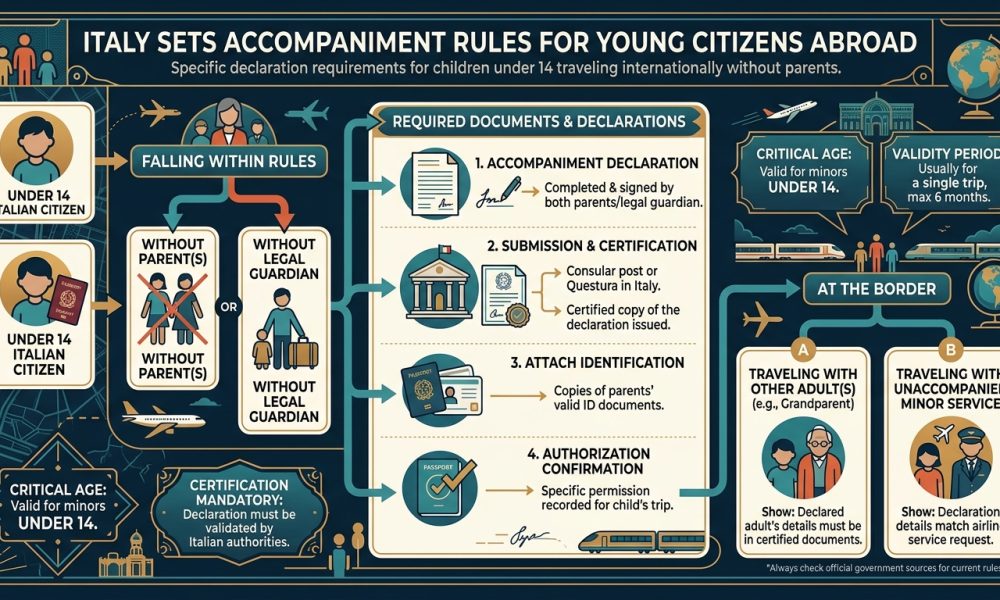
Italian children under 14 traveling internationally without a parent or equivalent legal representative fall within specific accompaniment declaration requirements.
WASHINGTON, DC, October 15, 2026 — Italian children under 14 who travel internationally without a parent or other person with equivalent legal authority may be required to carry an officially endorsed accompaniment declaration, establishing a child-protection procedure that differs substantially from the rules governing ordinary travel with either parent.
The requirement, known in Italy as the Dichiarazione di Accompagnamento, applies specifically to Italian minors below the designated age threshold and provides a formal mechanism for identifying the adults, organizations, or transportation companies entrusted with their care during an international journey.
Official guidance from Italy’s Ministry of Foreign Affairs and the Polizia di Stato confirms that children traveling with at least one parent or legally recognized representative generally do not require this additional declaration, correcting the misconception that every Italian child traveling with only one parent must obtain separate authorization.
For Italian-American families, dual-national children, and households maintaining connections between Italy and the United States, understanding these distinctions can prevent unnecessary paperwork while ensuring that international journeys involving grandparents, relatives, school groups, or unaccompanied travel satisfy the applicable legal requirements.
The Italian framework also illustrates a broader international trend toward separating passport Identification from parental travel permission, allowing authorities to recognize legitimate family arrangements while maintaining additional safeguards when young children travel without their legally responsible adults.
Italy’s Accompaniment Declaration Has a Specific Legal Purpose
Italy’s accompaniment declaration establishes who is responsible for an Italian child under fourteen when that child travels internationally without a parent or equivalent legal representative.
According to the Italian Ministry of Foreign Affairs’ official passport and accompaniment guidance, the declaration must identify the person, organization, or transportation company responsible for the minor and receive endorsement from the competent Italian authority.
The procedure reflects Italy’s passport legislation and aims to strengthen protections against unauthorized international movement while facilitating legitimate family, educational, and recreational travel.
Unlike a general parental consent letter prepared informally, Italy’s declaration involves an officially recognized authorization procedure administered through designated police offices or Italian diplomatic and consular authorities.
The requirement should therefore be understood as a specific legal safeguard for qualifying Italian children rather than a universal documentation rule affecting every foreign minor traveling through Italy.
The Age Threshold Is Under Fourteen
Italy’s framework focuses on minors who have not yet reached their fourteenth birthday, creating an important distinction between younger children and older teenagers traveling internationally.
An Italian child aged thirteen generally falls within the accompaniment declaration requirements when traveling abroad without a parent or legally equivalent representative. In contrast, a child who has already turned fourteen is not subject to that particular requirement.
However, reaching fourteen does not eliminate standard passport, immigration, airline, or destination-specific entry requirements, and some transportation companies maintain separate restrictions for unaccompanied minors.
For example, a fifteen-year-old Italian citizen may travel without the Italian accompaniment declaration but still encounter an airline policy governing passengers younger than sixteen.
Parents should therefore distinguish the statutory Italian age threshold from the different ages airlines and foreign immigration authorities use when assessing young travelers.
Traveling With Either Parent Generally Requires No Declaration
Italy expressly exempts children under fourteen from the accompaniment declaration requirement when they travel internationally with at least one parent or another individual legally exercising equivalent parental authority.
A mother traveling from Italy to the United States with her child generally does not need a declaration simply because the father remains in Italy, provided the accompanying parent possesses the necessary legal authority.
The same principle applies to a father traveling with the child without the mother, subject to applicable custody decisions and any legal restrictions affecting the proposed international journey.
The Italian Polizia di Stato’s official guidance on accompaniment declarations confirms that travel with one parent does not ordinarily require attaching a declaration to the child’s passport.
This distinction matters for separated families because Italy does not automatically treat a parent’s absence as requiring the same authorization procedure used for travel with unrelated adults.
Legal Representatives Can Qualify for the Parental Exemption
Italian law recognizes that a legally authorized representative, not just a biological parent, may exercise responsibility for a child, making the accompanying adult’s legal status important.
A child traveling with a legally recognized guardian or another individual exercising equivalent authority may qualify for the exemption that ordinarily applies when a parent accompanies the journey.
However, grandparents, relatives, family friends, and other familiar adults do not automatically possess that legal authority merely because they have established relationships with the child.
When guardianship arises through a judicial decision, documentation may be needed to establish the adult’s authority if questions arise during international travel.
Families should therefore distinguish recognized legal responsibility from informal caregiving arrangements before assuming that a child qualifies for the accompanying-parent exemption.
Grandparents and Relatives May Need Official Authorization
An Italian child younger than fourteen traveling internationally with grandparents, an aunt, an uncle, or another adult who does not exercise parental authority generally requires an accompaniment declaration.
The document identifies the person entrusted with the child’s care and confirms that a legally authorized person has approved the arrangement.
For example, a child traveling from Rome to New York with grandparents may require the declaration even when the accompanying adults are close relatives, and the child’s parents fully support the journey.
This requirement differs from a child traveling directly with either parent, showing why the accompanying adult’s identity and legal status matter.
Families should not rely exclusively on proof of biological relationship when the law requires an officially endorsed declaration identifying the person responsible for accompanying the minor.
Parents Can Identify Up to Two Alternative Accompanying Adults
Italy allows parents or legal guardians to name up to two individuals in an accompaniment declaration, offering flexibility when travel arrangements involve alternative adults who may accompany the child.
However, the two identified individuals serve as alternatives, not as automatic authorization for both to exercise responsibility simultaneously under the same arrangement.
This provision can help when families expect either of two relatives to accompany the child, depending on transportation schedules or other legitimate circumstances.
The Application must nevertheless accurately identify the relevant adults and satisfy the requirements established by the competent Italian authority.
Parents should verify that the final journey matches the authorization issued, rather than assuming an approved declaration permits any adult to accompany the child without further review.
An Organization or Airline Can Be Named Instead
Italy’s accompaniment framework also recognizes circumstances in which a young child is entrusted to an organization or transportation company rather than to an individually identified adult.
This arrangement applies to qualifying travel organized through educational institutions, youth programs, or airlines that accept responsibility for an unaccompanied minor under their established procedures.
When the child is entrusted to an organization or transportation company, Italian guidance requires a separate official certificate rather than recording accompanying individuals directly in the passport.
Parents should confirm that the relevant organization or airline accepts the proposed responsibility before arranging travel, particularly because carriers establish their own eligibility and supervision policies.
An officially endorsed declaration does not compel an airline to accept an unaccompanied child when the passenger falls outside the company’s permitted age range or operating procedures.
Accompaniment Declarations Are Usually Limited to One Journey
Italian accompaniment declarations are generally issued for one specific journey, which can include the outward and return portions of an authorized international trip.
The authorization must identify the intended destination and can only remain valid for more than six months, preventing families from treating a single declaration as unrestricted permission for indefinite international travel.
This approach differs from countries that allow broader parental travel authorizations to remain valid for the duration of a child’s passport.
An Italian child regularly traveling abroad with relatives may therefore need updated declarations for subsequent journeys when the earlier authorization no longer covers the relevant itinerary.
Parents should examine the validity dates, destination, and accompanying arrangements carefully before booking additional travel using previously issued documentation.
Italy Allows Passport Notation or a Separate Certificate
Italian authorities offer two ways to record an accompaniment authorization when the child is entrusted to specified individuals: families can request either a passport notation or a separate official certificate.
Under the first option, the competent authority can record the accompanying person’s identity and relevant journey details within the child’s passport, linking the permission directly to the travel document.
Under the second option, the authorities issue a separate attestazione di accompagnamento, which the child carries alongside the passport or other valid international travel document.
The choice depends on the applicable circumstances and administrative procedures, while arrangements involving organizations or transportation companies generally require the separate certificate.
Both approaches establish official travel authorization rather than relying solely on an informal letter signed by a parent.
Italian Police and Consulates Validate the Authorization
In Italy, the competent Questura, or provincial police headquarters, handles the endorsement and issuance procedures for accompaniment declarations for qualifying minors.
For Italian children residing abroad, the relevant Italian embassy or consulate may provide the same service, allowing families to obtain authorization without traveling to Italy solely to process documents.
Italian diplomatic missions publish Application instructions identifying the forms, supporting identity documents, and submission procedures applicable within their consular jurisdictions.
The process may involve email or other authorized electronic channels, although personal attendance and signature Authentication may be necessary in certain circumstances.
Families should therefore consult the competent office rather than assuming procedures announced by one consulate automatically apply the same way at every Italian diplomatic mission worldwide.
Applications Require Identification and Travel Information
The accompaniment declaration process generally requires Identification of the child, the parents or legally responsible individuals, and the person or organization entrusted with accompanying the minor.
Supporting documents may include the child’s passport, parental Identification, the accompanying adult’s travel document, and transportation Information establishing the proposed international itinerary.
Italy’s diplomatic missions may request additional documentation or Authentication, depending on the parents’ nationalities and the circumstances under which they provide consent.
The Information must match the actual travel arrangements because authorities use the declaration to identify who is authorized to accompany the child during the specified journey.
Parents should ensure that copies of documents remain readable and that identifying details match valid passports before submitting the Application.
Italian-American Families Can Apply Through Consulates
Families living in the United States or Canada may obtain the required authorization through the Italian diplomatic or consular office responsible for their place of residence.
For example, the Italian Embassy in Washington publishes procedures for qualifying Italian children under fourteen who are registered abroad and intend to travel without their parents.
The embassy requires documentation identifying the parents, child, and accompanying adult, along with relevant flight Information, and sets out procedures for parental signatures and issuing the official certificate.
These arrangements are particularly relevant for Italian-American children with dual citizenship who maintain family connections that require international travel with grandparents or other relatives.
Families should use the consulate responsible for their jurisdiction and verify current submission instructions before making travel commitments.
Dual Citizenship Does Not Automatically Remove Italian Obligations
Children holding both Italian and American citizenship may be subject to Italy’s accompaniment declaration framework when traveling internationally without an adult exercising parental authority.
An American passport does not automatically eliminate obligations arising from legally recognized Italian citizenship, especially when Italian authorities review the child’s departure arrangements.
However, the required documentation can depend on the journey, the child’s citizenship status, and the passport or other travel document presented at border control.
Families should not assume that dual nationality gives them unrestricted freedom to disregard the child Protection procedures established by either country.
If questions arise about Italian nationality or the appropriate travel document, guidance from the responsible Italian consulate can clarify the applicable legal arrangements.
Passport Issuance Consent Is a Separate Procedure
Italy distinguishes authorization to issue a passport to a minor from authorization for that child to travel internationally with someone who lacks parental authority.
The passport Application procedure ordinarily requires consent from individuals exercising parental responsibility, subject to legal exceptions and procedures for circumstances involving unavailable or nonconsenting parents.
An accompaniment declaration addresses a different question: who has permission to accompany an Italian child under fourteen on a particular international journey.
A child may therefore possess a fully valid Italian passport yet require additional accompaniment authorization when traveling with grandparents or another qualifying adult.
This distinction prevents families from assuming that parental permission granted during passport issuance automatically authorizes every future international travel arrangement.
Italy Uses Individual Passports for Children
Italy requires minors traveling internationally to possess their own valid travel documents, rather than relying on Identification details recorded inside a parent’s passport.
The Ministry of Foreign Affairs explains that children may travel using individual passports or qualifying identity cards recognized for international travel by the destination.
Italian passport validity also varies according to age, with shorter validity periods generally applying to younger children than to adult passport holders.
Parents should examine passport expiration dates independently from accompaniment declaration validity because the two documents serve different purposes and may expire at different times.
A valid accompaniment certificate cannot replace an expired passport, and a valid passport does not eliminate the declaration requirement when the child’s travel arrangements fall within the relevant Italian rules.
Parental Details in Passports Help Establish Relationships
Italy permits parents or guardians to request that their names appear in a minor’s passport, providing an additional reference that can help authorities identify the relationship between a child and accompanying adult.
When parental Information does not appear in the document, Italian guidance recommends carrying appropriate family registration or birth records when border authorities may need to establish the relationship.
This approach complements the broader use of parental Identification features in modern passports, including Mexico’s incorporation of additional family Information within documents issued to children.
Amicus International Consulting examined these developments in Mexico’s Children’s Passports Include Parents’ Photos to Strengthen Travel Security, describing how supplementary parental Identification can support international document examination.
However, including parental details in a passport does not automatically replace Italy’s accompaniment declaration when a child under fourteen travels without a person exercising parental authority.
Foreign Destinations May Apply Separate Requirements
Italy’s accompaniment declaration establishes permission under its own framework, but it does not automatically satisfy every parental consent or child travel requirement another jurisdiction imposes.
For example, a child traveling from Italy to the United States must still meet applicable U.S. entry and nationality documentation rules, along with any airline requirements governing unaccompanied minors.
Other countries may require additional parental consent evidence, recognize specific guardianship documentation, or impose different rules based on nationality and residence.
Families should therefore examine the entire itinerary, including transit countries and return arrangements, rather than treating the Italian declaration as universally sufficient.
The appropriate preparation depends on the child’s citizenship, age, destination, legal guardianship arrangements, and the identity of the person responsible during each portion of the journey.
Court Orders Can Affect International Travel Permission
Italy’s accompaniment declaration does not override binding custody orders, guardianship decisions, or judicial restrictions that limit the circumstances under which a child may travel internationally.
Where parental authority is disputed, the competent judicial or administrative authority may need to address the disagreement before a lawful international travel arrangement can proceed.
An otherwise complete declaration should not be interpreted as permission to disregard restrictions arising from family-law proceedings or decisions concerning parental responsibility.
Parents in custody disputes or when relocating internationally should seek appropriate legal guidance before relying on standard travel authorization procedures.
These distinctions matter because consent for a temporary journey and permission to relocate a child’s habitual residence abroad are not necessarily legally equivalent.
The Rules Support Child Protection Without Restricting Ordinary Parental Travel
Italy’s system distinguishes between young children traveling under direct parental supervision and those entrusted to other individuals or organizations, recognizing that different circumstances can justify different documentation requirements.
The exemption for travel with either parent reduces unnecessary administrative burdens on ordinary families. At the same time, the accompaniment declaration establishes a formal record when a child travels without someone holding parental authority.
The under-fourteen threshold also creates a clear legal category, allowing families to determine when this authorization is required without treating every teenager the same way.
However, the framework operates alongside destination-specific immigration rules and commercial transportation policies that may impose separate requirements.
Accurate public understanding helps preserve the intended child Protection safeguards without creating unnecessary documentation obligations for families whose journeys fall within recognized exemptions.
Conclusion: Italy’s Rules Depend on Age and Accompaniment
Italy’s accompaniment declaration provides a specific child travel safeguard for Italian citizens under fourteen who travel internationally without a parent or other legally recognized representative.
The procedure generally requires an officially endorsed declaration identifying the accompanying person, organization, or transportation company, with authorization ordinarily limited to one journey and a maximum period of six months.
Children traveling with either parent or someone with equivalent legal authority generally do not need the declaration, so blanket claims that consent documentation is required for every single-parent journey are inaccurate.
For Italian-American families and other internationally mobile households, understanding the distinctions between passport issuance, parental authority, accompaniment authorization, and destination requirements can reduce unnecessary administrative difficulties.
Ultimately, reliable preparation requires confirming the child’s nationality and age, identifying the accompanying adult’s legal status, and obtaining the appropriate Italian documentation when the proposed journey falls under the accompaniment declaration framework.




