
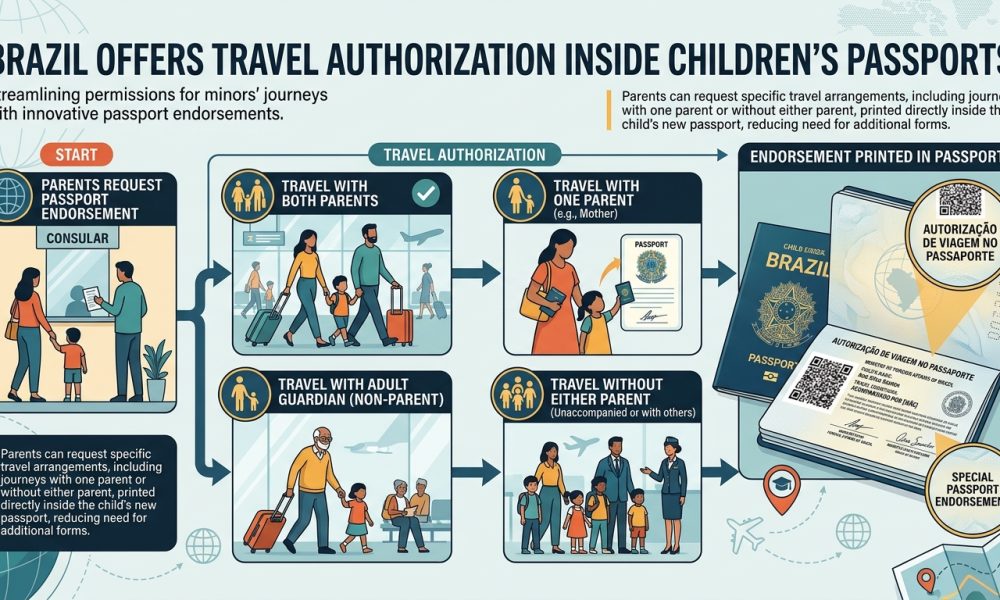
Parents can request passport endorsements that permit specific travel arrangements, including journeys with one parent or without either parent.
WASHINGTON, DC, October 15, 2026 — Brazil offers an important alternative to separate parental consent letters for international child travel, allowing parents and legally authorized guardians to request that passports issued to Brazilian minors include specified travel permissions printed inside.
The system lets families choose between authorization for a child to travel internationally with either parent and broader authorization allowing the child to travel without parental accompaniment, provided the appropriate permission is obtained during the passport Application process.
Unlike countries that depend primarily on separate consent documents, Brazil incorporates the selected authorization into the passport’s Identification page, allowing immigration authorities to examine the child’s identity and approved travel arrangements within a single official document.
The procedure is particularly relevant for Brazilian-American families, dual-national children, separated parents, and households in which minors regularly travel with one parent, relatives, school groups, or other responsible adults.
However, the authorization is not automatic, and parents must distinguish permission to issue a child’s passport from permission for international travel, because choosing the wrong option can create additional documentary requirements at departure.
Brazil Combines Passport Identification With Travel Permission
Brazil’s Federal Police administers the country’s standard passport issuance procedures, including applications for children under eighteen and authorization from individuals with parental authority.
Under the government’s framework, parents can authorize international travel permission within the passport itself, allowing the document to serve an additional administrative function beyond proving the child’s identity and nationality.
According to the Brazilian Federal Police’s official guidance on passports and travel authorization for minors, families can request different authorization categories that match the arrangements they intend to allow during the passport’s validity.
The government distinguishes between permission for a child to travel with either parent and broader permission covering independent travel, and it also allows families to request a passport without embedded travel authorization.
These options provide flexibility while preserving the principle that adults holding the relevant parental authority must approve the international travel arrangements recorded in the document.
Three Passport Application Options Are Available
BRAZILIAN PASSPORT OPTIONS FOR MINORS
Type 1: Travel with either parent
The passport authorizes international travel with either parent, without requiring both parents to accompany the child.
Type 2: Unaccompanied travel
The passport includes broader authorization, permitting the child to travel internationally without either parent and with either parent.
Type 3: No embedded travel authorization
The passport is issued without this permission, so the child may need separate authorization to travel without both parents.
The selected category must be expressly authorized during the passport Application process, subject to applicable legal restrictions.
Brazil’s approach lets parents consider the child’s foreseeable travel arrangements before the passport is issued, rather than preparing identical parental consent documentation for every subsequent journey.
The distinctions also make it important to select the correct category because the permission recorded in the passport determines whether additional documentation may be necessary at the Brazilian departure border.
Type 1 Allows Travel With Either Parent
Type 1 authorization allows a Brazilian minor to depart internationally with either parent, without requiring both parents to be physically present during the journey.
The authorization is not limited to a specifically named mother or father, so travel with either legally recognized parent falls within the permission established when the passport was issued.
This arrangement can be particularly useful for families with different work schedules, parents who live in separate countries, or parents who regularly accompany their children on different international journeys.
For example, a child may travel abroad with one parent during a school holiday and then travel with the other parent, provided the authorization remains valid and no separate legal restriction applies.
However, Type 1 does not provide the broader permission needed for a child to travel without parental accompaniment, making Type 2 relevant for families anticipating independent travel.
Type 2 Permits Broader International Travel Arrangements
Type 2 authorization offers greater flexibility because it lets the child travel internationally without either parent, while also allowing journeys with one parent under the same passport permission.
This arrangement may suit families whose children travel with grandparents, attend international educational programs, participate in organized sporting activities, or travel independently with appropriate transportation arrangements.
The authorization does not replace airline supervision policies or foreign immigration requirements, but it addresses Brazil’s ordinary parental travel permission requirement within the scope the government specifies.
Parents should carefully consider the scope of this permission because Type 2 authorizes broader travel arrangements than Type 1, including situations where neither parent accompanies the minor.
The decision should reflect the family’s genuine intentions and legal responsibilities, not the assumption that the broadest authorization is automatically the most appropriate choice.
Type 3 Preserves the Separate Consent Procedure
Parents who do not want to include travel authorization in the child’s passport can select Type 3, allowing the passport to be issued without additional international departure permission.
In this situation, the child may need a separate, valid travel authorization to depart Brazil without both parents, unless another recognized legal exception or authorization applies.
This option can suit families who prefer to approve specific international journeys individually rather than grant broader permissions that last throughout the relevant passport’s validity.
However, selecting Type 3 can create additional administrative steps when a child later needs to travel with only one parent or with another accompanying adult.
Families should therefore understand the practical consequences before completing the Application, since the decision determines which departure documentation may be necessary during future journeys.
Authorization to Issue a Passport Is Not the Same as Authorization to Travel
Brazil distinguishes between parental permission to issue a minor’s passport and permission for that child to undertake international journeys without both parents present.
The passport issuance authorization is required during the Application process, while international travel authorization addresses the circumstances under which the minor may subsequently depart Brazilian territory.
A parent who signs documents authorizing passport issuance has not necessarily approved inclusion of one of the travel permissions unless the chosen authorization category is expressly identified.
Brazilian Federal Police instructions therefore require applicants seeking an embedded endorsement to specify the appropriate category in the passport Application authorization.
This distinction prevents families from assuming that every passport issued to a Brazilian minor automatically permits travel with one parent or without parental accompaniment.
The Authorization Appears on the Passport Identification Page
Brazil’s system allows the selected international travel authorization to be printed on the passport Identification page, giving border authorities an official record of the permission established at issuance.
This approach differs from carrying a separate notarized consent letter for every journey because the authorization accompanies the document that establishes the child’s nationality and identity.
The arrangement can simplify document presentation when the child’s planned travel falls within the selected permission, particularly where the accompanying parent would otherwise need to obtain fresh consent documentation.
However, an embedded authorization does not mean every international destination recognizes the same parental permission rules or that unrelated custody restrictions no longer apply.
The passport endorsement specifically addresses the Brazilian international departure authorization framework, so you must review the requirements of other countries involved in the itinerary.
Both Parents Normally Participate in the Authorization Decision
Brazilian passport procedures generally require the consent of the parents or individuals with parental authority before issuing a passport to a minor, with different documentary procedures available when one parent cannot attend the appointment.
When both parents attend the Federal Police appointment, they can ordinarily sign the appropriate Application authorization in the presence of the responsible official and indicate whether to include an international travel endorsement.
If only one parent attends, the absent parent may provide consent through an appropriately executed form, recognized signature, specific power of attorney, or another legally accepted procedure.
Brazilian law also recognizes circumstances involving sole parental authority, judicial authorization, deceased parents, and legally appointed guardians, requiring documentation appropriate to the particular family situation.
Parents should therefore distinguish a routine Application involving two available legal decision-makers from circumstances requiring evidence that one individual possesses authority to act without the other’s consent.
The Child Must Attend the Passport Appointment
Brazilian Federal Police guidance requires minors to attend the passport Application appointment so that officials can conduct the Identification procedures associated with issuing the travel document.
This requirement includes infants and young children, even when parents have already completed the required Application forms and provided documentary evidence establishing the child’s identity.
Accompanying adults must also meet the applicable Identification and authorization requirements, depending on the child’s age and who is legally responsible for the Application.
For children younger than sixteen, the government generally requires a parent or legally responsible adult to be present, while qualifying applicants aged sixteen or seventeen may follow specified procedures involving parental authorization.
Families should confirm these appointment requirements before attending because a properly completed travel authorization form does not, by itself, eliminate the government’s identity verification procedures.
Embedded Authorization Can Remain Valid Throughout the Passport’s Life
Brazil’s Federal Police explains that international travel authorization printed in a minor’s passport generally remains effective during the document’s validity period, provided the permission has not been canceled or otherwise affected by a relevant legal decision.
This can reduce the need to prepare new consent documentation for repeated journeys that fall within the approved authorization category.
The benefit is particularly significant for families whose children travel regularly between Brazil and another country, including households maintaining legitimate residence, educational, or family connections in both jurisdictions.
However, passport validity periods for Brazilian minors vary by age, so the practical duration of an embedded authorization depends on the document issued to each child.
Parents should therefore check the passport’s expiration date and understand that the authorization does not automatically continue after the document expires or is replaced.
Changing the Authorization Can Require a Replacement Passport
The Federal Police distinguishes changes requested before the passport Application appointment is completed from attempts to alter an authorization after the issuing process is finalized.
According to Brazil’s official instructions, parents can generally choose another authorization category before the Application process is complete, provided they have the required consent and supporting documentation.
However, once the appointment is finalized, you cannot simply modify the selected endorsement in the existing passport through a standard administrative correction.
Government procedures indicate that changing the authorization after issuance may require canceling and replacing the passport, potentially resulting in additional expenses and disruption.
This makes the original selection important because families should consider not only their immediate travel plans but also whether the child may undertake different legitimate journeys during the passport’s validity.
Revoking Authorization Is a Separate Legal Question
Parents sometimes reconsider previously granted travel permission because family circumstances change, a child begins living with another adult, or disputes arise concerning custody and international movement.
Brazil has procedures for canceling travel authorization included in a minor’s passport, but the government distinguishes administrative requests from disputes that require judicial intervention.
The Brazilian Federal Police’s passport regulations set rules for parental authorization, legal guardianship, and including international travel permission in children’s passports.
Cancellation can also affect the underlying passport, so parents should understand the consequences before requesting changes to an existing authorization.
When parents disagree about international travel, a competent court may need to determine their respective rights rather than resolving the dispute solely through passport administration.
Travel Permission Does Not Automatically Authorize Permanent Relocation
An important limitation is the distinction between authorizing international travel and consenting to a child establishing permanent residence in another country.
Brazil’s passport authorization procedures address specific travel arrangements and should not be interpreted as automatically granting permission to relocate or permanently change a child’s habitual residence.
This distinction becomes especially relevant when one parent intends to move internationally with a child while the other parent retains legally recognized parental responsibility.
A passport with Type 1 or Type 2 travel permission does not, by itself, resolve disputes over custody, residence, relocation, or other rights governed by family law.
Parents considering permanent international relocation should therefore seek appropriate legal guidance and obtain any necessary consent or judicial authorization, rather than relying solely on the wording printed in the child’s passport.
Dual-National Children May Face Brazilian Departure Requirements
Children with both Brazilian and American citizenship may face distinct documentary obligations because Brazilian law may recognize them as Brazilian nationals even when they also hold valid United States passports.
A child cannot necessarily avoid Brazilian departure authorization requirements simply by presenting a passport from another nationality, particularly when the relevant rules apply to Brazilian minors leaving the country.
Families should ensure the child’s citizenship status, passport arrangements, and parental travel authorization align with Brazil’s applicable immigration and nationality requirements.
Additional considerations may arise when the child’s parents possess different citizenships or when the child was born abroad and later obtained recognition of Brazilian nationality.
The appropriate documentation depends on the child’s actual legal status, not assumptions based solely on the passport selected for a particular airline reservation.
Foreign Destinations May Require Separate Consent Documents
Brazilian passport endorsements address the country’s departure authorization requirements, but other governments may set different rules for children traveling with one parent, another adult, or without parental accompaniment.
An authorization sufficient for departure from Brazil may therefore not meet a foreign country’s requirements for parental consent, legal guardianship, or proof of the relationship between the child and the accompanying adult.
Likewise, airlines may maintain separate policies governing unaccompanied minors, including supervision arrangements, minimum ages, Identification of receiving adults, and procedures for transferring responsibility after arrival.
Families should review the entire itinerary rather than assume a Brazilian passport endorsement provides universally recognized permission across all immigration jurisdictions.
This distinction matters most for trips involving several countries, where entry, transit, or departure may require additional documentation.
Brazil and Mexico Illustrate Different Passport Security Approaches
Countries continue to develop different methods for incorporating family Information and child Protection safeguards into official travel documents, reflecting distinct legal objectives and administrative practices.
Brazil’s approach allows a specified parental travel permission to appear in the child’s passport. At the same time, Mexico has introduced passport features that include additional Identification Information about parents or legally recognized guardians.
Amicus International Consulting examined Mexico’s approach in Mexico’s Children’s Passports Include Parents’ Photos to Strengthen Travel Security, discussing how parental Identification details can help verify family relationships during international travel.
This distinction matters because identifying parents in a passport is not legally equivalent to recording their authorization for specific international journeys.
Brazil’s endorsement addresses specified departure permission, whereas supplementary parental photographs or names primarily support Identification and should not be assumed to replace consent documents wherever those documents remain legally required.
Electronic Passport Authentication Does Not Replace Legal Permission
Modern electronic passports include security features intended to establish document Authenticity and support identity verification. Still, these technologies serve functions different from parental consent and legal travel authority.
A border officer may successfully authenticate a Brazilian child’s electronic passport yet still need to determine whether the proposed journey aligns with its printed authorization and any other applicable legal restrictions.
Similarly, a passport’s biometric and digitally protected Information does not independently establish that an accompanying adult possesses custody or guardianship rights under the relevant family law.
The relationship between identity verification and travel permission therefore remains important even when both categories of Information appear within the same physical passport.
A secure document supports reliable examination, but lawful international movement still depends on the legal authority and entry conditions that apply to the specific journey.
Families Should Choose Authorization Based on Actual Travel Needs
Parents applying for Brazilian passports should consider whether their children will travel only with both parents, with either parent alone, or independently under legitimate supervision arrangements.
Type 1 may offer flexibility for families whose children routinely travel with one parent, while Type 2 provides broader permission when independent international travel is anticipated and legally authorized.
Type 3 remains available for families who prefer a passport without embedded travel permission, although separate authorization may later be needed when the child travels without both parents.
Make these decisions with an understanding of parental responsibility, applicable court orders, the child’s maturity, and the practical arrangements for future travel.
The objective is to select an authorization that reflects legitimate family needs without misunderstanding the scope or legal consequences of the permission granted.
Conclusion: Brazil Provides a Distinctive Passport-Based Consent Option
Brazil’s passport system offers families a practical way to document international travel permission for minors, allowing qualifying parents and guardians to select specific authorizations printed directly in the child’s official travel document.
Options include travel with either parent, broader permission for unaccompanied journeys, and passports issued without embedded travel authorization, giving families different approaches based on their legal circumstances.
However, passport issuance remains distinct from international travel authorization, and custody orders, foreign entry requirements, and permanent relocation restrictions continue to operate independently.
For Brazilian-American families and other households managing international child travel, understanding these distinctions can simplify legitimate journeys while preserving safeguards intended to prevent unauthorized removal of minors.
Ultimately, Brazil’s system demonstrates how passport issuance and parental travel authorization can be integrated within one official document without eliminating the need to respect family law, child Protection measures, and destination-specific immigration requirements.




