
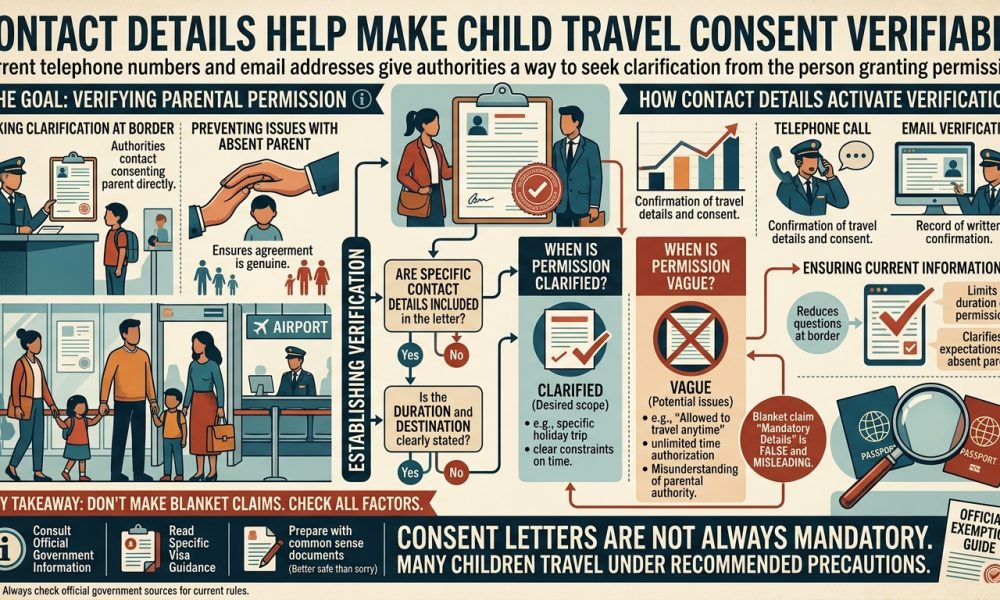
Current telephone numbers and email addresses allow authorities to contact the person granting permission for clarification.
WASHINGTON, DC, October 15, 2026 — Parents preparing international travel consent letters for children should include reliable contact Information for the individuals granting permission so border authorities and transportation personnel can seek clarification when questions arise about the child’s accompanying adult, intended destination, or authorized travel arrangements.
Although parental consent letters are not universally required for every international journey, government guidance recognizes that identifying the consenting adults and providing practical ways to contact them can help establish whether a child is traveling with appropriate permission.
Canadian authorities specifically recommend including contact Information for parents and other individuals with decision-making responsibility. At the same time, separate border guidance identifies addresses and telephone numbers as useful when officials need to contact an absent parent or guardian.
For American and Canadian families, these recommendations matter most when children travel with one parent, grandparents, other relatives, school groups, or adults whose legal relationship to the minor may not be immediately apparent from their passports.
However, a telephone number or email address does not independently establish legal authority, and travelers should distinguish contact details that facilitate verification from documents proving parental relationships, custody rights, or legally required departure permission.
Contact Information Makes a Consent Letter More Useful
A child travel consent letter shows that someone with the necessary parental or legal authority has approved a specific trip, usually identifying the child, accompanying adult, destinations, and intended travel dates.
Including current contact Information gives officials a practical way to seek clarification when the document raises legitimate questions about the signatory’s identity or the arrangements being authorized.
According to the Government of Canada’s official guidance on parental travel consent letters, a recommended letter usually includes the names and contact Information of parents or other individuals possessing decision-making responsibility.
The guidance also recommends identifying the accompanying adult and providing that person’s address and contact Information, helping establish who will be responsible for the child during the journey.
These details can make a declaration clearer and more practical, although the Canadian recommendation does not create a universal legal obligation to include identical Information in every international travel authorization.
Canadian Border Guidance Specifically Mentions Telephone Numbers
Canada’s border authorities recognize that adults accompanying children may be asked questions concerning the child’s identity, family relationships, and permission to travel internationally.
The Government of Canada’s guidance on entering Canada advises adults who are not parents or legal guardians to carry written permission that includes addresses and telephone numbers where the child’s parents or guardians can be reached.
This recommendation is particularly relevant when grandparents, family friends, or other adults accompany children across the Canada–United States border without either parent present.
A reliable telephone number can help officers who need additional Information, but contact details do not mean every traveler will be questioned or that officials must call.
Families should therefore view contact Information as a useful verification measure rather than an automatic requirement for a real-time conversation with the absent parent.
The Consenting Parent Should Be Clearly Identified
A useful consent letter should identify the parent or guardian granting permission by full legal name so that the declaration can be linked to the individual responsible for the child.
The letter may also explain the signatory’s relationship with the minor, particularly where the adult is a legal guardian, adoptive parent, or another person exercising decision-making authority under applicable law.
Where both parents possess relevant authority but neither accompanies the journey, the declaration may identify both individuals and provide separate contact Information for each.
These details help distinguish genuine parental permission from a document signed by someone who merely knows the child but lacks authority to authorize international travel.
However, identifying a parent by name does not automatically establish legal responsibility, particularly when court orders or other family-law arrangements allocate decision-making powers differently.
International Telephone Numbers Should Include Country Codes
A consent letter intended for international use should generally provide telephone numbers in a format that can be understood and dialed from the countries involved in the journey.
Including the international country code can reduce uncertainty, especially when the absent parent remains in North America while the child travels through Europe, Asia, or another region.
A number written only in a local format may be harder for a foreign official to use without additional Information concerning the appropriate dialing prefix.
Families should also confirm that the telephone number remains active and that the consenting individual understands when the child is expected to travel.
Although Canadian guidance does not prescribe one universal international telephone format, providing a clearly identifiable number supports the practical purpose of making the consenting person reachable.
Email Addresses Can Provide an Additional Communication Channel
An email address can supplement telephone contact details by allowing an official or transportation representative to communicate with the person granting permission when immediate telephone contact is unavailable.
Email may be especially useful when the consenting parent is traveling, working irregular hours, or living in a country where international telephone calls are difficult to arrange.
However, an email address alone does not prove a declaration is authentic, because individuals other than the person identified as the sender can create or access electronic accounts.
Officials may therefore require additional Identification, legally recognized authorization documents, or other evidence rather than relying solely on an exchange of electronic messages.
Families should treat email as an optional, practical addition unless a particular government’s official form specifically requires it, since contact-information standards differ between jurisdictions.
Contact Details Should Remain Current Throughout the Journey
A consent letter prepared several weeks before departure may contain Information that becomes outdated if a parent changes telephone numbers, moves residence, or replaces an email account.
Parents should therefore review the contact Information shortly before the child travels, particularly when the journey involves several countries or a prolonged period away from home.
If a significant change occurs after the declaration is signed, an updated letter may provide clearer Information, subject to any official requirements governing the authorization.
An outdated contact number does not automatically invalidate a consent document, but it can reduce the letter’s usefulness if officials need clarification.
Keeping Information accurate supports the practical purpose of the declaration without expanding the scope of permission the parent or guardian originally granted.
Families Should Consider Availability Across Time Zones
International journeys can involve substantial time differences between the child’s destination and the country where an absent parent or guardian remains.
A parent in Vancouver may be asleep when a child arrives at a European airport, while another parent working overnight may be hard to reach during normal business hours.
Families can reduce potential communication difficulties by ensuring that the consenting parent knows the approximate travel schedule and understands that officials may seek clarification.
However, parents should not assume they must remain continuously available or answer every unexpected call, since government verification requirements depend on the jurisdiction and circumstances.
A written declaration with accurate Identification, contact details, and authorized travel arrangements remains useful even when immediate communication is not possible.
The Accompanying Adult Also Needs Reliable Contact Details
The consent letter should identify the adult accompanying the child and provide contact Information so that person can be reached during the authorized journey.
This is especially important when the child travels with grandparents, school representatives, family friends, or other adults without ordinary parental authority.
Canada recommends including the accompanying adult’s full name, address, contact Information, and relationship to the child to help authorities understand who is responsible for the minor.
When several adults accompany different parts of the journey, families may need additional details explaining the handover arrangements or separate letters covering the relevant travel segments.
Clear Identification helps avoid uncertainty about who can accompany the child without implying that every named adult automatically has legal guardianship.
Travel Dates and Destinations Give Contact Information Context
Telephone numbers and email addresses become more meaningful when they appear alongside accurate Information concerning the child’s destination, intended departure date, return date, and accompanying adult.
A consent letter should clearly state which journey the parent has authorized, rather than providing contact Information without explaining the circumstances under which permission applies.
For example, an authorization for a two-week holiday with grandparents should identify the relevant travel period and destination so that any questions can be considered within the intended arrangements.
If the family substantially changes its itinerary, updated permission may be appropriate, particularly if a different adult will accompany the child or the journey extends beyond the originally approved period.
Clear travel details and reliable contact Information therefore serve complementary purposes: one explains the permission granted, and the other helps authorities seek clarification when necessary.
Separated Parents May Have Different Contact Arrangements
Separated or divorced parents may live in different residences, have different telephone numbers, and use different communication arrangements, so a consent letter should identify the person with the relevant legal authority.
Where parents share decision-making responsibility, Canadian guidance recommends obtaining consent from an absent parent whenever possible and safe, even when a parenting order permits one parent to make travel decisions.
However, an existing court order may restrict communication, prohibit contact between particular individuals, or assign decision-making responsibility in ways that make ordinary consent arrangements inappropriate.
Families should not interpret recommendations about contact Information as permission to disregard protective orders or disclose confidential personal details that conflict with binding legal arrangements.
If providing an absent parent’s contact Information would be unsafe or legally inappropriate, qualified family-law advice can help determine what documentation suits the proposed journey.
Court Orders Can Help Establish Who Has Authority
A consent letter may include accurate contact Information but may not establish whether the person signing has legal authority to permit international travel, especially when a court governs parental responsibilities.
Canadian authorities recommend carrying relevant parenting orders or agreements because those records can explain the legal relationship between the child, the accompanying adult, and absent decision-makers.
Some orders grant one parent exclusive authority over international travel, while others require consent from both parents or impose restrictions concerning destinations, advance notice, and return dates.
Where such an order exists, the consent letter should align with its terms rather than suggest that ordinary contact details or an additional signature can override a judicial restriction.
The central consideration is whether the individual granting permission has authority under the applicable law, not simply whether someone can reach them by telephone.
Notarization Helps Address a Different Verification Question
Families sometimes assume that providing current contact details eliminates the need for notarization, although the two measures address different aspects of a consent document’s reliability.
Contact Information lets officials try to reach the person granting permission, while notarization can provide additional evidence of the identity of the person who executed the declaration.
Canada strongly recommends that a notary public witness a travel consent letter, but it does not impose a universal Canadian legal requirement to notarize every such letter.
Other governments may prescribe notarization, legalization, official forms, or other Authentication procedures, making their requirements more specific than Canada’s general recommendations.
Families should therefore confirm whether formal Authentication is legally required for the intended journey, rather than assuming that notarization or accessible contact Information automatically satisfies every jurisdiction.
A Phone Conversation Does Not Replace Required Exit Permits
Some countries maintain formal departure authorization systems for specified children traveling without parents or legally recognized guardians, requiring official documentation regardless of whether an absent parent can be reached.
France’s AST procedure, Mexico’s SAM system, and Italy’s accompaniment declaration framework show how governments can set different requirements based on age, nationality, residence, and the adult accompanying the child.
An immigration officer’s ability to contact a parent does not automatically eliminate an official form, government endorsement, or judicial authorization that the applicable law expressly requires.
Likewise, an ordinary letter containing multiple telephone numbers may be insufficient when the relevant government requires parental permission to be recorded through its designated administrative process.
Parents should distinguish Information that helps verify a declaration from the separate legal requirements that determine whether the child may depart.
Unaccompanied Children May Need Several Contacts
Children traveling without an accompanying parent or adult may need additional arrangements to identify the individuals responsible for delivering them to an airline and receiving them upon arrival.
Airlines often establish their own unaccompanied-minor procedures, including minimum ages, supervision services, emergency contact Information, and Identification requirements for designated receiving adults.
A parental consent letter may support those arrangements by identifying the person authorizing the journey, but it does not necessarily substitute for the airline’s required forms.
Parents should verify that the receiving adult’s contact numbers remain active and that the individual understands the arrival arrangements, especially when connecting flights or schedule changes are possible.
Consider government and airline procedures separately because an acceptable parental declaration does not automatically authorize a carrier to transport an otherwise ineligible unaccompanied child.
Schools and Organized Groups Need Clear Responsibility
International school trips, athletic competitions, cultural exchanges, and other organized activities can involve numerous children traveling under the supervision of teachers, coaches, or designated group leaders.
Consent letters may identify the responsible organization and accompanying adults and provide parent or guardian contact Information for clarification about a particular child.
However, organizers should distinguish parental permission for international travel from separate authorizations for medical treatment, activity participation, and emergency decision-making.
A school’s general registration record does not necessarily show that the institution has the authority required for international travel under the destination country’s rules.
Accurate consent records and clearly identified responsible adults can help organizations coordinate legitimate travel while avoiding unnecessary disclosure of children’s personal Information.
Different Family Names May Require Relationship Evidence
Parents and children may legitimately have different surnames after marriage, divorce, adoption, or other recognized family circumstances, which may raise questions that cannot be resolved by phone alone.
The United States Department of State recommends carrying a birth certificate or other evidence establishing the legal relationship between the child and accompanying adult during international travel.
Additional records, such as adoption orders, marriage certificates, or legal name-change documents, may be relevant where those circumstances explain differences between Identification documents.
However, proof of a family relationship does not automatically establish permission from every individual possessing legal decision-making responsibility, nor does contact Information independently prove parentage.
Families should therefore distinguish records that establish identity and relationship from documents that demonstrate consent for the specific journey.
Passport Technology Does Not Verify Parental Consent
Modern electronic passports incorporate security technologies intended to authenticate government-issued documents and support verification of the legitimate holder’s identity during international border examinations.
Some countries also include additional family Identification Information inside passports issued to children, potentially helping authorities establish relationships between minors and their parents or guardians.
Amicus International Consulting examined this development in Mexico’s Children’s Passports Include Parents’ Photos to Strengthen Travel Security, describing how supplementary parental Identification can support document examination.
However, a photograph or name in an authentic passport does not automatically show that the identified parent authorized a particular journey or remains available to answer questions.
Passport Authentication, legal parental authority, and communication with absent decision-makers therefore remain separate elements of international child travel verification.
Families Should Protect Children’s Personal Information
Consent letters can contain sensitive Information about children’s identities, family relationships, residential addresses, telephone numbers, email accounts, and planned international travel, so handling them appropriately is especially important.
Parents should include only the Information reasonably necessary to identify the relevant adults and clarify the authorized journey, without automatically providing unrelated financial, medical, or private family documents.
When sharing a letter with an airline, school, or travel organization, families should consider whether the recipient needs a complete copy and how it will be stored.
Parents should also avoid publishing consent letters on public websites or sending Identification records to unfamiliar intermediaries claiming that every international border requires extensive family documentation.
Protecting personal data does not diminish the value of verification, since officials can often obtain necessary clarification through appropriately identified contact details without unrestricted distribution of private records.
Officials May Seek Clarification Without Guaranteeing Acceptance
Canadian guidance recognizes that border officials may ask additional questions or contact an absent parent when a child travels without a consent letter or when uncertainty arises about the journey.
However, including contact Information does not guarantee an official will call, that a call will resolve every concern, or that the child will be permitted to enter or depart.
Authorities may still examine the child’s passport, relevant court orders, evidence of the parental relationship, and any official departure authorization required under applicable law.
A parent who cannot be reached immediately does not automatically establish that the child’s journey is unauthorized, although the practical consequences depend on the destination’s procedures and circumstances.
Families should therefore treat reliable contact details as supporting evidence rather than an unconditional guarantee of acceptance at international border checks.
Conclusion: Contact Information Strengthens Clear Parental Authorization
Current telephone numbers, relevant addresses, and appropriate email contact details can make child travel consent letters more useful by allowing officials to identify and potentially communicate with the individuals granting permission.
Canada’s official guidance specifically recommends including contact Information for parents and accompanying adults, while its border advice emphasizes the importance of telephone numbers parents or guardians can be reached at.
However, contact Information alone does not establish legal parental authority, replace required government departure permits, override court orders, or guarantee that an immigration officer will accept the proposed journey.
For families traveling internationally, the strongest consent documentation clearly identifies the child, the authorized journey, the consenting decision-makers, and the accompanying adult, while remaining consistent with applicable family-law and immigration requirements.
Ultimately, reliable communication details help verify legitimate travel permission, provided families distinguish recommended precautions from legally binding obligations and protect sensitive personal Information in children’s travel documents.




