
Market Overview
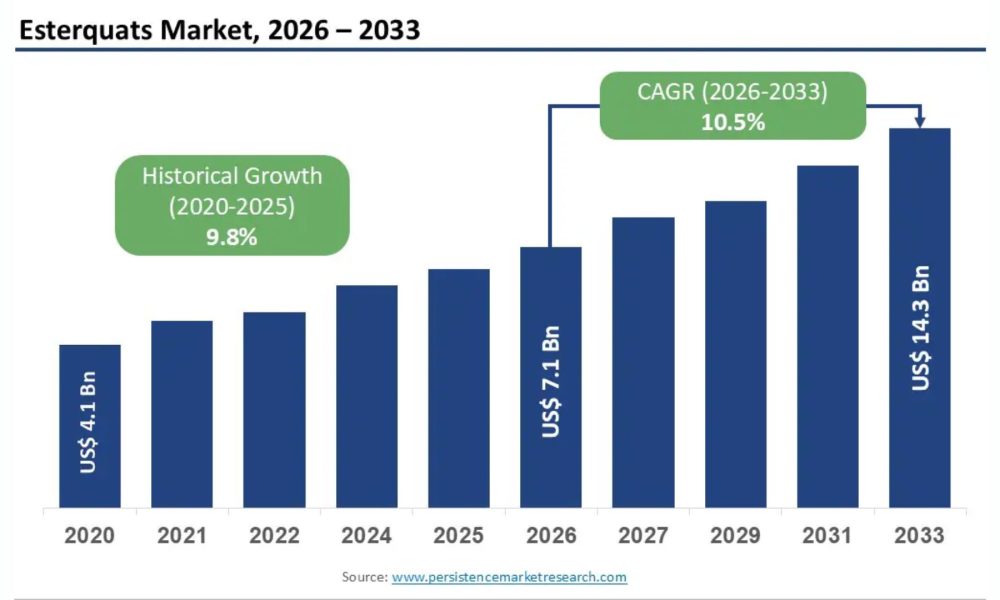
According to insights from Persistence Market Research, the global esterquats market is projected to reach US$ 7.1 billion in 2026 and further expand to US$ 14.3 billion by 2033, registering a robust CAGR of 10.5% during the forecast period.
Esterquats are biodegradable cationic surfactants widely used in fabric softeners, hair conditioners, and personal care formulations. They have emerged as a preferred alternative to traditional quaternary ammonium compounds due to their low toxicity, superior biodegradability, and excellent conditioning performance. The market is witnessing strong growth driven by sustainability trends and increasing demand for premium personal care and household products.
Get Your FREE Sample Report Instantly – Click Now: https://www.persistencemarketresearch.com/samples/23521
Key Market Drivers
Rising Demand for Sustainable Fabric Care Products
A major factor driving market growth is the global shift toward eco-friendly and biodegradable formulations in the fabric care industry. Esterquats are replacing conventional surfactants such as DHTDMAC due to their improved environmental profile and compliance with stringent regulations.
Regulatory frameworks, especially in developed regions, mandate the use of biodegradable surfactants, which has significantly boosted esterquat adoption. Additionally, leading consumer brands are increasingly launching plant-based and concentrated fabric softeners, further strengthening market demand.
Growth of Personal and Hair Care Industry
The expanding personal care sector is another key growth driver. Esterquats are extensively used in hair conditioners, serums, masks, and styling products due to their ability to provide smoothness, softness, and conditioning without a greasy feel.
With rising consumer preference for multifunctional and premium beauty products, esterquats are gaining popularity as essential ingredients in advanced formulations. This trend is particularly strong among younger consumers seeking performance-driven and sustainable personal care solutions.
Market Segmentation Insights
Product Type Analysis
The market is segmented into TEA-quats, MDEA, and others, with TEA-quats holding around 43% market share. This dominance is attributed to their high conditioning efficiency, biodegradability, and wide industry acceptance.
Other variants such as MDEA-based esterquats offer formulation flexibility and are increasingly used in customized applications across personal care and fabric care products.
Form Analysis
Esterquats are available in liquid and solid forms, with liquid variants dominating the market. Their high solubility, ease of formulation, and compatibility with modern detergent and cosmetic products make them highly preferred.
Solid and paste forms are primarily used in niche applications such as dryer sheets and specialized conditioning systems.
Feedstock Trends
The market is categorized into tallow-based and vegetable-based esterquats. Tallow-based variants currently dominate due to superior performance and established supply chains. However, vegetable-based esterquats are gaining traction as companies focus on renewable and sustainable raw materials.
Application Insights
- Fabric care remains the largest application segment, accounting for nearly 50% of total demand.
- Personal care is the fastest-growing segment, driven by rising demand for premium hair and skincare products.
Regional Analysis
Asia Pacific: Fastest Growing Region
Asia Pacific is the fastest-growing market, with countries like China and India witnessing strong demand due to urbanization, rising disposable income, and expanding manufacturing capacity. Growth rates in the region are estimated at over 11–12%, supported by increasing consumption of personal and household care products.
North America and Europe
North America holds a significant share, supported by mature personal care and fabric care industries and strict environmental regulations favoring biodegradable ingredients. Europe also plays a crucial role due to strong regulatory frameworks and high consumer awareness regarding sustainability.
Market Trends
Shift Toward Bio-based Esterquats
The increasing adoption of vegetable oil-based esterquats is a key trend. These products offer comparable performance while supporting sustainability goals and enhancing brand positioning in premium segments.
Innovation in Formulations
Companies are focusing on developing advanced esterquats with improved conditioning efficiency, stability, and compatibility with modern formulations. Innovations are enabling the use of esterquats in a wider range of applications.
Expansion of Manufacturing in Asia
The growth of manufacturing hubs in Asia Pacific is supporting global supply chains and reducing production costs. Strategic collaborations between global and regional players are accelerating technology adoption.
Market Challenges
Despite strong growth prospects, the market faces several challenges:
- High production costs due to complex chemical synthesis processes
- Volatility in raw material supply, especially tallow-based feedstocks
- Stringent regulatory requirements, increasing compliance costs
- Limited participation of small manufacturers due to capital-intensive production
These factors may impact pricing and restrict market penetration in cost-sensitive regions.
Get a Customized Market View in One Click: https://www.persistencemarketresearch.com/request-customization/23521
Competitive Landscape and Key Players
The global esterquats market is moderately consolidated, with a mix of multinational corporations and regional manufacturers. Leading companies account for a significant share due to their strong R&D capabilities, global presence, and sustainable product portfolios.
Key players include:
- BASF SE
- Evonik Industries AG
- Stepan Company
- Kao Corporation
- Akzo Nobel N.V.
- Clariant AG
- Italmatch Chemicals S.p.A.
- Innospec Inc.
- ABITEC Corporation
- Hangzhou FandaChem Co. Ltd.
These companies are focusing on bio-based innovations, capacity expansions, and strategic partnerships to strengthen their market position.
Conclusion
The esterquats market is poised for strong growth through 2033, driven by rising demand for sustainable fabric care and high-performance personal care products. With increasing regulatory pressure and consumer awareness, esterquats are emerging as a preferred surfactant solution globally.
While challenges such as high production costs and regulatory complexities persist, ongoing innovation and the shift toward bio-based feedstocks are expected to unlock new growth opportunities. The market’s strong CAGR of 10.5% reflects its critical role in the evolving landscape of sustainable chemicals and specialty ingredients.
About Persistence Market Research:
Persistence Market Research delivers strategic research solutions that drive business growth. Founded in 2012 and registered in England and Wales in 2023 as Persistence Research & Consultancy Services Ltd., we have completed 3,600+ custom and syndicated studies and supported 2,700+ projects for leading research firms. Combining traditional methodologies with modern tools, we provide actionable insights to multinational corporations, consultants, investors, and government bodies, earning strong trust through long-term client relationships.
Contact Us:
Persistence Market Research
Second Floor, 150 Fleet Street,
London, EC4A 2DQ, United Kingdom
USA Phone: +1 646-878-6329
UK Phone: +44 203-837-5656
Email: [email protected]
Web: https://www.persistencemarketresearch.com




