
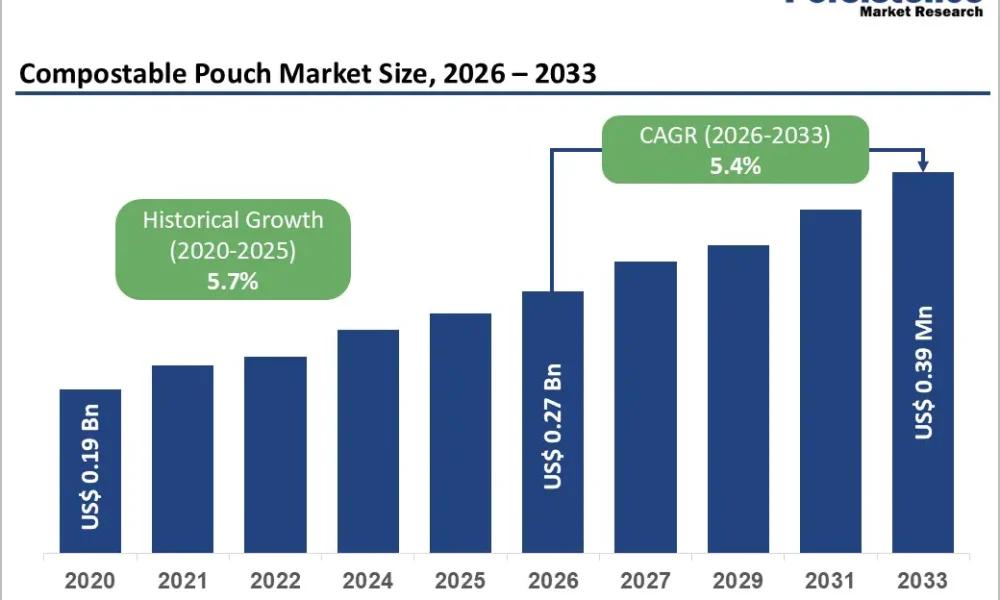
The compostable pouch market has emerged as a vital segment of sustainable packaging, driven by increasing environmental awareness, regulatory bans on single-use plastics, and growing consumer demand for eco-friendly alternatives. Compostable pouches are designed to biodegrade under industrial or home composting conditions, providing an environmentally responsible solution for packaging food, beverages, and other consumer products. As of 2026, the global compostable pouch market is expected to reach US$ 0.27 billion, and by 2033, it is projected to achieve US$ 0.39 billion, reflecting a CAGR of 5.4% during the forecast period.
The market growth is primarily driven by the need for sustainable packaging solutions that align with global environmental regulations and consumer eco-consciousness. Among the product types, stand-up compostable pouches dominate due to their versatility, resealability, and ease of use in retail and e-commerce channels. Geographically, North America leads the market due to stringent government regulations on plastics, high consumer awareness, and adoption of sustainable packaging by major food and beverage brands. Meanwhile, Europe is emerging as a key growth region, supported by robust legislative frameworks such as the European Green Deal, which encourages the use of compostable and recyclable packaging materials.
Key Highlights from the Report
• The global compostable pouch market is projected to grow from US$ 0.27 billion in 2026 to US$ 0.39 billion by 2033.
• Stand-up pouches dominate due to their convenience, resealability, and retail adaptability.
• North America holds the largest share, driven by regulatory mandates and consumer eco-consciousness.
• Europe is witnessing rapid growth due to stringent sustainability policies and increased adoption of compostable packaging.
• Rising consumer preference for plant-based and organic products is boosting demand for eco-friendly packaging.
• Technological innovations in compostable materials are enhancing durability, barrier performance, and shelf life.
𝐆𝐞𝐭 𝐚 𝐒𝐧𝐞𝐚𝐤 𝐏𝐞𝐞𝐤, 𝐒𝐚𝐦𝐩𝐥𝐞 𝐏𝐃𝐅 𝐈𝐧𝐬𝐢𝐝𝐞: https://www.persistencemarketresearch.com/samples/34306
Market Segmentation
The compostable pouch market can be segmented based on product type, material, and end-use industry. By product type, the market includes stand-up pouches, flat pouches, spout pouches, and vacuum pouches. Stand-up pouches lead the market due to their high visibility on retail shelves, ease of resealing, and suitability for a variety of dry and liquid products. Flat pouches are commonly used for lightweight snack and food packaging, while spout pouches are ideal for beverages and liquid food items, offering controlled pouring and storage convenience. Vacuum pouches are often adopted for perishable food products to extend shelf life while maintaining sustainability.
By material, the market includes PLA (Polylactic Acid), PBAT (Polybutylene Adipate Terephthalate), starch-based blends, and other biodegradable polymers. PLA is widely used for its clarity, printability, and compostability in industrial settings. PBAT is often blended with PLA to enhance flexibility, tear resistance, and barrier properties. Starch-based blends are gaining traction due to cost-effectiveness and eco-friendliness.
By end-use industry, the market is segmented into food & beverages, personal care, healthcare, and others. The food and beverage sector dominates due to rising demand for ready-to-eat meals, snacks, coffee, and beverages packaged in sustainable pouches. Personal care products, such as soaps, powders, and cosmetics, are increasingly adopting compostable pouches to appeal to environmentally conscious consumers. Healthcare applications include packaging of supplements and nutraceuticals in compostable pouches to reduce plastic footprint. Emerging applications in pet food and household goods are also contributing to market expansion.
Regional Insights
North America leads the compostable pouch market, primarily due to strict federal and state-level regulations limiting single-use plastics and promoting sustainable alternatives. The U.S. has witnessed increasing adoption of compostable pouches across food, beverage, and personal care industries. High consumer awareness and corporate sustainability initiatives further reinforce market growth.
Europe is a key growth region, with countries such as Germany, France, and the U.K. implementing rigorous environmental policies. The European Green Deal and packaging waste directives encourage businesses to adopt compostable and biodegradable packaging materials. Retailers and brands increasingly prioritize packaging that minimizes environmental impact, creating strong demand for compostable pouches.
The Asia-Pacific region is emerging as a high-growth market due to rapid urbanization, growing disposable incomes, and increasing environmental awareness among consumers. Countries such as Japan, China, India, and Australia are witnessing rising adoption of compostable packaging, especially in food and beverage and e-commerce sectors. Latin America and the Middle East & Africa are in developing stages, with growth driven by government initiatives to curb plastic pollution and rising adoption of sustainable packaging in urban centers.
𝐆𝐞𝐭 𝐚 𝐂𝐮𝐬𝐭𝐨𝐦𝐢𝐳𝐞𝐝 𝐌𝐚𝐫𝐤𝐞𝐭 𝐕𝐢𝐞𝐰 𝐢𝐧 𝐎𝐧𝐞 𝐂𝐥𝐢𝐜𝐤 : https://www.persistencemarketresearch.com/request-customization/34306
Market Drivers
The growth of the compostable pouch market is largely driven by rising demand for sustainable packaging solutions, spurred by global plastic bans, increasing consumer eco-consciousness, and corporate sustainability commitments. Food and beverage brands are adopting compostable pouches to reduce environmental impact while maintaining functionality, shelf life, and product safety. Additionally, the expansion of e-commerce has amplified the need for lightweight, durable, and eco-friendly packaging that can withstand shipping while appealing to environmentally aware consumers. Technological innovations in barrier properties, compostability certifications, and material blends are further boosting market adoption.
Market Restraints
Despite promising growth, the compostable pouch market faces several challenges. High production costs and limited availability of raw materials, such as PLA and PBAT, can deter small-scale manufacturers from adoption. Performance limitations compared to conventional plastic packaging, particularly regarding moisture and oxygen barriers, pose challenges for certain food and beverage applications. Furthermore, compostable certification requirements and lack of consumer awareness in certain regions may limit widespread adoption. Infrastructure for industrial composting is also unevenly distributed, which may affect the perceived effectiveness of compostable pouches in end-use markets.
Market Opportunities
The market presents significant opportunities for growth, particularly through innovation in compostable materials and expansion into emerging markets. The development of high-performance biodegradable polymers that match conventional plastics in barrier protection and flexibility opens new applications in packaged foods, beverages, and personal care products. Asia-Pacific, Latin America, and parts of Africa offer high growth potential due to rising environmental awareness, expanding retail and e-commerce sectors, and supportive government initiatives. Companies investing in smart and interactive packaging that integrates compostability with functionality, such as resealability and barrier performance, are well-positioned to capitalize on evolving consumer preferences.
𝐁𝐮𝐲 𝐍𝐨𝐰 𝐭𝐡𝐞 𝐃𝐞𝐭𝐚𝐢𝐥𝐞𝐝 𝐑𝐞𝐩𝐨𝐫𝐭: https://www.persistencemarketresearch.com/checkout/34306
Company Insights
• Amcor – Provides compostable pouch solutions for food and beverage applications, focusing on PLA and PBAT blends.
• Sealed Air Corporation – Offers innovative compostable packaging materials for retail and e-commerce sectors.
• Mondi Group – Specializes in sustainable flexible packaging solutions with industrial compostability certification.
• Tetra Pak – Supplies compostable pouches and carton-based packaging with enhanced recyclability features.
• Berry Global – Develops eco-friendly pouches with a focus on reducing environmental impact while maintaining durability.
• Huhtamaki – Provides compostable and biodegradable packaging for food service and retail applications.
• Novamont – Innovates in starch-based compostable materials for pouches and flexible packaging.
• BASF – Offers biodegradable polymer solutions for high-performance compostable packaging.
• Biopak – Supplies compostable pouches and films for food, beverage, and consumer goods industries.
• Winpak Ltd. – Develops compostable flexible packaging solutions for sustainable consumer packaging.
Recent Developments
Amcor launched a PLA/PBAT-based compostable stand-up pouch in 2025 for retail and e-commerce applications, meeting industrial composting standards.
Mondi Group introduced a high-barrier compostable pouch solution in 2024, providing enhanced shelf-life and moisture resistance for packaged foods.
Conclusion
The global compostable pouch market is set to experience steady growth through 2033, driven by environmental concerns, regulatory restrictions on plastics, and rising consumer demand for sustainable packaging. North America remains the dominant market due to advanced regulatory frameworks, strong consumer awareness, and widespread adoption in the food and beverage industry. Europe is rapidly expanding due to stringent sustainability policies, while Asia-Pacific presents high growth potential through urbanization, e-commerce expansion, and increasing disposable incomes. Innovations in material science, barrier performance, and compostable certification are enabling broader adoption of compostable pouches across food, beverage, personal care, and healthcare industries. The market is expected to grow from US$ 0.27 billion in 2026 to US$ 0.39 billion by 2033, at a CAGR of 5.4%, reflecting the sustained global shift toward eco-friendly, functional, and consumer-preferred packaging solutions.




