
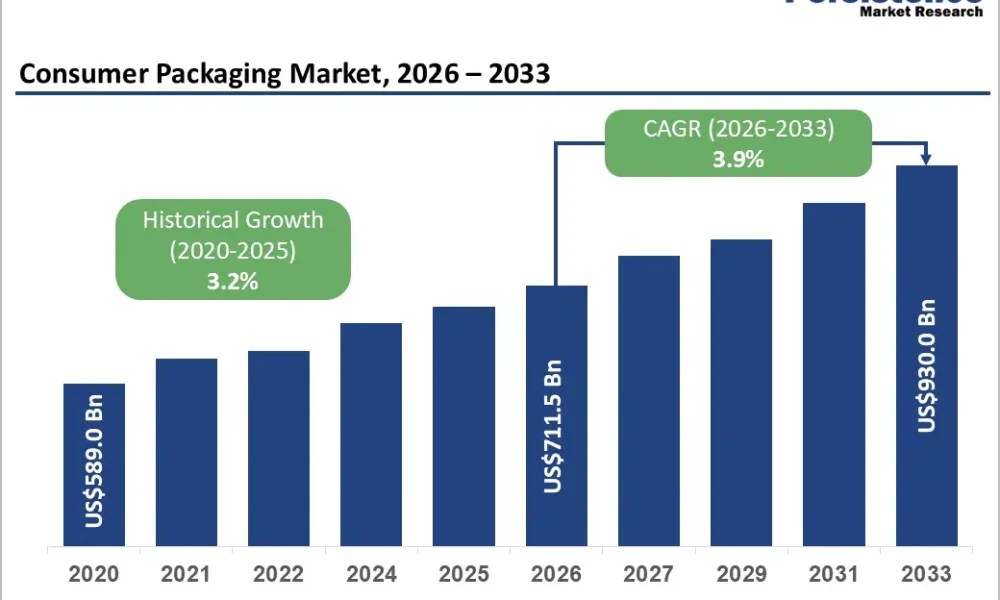
The consumer packaging market has experienced steady growth in recent years, fueled by evolving consumer behavior, rapid expansion of e-commerce, and increasing regulatory pressure for sustainable and recyclable packaging solutions. Consumer packaging includes a wide range of products such as flexible packaging, rigid containers, bottles, cartons, and labels that are designed to protect, preserve, and present goods while enhancing brand appeal. As of 2026, the global consumer packaging market is estimated to reach US$ 711.5 billion, with projections indicating expansion to US$ 930.0 billion by 2033, representing a CAGR of 3.9% during the forecast period.
The growth of the market is largely driven by the rising penetration of e-commerce, which has transformed the packaging landscape by increasing the demand for durable, lightweight, and protective packaging solutions. Among product types, flexible packaging leads the market, owing to its versatility, cost-effectiveness, and ability to extend product shelf life, particularly in food, beverage, and personal care sectors. Geographically, North America currently dominates the market due to high consumer spending, advanced logistics networks, and early adoption of eco-friendly packaging practices. Meanwhile, the Asia-Pacific region is projected to grow at the fastest rate, driven by rapid urbanization, rising disposable incomes, and the expansion of e-commerce platforms in countries such as China, India, and Southeast Asian nations.
Key Highlights from the Report
• The global consumer packaging market is projected to grow from US$ 711.5 billion in 2026 to US$ 930.0 billion by 2033.
• Flexible packaging continues to lead the market due to its cost-effectiveness and shelf-life extension benefits.
• Asia-Pacific is the fastest-growing region, driven by expanding e-commerce and rising disposable incomes.
• Sustainability regulations and environmental concerns are driving the adoption of recyclable and biodegradable packaging solutions.
• E-commerce growth has intensified demand for lightweight, durable, and protective packaging materials.
• Increasing innovation in smart and functional packaging is reshaping consumer expectations and industry standards.
𝐆𝐞𝐭 𝐚 𝐒𝐧𝐞𝐚𝐤 𝐏𝐞𝐞𝐤, 𝐒𝐚𝐦𝐩𝐥𝐞 𝐏𝐃𝐅 𝐈𝐧𝐬𝐢𝐝𝐞: https://www.persistencemarketresearch.com/samples/34318
Market Segmentation
The consumer packaging market can be segmented based on product type, material, and end-use industry. By product type, the market includes flexible packaging, rigid packaging, bottles & containers, cartons & folding boxes, and labels & closures. Flexible packaging, such as pouches, films, and wraps, dominates the market due to its adaptability across food, beverage, and personal care applications. Rigid packaging, including plastic and glass containers, is preferred in applications requiring durability and premium product positioning, while cartons and folding boxes are widely used for packaging convenience and sustainability compliance. Labels and closures play a critical role in branding, product information, and tamper-evidence, making them an essential segment of consumer packaging.
By material, the market comprises plastics, paper & board, glass, and metals. Plastics remain the dominant material due to their versatility, lightweight nature, and cost-effectiveness, though growing sustainability concerns are driving the adoption of paper-based, biodegradable, and recyclable alternatives. Glass and metal packaging are commonly used in premium food and beverage applications, where product integrity and aesthetic appeal are important.
By end-use industry, the market is segmented into food & beverages, personal care, healthcare, consumer electronics, and others. Food & beverages account for the largest share, as packaged foods and beverages are increasingly demanded in ready-to-eat and takeaway formats. The personal care and cosmetics industry is rapidly adopting sustainable and innovative packaging to appeal to environmentally conscious consumers. Healthcare and pharmaceutical packaging are highly regulated, necessitating high-quality, tamper-evident, and protective packaging solutions. Consumer electronics, driven by e-commerce growth, relies on durable and impact-resistant packaging to prevent product damage during shipping.
Regional Insights
North America dominates the consumer packaging market due to advanced logistics networks, high consumer spending, and early adoption of sustainable packaging solutions. The U.S. and Canada lead in innovative packaging designs, smart packaging adoption, and regulatory compliance, particularly in food and personal care sectors.
Europe holds significant market share, with growth driven by stringent environmental regulations, such as the European Union’s Single-Use Plastics Directive, promoting recyclable and biodegradable materials. Germany, France, and the U.K. are key contributors, particularly in premium food, beverage, and personal care segments.
The Asia-Pacific region is projected to register the fastest growth during the forecast period. Rising e-commerce adoption, expanding middle-class populations, and increasing demand for packaged goods in countries like China, India, and Indonesia are key factors. Additionally, government initiatives promoting sustainable packaging practices and increasing investments in modern packaging technologies are boosting regional market growth.
Latin America and the Middle East & Africa exhibit moderate growth. Adoption is primarily driven by urbanization, retail sector expansion, and rising demand for convenient, protective, and sustainable packaging solutions. The increasing presence of multinational brands and local manufacturing facilities also stimulates the demand for modern consumer packaging solutions.
𝐆𝐞𝐭 𝐚 𝐂𝐮𝐬𝐭𝐨𝐦𝐢𝐳𝐞𝐝 𝐌𝐚𝐫𝐤𝐞𝐭 𝐕𝐢𝐞𝐰 𝐢𝐧 𝐎𝐧𝐞 𝐂𝐥𝐢𝐜𝐤 : https://www.persistencemarketresearch.com/request-customization/34318
Market Drivers
The consumer packaging market is primarily driven by the rapid growth of e-commerce, which has significantly increased the demand for durable, lightweight, and protective packaging materials capable of withstanding long-distance shipping. Rising environmental awareness and tightening sustainability regulations are further accelerating the adoption of recyclable, biodegradable, and reusable packaging solutions. Growing disposable incomes and evolving consumer preferences for convenience, premium packaging, and branded experiences are also important drivers. Additionally, technological advancements in smart packaging, functional materials, and innovative printing solutions are enhancing the value proposition of consumer packaging, making it increasingly attractive to manufacturers and end-users alike.
Market Restraints
Despite robust growth prospects, the consumer packaging market faces certain challenges. The high cost of sustainable and biodegradable materials compared to conventional plastics can hinder adoption, especially in cost-sensitive regions. Supply chain disruptions and fluctuations in raw material prices, such as plastics, paper, and aluminum, can also affect production costs and profitability. Moreover, regulatory compliance requirements and certification processes for eco-friendly packaging add operational complexity for manufacturers. Environmental concerns over packaging waste, although driving sustainability initiatives, also create challenges in balancing cost, functionality, and environmental responsibility.
Market Opportunities
The consumer packaging market presents substantial opportunities, particularly in emerging markets and sustainable packaging innovations. Asia-Pacific, Latin America, and parts of Africa provide untapped potential due to growing e-commerce penetration, increasing consumer awareness, and rising packaged goods demand. Companies investing in eco-friendly, lightweight, and reusable packaging materials are well-positioned to capture market share. Moreover, the integration of smart packaging technologies, including QR codes, RFID, and interactive designs, offers opportunities to enhance customer engagement, track shipments, and optimize inventory management. Innovations in functional packaging, such as temperature-sensitive and barrier-enhanced materials, also provide new avenues for growth in the food, beverage, and healthcare sectors.
𝐁𝐮𝐲 𝐍𝐨𝐰 𝐭𝐡𝐞 𝐃𝐞𝐭𝐚𝐢𝐥𝐞𝐝 𝐑𝐞𝐩𝐨𝐫𝐭: https://www.persistencemarketresearch.com/checkout/34318
Company Insights
• Amcor – A global leader in flexible and rigid packaging solutions with sustainable product offerings.
• Tetra Pak – Provides innovative carton-based packaging and solutions for beverages and processed foods.
• Ball Corporation – Specializes in metal packaging solutions for beverages, food, and personal care products.
• Sealed Air Corporation – Offers protective and sustainable packaging materials for e-commerce and consumer goods.
• WestRock – Supplies paper-based packaging solutions, including folding cartons and corrugated boxes.
• Smurfit Kappa Group – Focuses on sustainable and recyclable packaging solutions in Europe and globally.
• Owens-Illinois – Provides glass packaging solutions for premium beverages and pharmaceuticals.
• Mondi Group – Offers integrated packaging solutions, including flexible films and specialty papers.
• Amphenol Packaging – Provides protective packaging solutions for consumer electronics and industrial goods.
• Berry Global – Manufactures plastic packaging solutions with a focus on sustainability and innovation.
Recent Developments
Amcor launched a fully recyclable flexible packaging line in 2025, aimed at the food and beverage sector to meet sustainability regulations.
Tetra Pak introduced an eco-friendly carton solution in 2024, featuring reduced carbon footprint and improved recyclability for liquid food packaging.
Conclusion
The global consumer packaging market is poised for steady growth through 2033, driven by rapid e-commerce expansion, increasing consumer demand for convenience, and tightening sustainability regulations. North America remains the dominant market due to advanced logistics, high disposable incomes, and early adoption of eco-friendly packaging solutions, while Asia-Pacific is expected to grow fastest due to rising consumer demand, urbanization, and investments in modern packaging infrastructure. Flexible packaging continues to lead due to versatility and cost-effectiveness, with innovations in smart, functional, and sustainable packaging further shaping the market landscape. Despite challenges such as raw material price volatility and higher costs for sustainable solutions, the market is projected to grow from US$ 711.5 billion in 2026 to US$ 930.0 billion by 2033 at a CAGR of 3.9%, reflecting strong opportunities for manufacturers, retailers, and consumers in creating efficient, sustainable, and innovative packaging solutions globally.




