
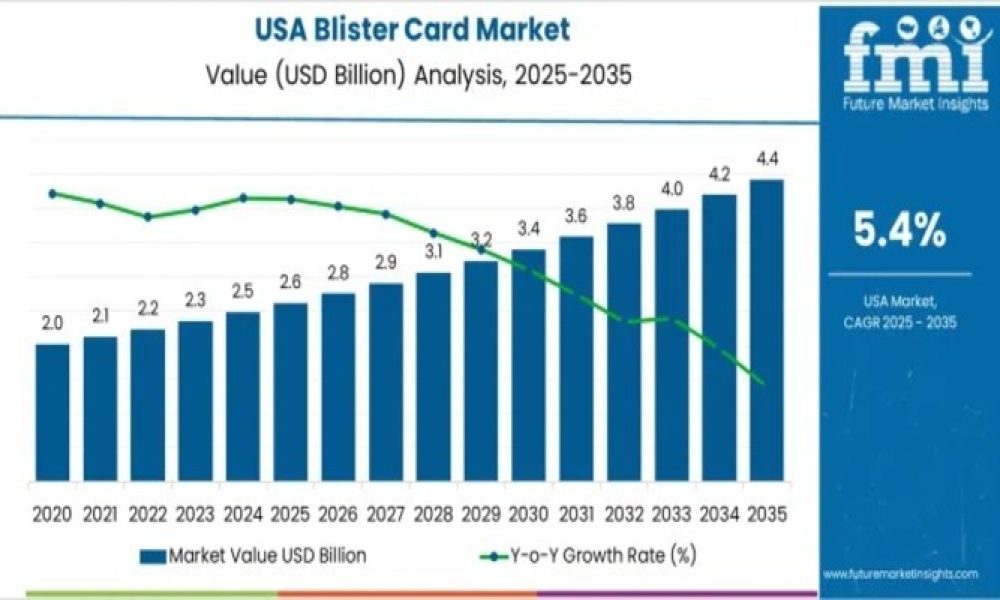
The USA blister card market is entering a decade of steady, regulation-driven expansion as pharmaceutical, nutraceutical, healthcare, and retail industries continue to prioritize secure, tamper-evident, and unit-dose packaging formats. Valued at USD 2.6 billion in 2025, demand for blister cards in the United States is projected to reach USD 4.4 billion by 2035, CAGR of 5.4%.
This growth reflects the sustained relevance of blister cards across safety-critical applications, alongside ongoing innovation by both established manufacturers and emerging players seeking to expand capacity, improve materials, and introduce new packaging technologies.
Market Overview and Growth Outlook
Blister cards remain a foundational packaging solution in regulated industries, particularly pharmaceuticals and consumer healthcare. Their ability to provide unit-dose protection, clear product visibility, and tamper evidence makes them indispensable for tablets, capsules, and over-the-counter medicines. Medication adherence initiatives, child-resistant packaging regulations, and compatibility with high-speed automated packaging lines continue to reinforce procurement preferences across the USA.
Explore Opportunities – Get Your Sample of Our Industry Overview Now!
PVC/Vinyl continues to dominate as the leading material type due to its cost efficiency, excellent thermoformability, and proven performance within existing pharmaceutical filling and sealing systems. At the same time, innovation in recyclable PET, reduced-plastic card designs, and paperboard-forward blister structures is enabling manufacturers to respond to growing sustainability expectations without compromising safety or efficiency.
Quick Stats: USA Blister Card Demand
- USA Blister Card Sales Value (2025): USD 2.6 billion
- USA Blister Card Forecast Value (2035): USD 4.4 billion
- Forecast CAGR (2025–2035): 5.4%
- Leading Material Type: PVC/Vinyl
- Key Growth Regions: West USA, South USA, Northeast USA
- Top Players: SupplyOne, Inc., Rohrer Corp, MARC, Inc., Pharma Packaging Solutions, Wasdell Group
Why Demand for Blister Cards Is Rising in the USA
Demand growth is anchored in the healthcare sector, where blister cards support dosage accuracy, traceability, and tamper resistance critical factors for aging populations and chronic disease management. Nutraceutical brands rely on blister cards to limit exposure to moisture and handling, preserving product integrity throughout distribution. Retailers favor carded blister packaging for small electronics, hardware accessories, and personal care items because it enhances shelf presentation, reduces shrinkage, and supports UPC visibility.
Automation investments across USA packaging facilities further strengthen demand. Blister cards integrate seamlessly with high-speed sealing, inspection, and serialization systems, reducing labor dependence while improving consistency. While bottles and flexible pouches compete in some high-volume categories, blister cards remain preferred for applications where safety, compliance, and visibility are non-negotiable.
Material, End-use, and Product Type Insights
By Material Type
- PVC/Vinyl (42.0%) – Leads due to seal strength, cost alignment, and machinery compatibility
- PET (26.0%) – Expands with better recyclability and transparency
- Generic Plastics (15.0%) – Used for flexible or lower-cost applications
- PE (10.0%) – Selected for lightweight and chemical resistance
- Others (7.0%) – Specialty barrier and branding-focused materials
Key Takeaways:
- PVC remains dominant, but PET adoption is rising
- Specialty materials support niche performance needs
- Material innovation mitigates sustainability-related risks
By End-use Industry
- Pharmaceuticals (38.0%) – Largest share due to compliance and unit-dose requirements
- Food (22.0%) – Portion-controlled snacks and confectionery
- Medical Devices (16.0%) – Sterile packaging for small disposables
- Veterinary & Nutraceuticals (13.0%) – Controlled dispensing formats
- Electronics & Electricals (11.0%) – Moisture protection and retail display
By Product Type
- Carded Blister Packaging (58.0%) – Favored for labeling space and efficiency
- Clamshell Blisters (42.0%) – Used for higher-protection retail goods
Regional Demand Dynamics
- West USA (6.2% CAGR): Driven by strong pharmaceutical distribution networks, hospital dispensing systems, and mass-merchant retail. Sustainability initiatives are accelerating adoption of recyclable blister structures.
- South USA (5.6% CAGR): Supported by nutraceutical manufacturing, OTC medicines, and large logistics corridors across Texas and Florida.
- Northeast USA (5.0% CAGR): Anchored by pharmaceutical production hubs in New Jersey and Pennsylvania, with strong hospital and specialty pharmacy demand.
- Midwest USA (4.3% CAGR): Sustained by industrial hardware, DIY products, and automated pharmaceutical packaging lines.
Competitive Landscape and Manufacturer Expansion
The competitive landscape of the USA blister card market is shaped by converters and contract packagers that combine thermoforming expertise with advanced printing, sealing, and compliance capabilities. SupplyOne, Inc. leads with an estimated 31.3% market share, supported by consistent material performance and strong relationships with pharmaceutical and consumer goods clients. Rohrer Corp and MARC, Inc. continue to expand their customized blister-card programs, focusing on precision die-cutting, heat-seal reliability, and scalable production.
Healthcare-focused specialists such as Pharma Packaging Solutions and Wasdell Group are strengthening their positions by investing in serialization-ready blister cards, adherence packaging systems, and contract-packaging services tailored to regulated products. At the same time, new and mid-sized manufacturers are entering the market with eco-friendly blister technologies, paperboard-forward designs, and recyclable mono-material solutions, positioning themselves for partnerships with sustainability-focused brands and retailers.
Why FMI: https://www.futuremarketinsights.com/why-fmi
About Future Market Insights (FMI)
Future Market Insights, Inc. (FMI) is an ESOMAR-certified, ISO 9001:2015 market research and consulting organization, trusted by Fortune 500 clients and global enterprises. With operations in the U.S., UK, India, and Dubai, FMI provides data-backed insights and strategic intelligence across 30+ industries and 1200 markets worldwide.



