
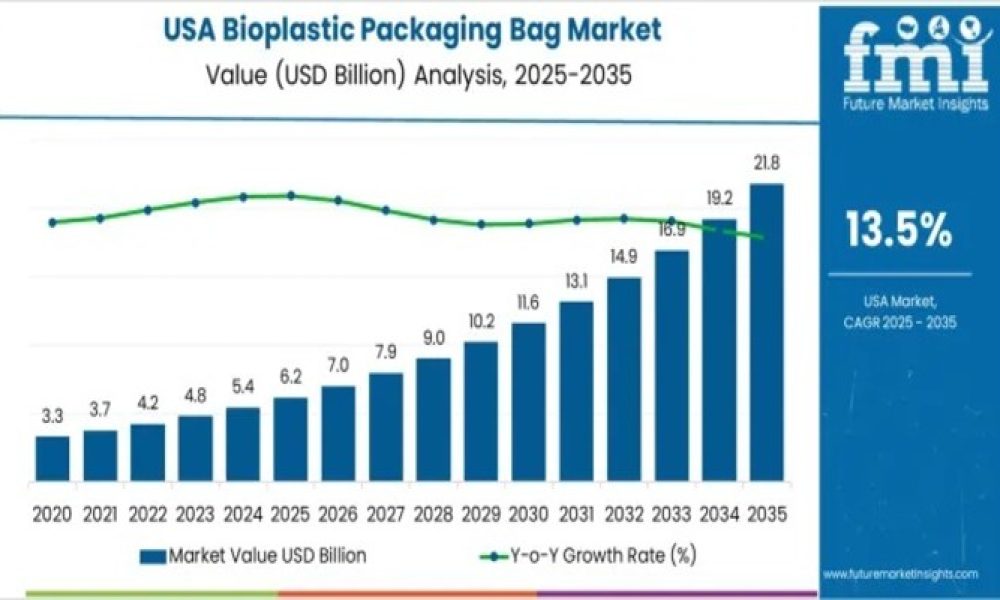
The demand for bioplastic packaging bags in the United States is entering a decisive decade of structural expansion as environmental regulation, retail compliance mandates, and industrial scaling converge to reshape packaging norms. Valued at USD 6.2 billion in 2025, the market is projected to reach USD 21.8 billion by 2035, expanding at a robust CAGR of 13.5% over the forecast period.
This growth reflects more than a shift in consumer sentiment—it signals a transformation in how retailers, foodservice operators, municipalities, and logistics providers approach packaging procurement under tightening plastic regulations and sustainability targets.
Discover Growth Opportunities in the Market – Get Your Sample Report Now
Market Snapshot: USA Bioplastic Packaging Bags
- Market Value (2025): USD 6.2 billion
- Forecast Value (2035): USD 21.8 billion
- CAGR (2025–2035): 13.5%
- Leading Material: Polylactic Acids (PLA) – 36% share
- Key Growth Regions: West, South, Northeast, Midwest
- Major Players: Novamont S.p.A., BASF SE, NatureWorks LLC, Mitsubishi Chemical Holdings, Biome Bioplastics
Early Growth Fueled by Regulation and Retail Compliance (2025–2030)
Between 2025 and 2030, demand for bioplastic packaging bags in the USA rises from USD 6.2 billion to USD 7.9 billion, adding USD 1.7 billion in incremental value. This phase of growth is policy-enabled rather than preference-led, driven by state and municipal bans on conventional plastic carryout bags.
Retailers—particularly grocery chains, pharmacies, apparel outlets, and foodservice brands—have adopted bioplastic bag formats to ensure uninterrupted checkout operations while meeting legal compliance thresholds. Carryout bags, produce bags, and delivery packaging account for the bulk of early demand, as these formats offer functional parity with polyethylene while satisfying compostability or bio-based content requirements.
Key early demand drivers include:
- State and city-level restrictions on single-use plastics
- Retail sustainability mandates and ESG compliance reporting
- Adoption by grocery chains, quick-service restaurants, and meal delivery platforms
- Expansion of compostable bag use in institutional foodservice contracts
During this phase, bioplastic packaging bags function less as a branding choice and more as an operational necessity—a compliance tool embedded into supply contracts.
Post-2030: Infrastructure, Scale, and Cost Efficiency Drive Acceleration
From 2030 to 2035, the market undergoes a dramatic inflection, expanding from USD 7.9 billion to USD 21.8 billion, adding nearly USD 13.9 billion in value within five years. This back-weighted acceleration reflects the maturation of domestic biopolymer infrastructure rather than new regulatory shocks.
Expanded resin capacity, compounding operations, and bag conversion facilities—particularly across the Midwest and Gulf Coast—enable higher production volumes and improved price competitiveness. As costs decline, bioplastic bags become viable not only for regulated carryout use, but also for e-commerce mailers, secondary packaging, and food waste collection programs.
Structural growth enablers after 2030 include:
- Expansion of domestic PLA and bio-resin production
- Economies of scale improving cost parity with petroplastics
- Growth in compostable refuse bags for municipal food waste programs
- Long-term procurement contracts stabilizing pricing and supply
Bioplastic packaging bags increasingly transition from regulated alternatives to default packaging formats across mass retail and logistics networks.
Material and Type Dynamics Shape Market Structure
Why Polylactic Acids (PLA) Lead the Market
Polylactic acids account for 36% of total bioplastic packaging bag demand in the USA, supported by their commercial scalability, compostability certification, and compatibility with existing film extrusion equipment. PLA resins offer a balance of clarity, tensile strength, and sealing performance, making them suitable for grocery bags, produce packaging, and foodservice applications.
PLA’s established supply chains and starch-based feedstock availability further reinforce its position as the preferred material for large-volume procurement programs.
Flat Bags Dominate by Type
Flat bags represent 29.0% of total demand, driven by their operational simplicity and cost efficiency. Their compatibility with automated bagging equipment, lower material usage per unit, and widespread acceptance in municipal compostable bag programs make them the dominant format across retail and food waste applications.
Regional Outlook: Policy Intensity Shapes Growth Rates
- West (15.5% CAGR): Leads the market due to strict regulations, high retail compliance, and strong adoption by foodservice and organic brands
- South (13.9% CAGR): Driven by expanding retail networks, produce packaging, and food processing volumes
- Northeast (12.4% CAGR): Supported by dense urban retail, early policy enforcement, and institutional procurement
- Midwest (10.8% CAGR): Shows steady, cost-sensitive growth tied to phased plastic replacement strategies
Competitive Landscape: Innovation Meets Scale
The USA bioplastic packaging bag market is shaped by global material innovators and specialty biopolymer producers focused on performance, scalability, and regulatory alignment.
Key players include:
- Novamont S.p.A. – Pioneer in compostable materials and bio-based polymers
- NatureWorks LLC – Leading supplier of PLA resins for packaging applications
- BASF SE – Broad bioplastics portfolio supporting industrial-scale demand
- Mitsubishi Chemical Holdings – Advanced material systems and global supply reach
- Biome Bioplastics – Specialized formulations for compostable flexible packaging
These companies are influencing the market through capacity expansion, material innovation, and strategic partnerships with retailers and municipalities.
Why FMI: https://www.futuremarketinsights.com/why-fmi
About Future Market Insights (FMI)
Future Market Insights, Inc. (FMI) is an ESOMAR-certified, ISO 9001:2015 market research and consulting organization, trusted by Fortune 500 clients and global enterprises. With operations in the U.S., UK, India, and Dubai, FMI provides data-backed insights and strategic intelligence across 30+ industries and 1200 markets worldwide.



