
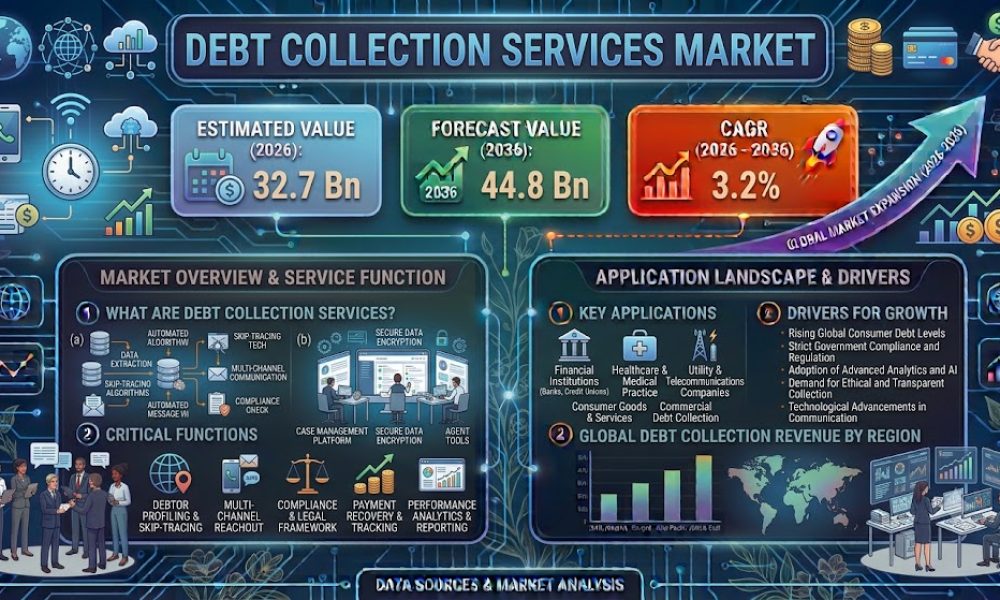
The global debt collection services market is estimated at USD 32.7 billion in 2026 and is projected to reach USD 44.8 billion by 2036, expanding at a 3.2% CAGR from 2026 to 2036. The market was valued at USD 31.7 billion in 2025. The forecast represents an incremental opportunity of approximately USD 12.1 billion over the period.
Demand for debt collection services is linked to credit expansion, overdue account volumes, and the growing need for structured recovery programs. Lenders are also placing greater emphasis on documented borrower communication and compliance controls when outsourcing recovery work. The Federal Reserve Board reported that consumer credit increased at a 3.2% seasonally adjusted annual rate during the first quarter of 2026.
Get Detailed Market Forecasts, Competitive Benchmarking, and Pricing Trends: https://www.factmr.com/connectus/sample?flag=S&rep_id=8052
Global Segment Leaders
- Bad debts are expected to account for 64.0% of the market in 2026. These accounts are commonly transferred to collection agencies after internal recovery efforts have been exhausted.
- Healthcare is projected to hold 41.0% share. Hospitals and physician groups use recovery partners to manage unpaid patient balances while maintaining clear communication.
- Third-party collections are expected to capture 52.0% share. Outsourcing allows lenders to manage larger overdue account pools without building equivalent internal recovery teams.
- Digital outreach is projected to account for 37.0% share. Payment links, digital reminders, and account-status messages allow agencies to document borrower contact and support faster payment resolution.
- Banks and credit unions are expected to represent 45.0% of demand. Credit cards and personal loans create a steady flow of overdue accounts requiring structured recovery.
Country-Level Performance
- India: The market is projected to grow at a 5.1% CAGR through 2036. Digital lending and NBFC credit activity are increasing the need for faster routing and disciplined recovery of overdue accounts.
- China: Debt collection services are forecast to expand at a 4.0% CAGR. Formal credit channels and consumer finance activity are creating demand for organized recovery programs and stronger account controls.
- United States: The market is expected to register a 3.0% CAGR. A large household credit base keeps recovery activity active, while digital payment options are becoming more relevant for account resolution.
- Germany: Growth is projected at 2.8% CAGR. Bank-led recovery activity places emphasis on documentation, case records, and legal process controls.
- United Kingdom: The market is expected to expand at 2.6% CAGR. Consumer credit reporting and regulatory requirements are increasing the importance of clean data trails for account status and borrower contact.
Credit Expansion Supports Recovery Demand
Credit expansion remains a central demand driver for debt collection services. As banks and finance companies manage larger credit card and personal loan portfolios, the volume of accounts requiring follow-up can increase.
Outsourcing allows creditors to route late-stage accounts to specialist agencies instead of maintaining large internal recovery teams. Collection companies can use account scoring, trained collectors, digital reminders, and payment portals to manage different levels of overdue accounts.
The market is also being shaped by compliance requirements. Lenders increasingly require agencies to maintain clear call records, borrower notices, payment records, and complaint controls. These requirements can influence which agencies receive outsourced account placements.
Healthcare Receivables Create a Specialized Opportunity
Healthcare is the leading end-use segment, with a projected 41.0% share in 2026. Hospitals and physician groups face unpaid patient balances that may require more careful communication than standard consumer accounts.
Medical debt recovery can involve billing questions, affordability concerns, and requests for repayment plans. Agencies serving this segment therefore need account verification, trained staff, and defined escalation procedures.
For healthcare providers, specialist recovery programs can support unpaid balance resolution while maintaining clearer communication with patients.
Digital Outreach Changes Collection Workflows
Digital outreach is becoming a significant collection channel. The segment is expected to account for 37.0% share in 2026, supported by payment links, digital reminders, and self-service payment options.
Digital tools can reduce dependence on repeated voice calls and provide a record of account communication. Voice calling remains relevant for disputes and repayment discussions, while legal collections are used when accounts require formal escalation.
For agencies, combining digital contact with documented payment resolution can help address lender requirements for transparency and compliance.
Regulatory Compliance Remains a Key Challenge
Compliance requirements can increase operating costs for collection agencies. Firms need investment in call monitoring, employee training, account documentation, and audit-ready records.
Regulatory scrutiny can also limit aggressive collection practices. Lenders increasingly expect partners to demonstrate controlled borrower communication and complaint management.
The Fact.MR report highlights compliance-led outsourcing as an opportunity for agencies that can demonstrate clear contact records and borrower-notice controls.
Competitive Landscape
The debt collection services market includes third-party collection agencies, debt purchasers, commercial receivables specialists, and healthcare recovery providers.
Key companies profiled in the Fact.MR report include Encore Capital Group, Inc., PRA Group, Inc., Atradius Collections, TrueAccord, IC System, Inc., and Cedar Financial.
Encore Capital Group and PRA Group are associated with defaulted receivables and nonperforming loan recovery. Atradius Collections and Cedar Financial support commercial debt recovery, while TrueAccord provides digital and outsourced collection models.
Competition is shaped by creditor access, compliance capabilities, recovery workflows, borrower communication, and the ability to manage different account types. Digital-first platforms are also increasing pressure on traditional models that rely heavily on call volume.
Analyst Perspective
Shambhu Nath Jha, Senior Analyst at Fact.MR, states:
“Debt collection services demand is moving toward follows compliance rules and protects borrower communication. Lenders no longer judge agencies only by recovery rate. They need payment resolution and documented outreach in the same service relationship.”
About the Debt Collection Services Market Report
Fact.MR’s Debt Collection Services Market report analyzes outsourced and specialist recovery services used to collect overdue consumer and commercial accounts.
The study covers bad debts and early out debts, along with healthcare, student loans, government debts, and other end-use applications. It evaluates first-party collections, third-party collections, and debt purchase services.
The report also analyzes voice calling, digital outreach, legal collections, and field collections across creditor types including banks and credit unions, healthcare providers, government agencies, utilities, and telecom firms.
The forecast covers 2026 to 2036, with country-level analysis for India, China, the United States, Germany, and the United Kingdom.
Explore More Related Studies Published by Fact.MR Research:
Paper Trays Market
Stamp Pad Market
About Fact.MR
Fact.MR is a global market research and consulting firm, trusted by Fortune 500 companies and emerging businesses for reliable insights and strategic intelligence. With a presence across the U.S., UK, India, and Dubai, we deliver data-driven research and tailored consulting solutions across 30+ industries and 1,000+ markets. Backed by deep expertise and advanced analytics, Fact.MR helps organizations uncover opportunities, reduce risks, and make informed decisions for sustainable growth.



