
The global automotive heat pump refrigerant components market is projected to increase from USD 1.2 billion in 2026 to USD 4.0 billion by 2036, expanding at a 12.5% CAGR between 2026 and 2036. Market demand is being driven by electric vehicle programs investing in thermal systems capable of maintaining cabin comfort and battery performance while limiting energy consumption during heating and cooling cycles.
The International Energy Agency reported in May 2025 that global electric car sales exceeded 17 million units during 2024. The expanding electric vehicle base is increasing the number of platforms requiring pressure control, heat exchange, sensing, and refrigerant management across changing ambient conditions.
Automotive heat pump architectures must operate across both heating and cooling modes, increasing the importance of compatible seals, sensors, valves, and control systems. Reusable component families can reduce redesign requirements across related vehicle models while supporting consistent performance and practical workshop servicing.
Regional refrigerant requirements are also influencing component engineering. United States vehicle programs follow federal SNAP decisions for applicable refrigerants, while European platforms must address fluorinated-gas restrictions alongside regional approval and service procedures. The U.S. Environmental Protection Agency explained in April 2026 that acceptable refrigerants carry defined conditions of use for vehicle air-conditioning applications.
These requirements affect pressure controls, seals, heat exchangers, and other components within vehicle climate-control systems. China-based manufacturing can support large module volumes, but exported vehicles must use refrigerant solutions that satisfy destination-market requirements. Engineering teams therefore need to validate hardware, control software, and service procedures together for each platform and refrigerant combination.
What Are the Key Segments in the Automotive Heat Pump Refrigerant Components Market?
- Sensors are expected to account for 32.0% share in 2026 by component type, reflecting their role in continuously monitoring pressure and temperature across different heat-pump operating modes.
- Passenger Cars are estimated to represent 27.0% share in 2026, supported by high vehicle volumes that allow validation and component-development costs to be distributed across related platform families.
- Battery Electric Vehicles are forecast to capture 74.0% share by propulsion in 2026, reflecting their dependence on heat-pump systems to manage cabin heating and cooling while preserving traction-battery energy.
- Refrigerant Management Components are gaining importance as manufacturers optimize pressure control, heat exchange, sealing, and fluid compatibility across multiple operating modes.
- Modular Thermal Architectures are becoming more relevant as automakers seek reusable component families that can be adapted across regional vehicle variants and different refrigerant requirements.
Get detailed market forecasts, competitive benchmarking, and pricing trends:
https://www.futuremarketinsights.com/reports/sample/rep-gb-34383
Which Countries Are Showing the Strongest Growth in Automotive Heat Pump Refrigerant Components?
India is projected to record the fastest growth among the profiled countries, advancing at a 16.9% CAGR through 2036. Expanding electric vehicle adoption and increasing localization of vehicle component manufacturing are creating opportunities for heat-pump suppliers. Local application engineering can help manufacturers adapt refrigerant components to vehicle packaging, climate conditions, and regional service requirements.
China is forecast to grow at a 15.6% CAGR, supported by its large electric vehicle manufacturing ecosystem and high-volume production of electrified platforms. Local factories can support large module runs and close integration with vehicle assembly, although exported vehicles require refrigerant and service configurations compatible with destination-market requirements.
South Korea is projected to advance at a 14.4% CAGR, supported by established automotive manufacturing and thermal-system engineering capabilities. Vehicle programs increasingly require compact refrigerant components that can be integrated into high-voltage electric platforms while maintaining controlled thermal performance.
The United States is expected to grow at a 13.1% CAGR, with vehicle manufacturers placing emphasis on refrigerant compliance, service procedures, and component reliability across passenger and commercial applications. Federal refrigerant-use requirements influence the selection and validation of components within vehicle climate-control systems.
Germany is forecast to register an 11.9% CAGR, supported by electric vehicle platform development and formal engineering requirements surrounding refrigerant systems. Manufacturers are evaluating components based on thermal performance, fluid compatibility, durability, and documented compliance.
Japan is projected to expand at a 10.6% CAGR, with automakers emphasizing compact assemblies, detailed thermal validation, and long-term service continuity. Reusable component architectures can support multiple vehicle models while reducing redesign requirements during platform development.
How Is Regional Demand Shaping the Automotive Heat Pump Refrigerant Components Market?
Regional refrigerant requirements are creating different engineering and commercialization priorities. United States programs must account for federal refrigerant-use conditions, while European vehicle platforms must address fluorinated-gas restrictions and associated service procedures. These requirements influence component selection rather than creating demand independently.
China’s large-scale electric vehicle production supports localized manufacturing of thermal modules and refrigerant components. However, manufacturers supplying international vehicle platforms must account for destination-market fluid requirements. Japan emphasizes detailed model-level validation, while India is developing opportunities around vehicle electrification and localized component engineering.
What Is Changing the Competitive Landscape?
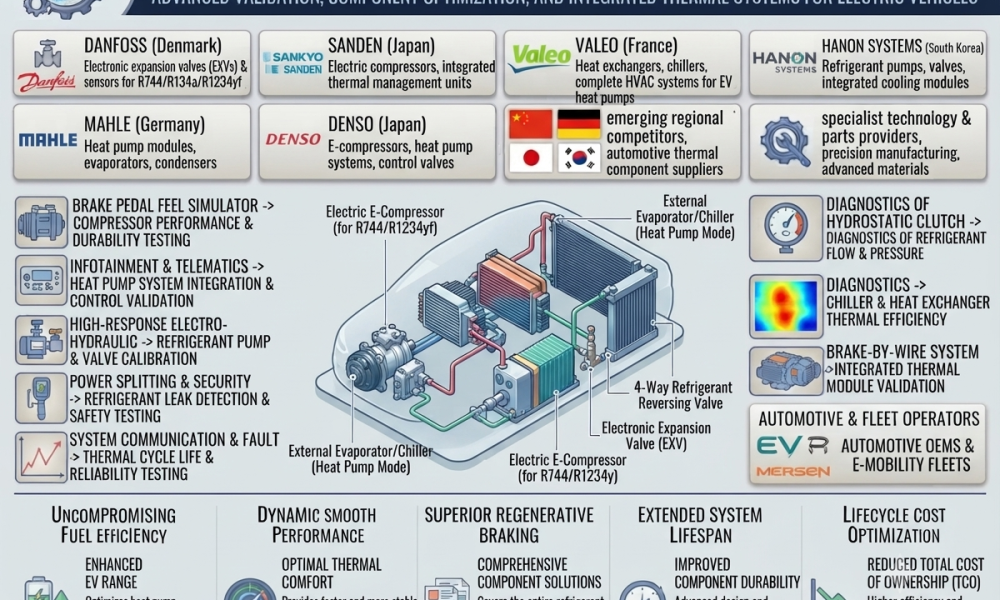
Competition is increasingly centered on integrated thermal architectures rather than individual refrigerant components. Automakers want compact systems that combine sensing, pressure management, heat exchange, and control functions while remaining accessible for diagnosis and servicing.
DENSO and Hanon Systems compete through integrated thermal-management architectures that connect refrigerant components with wider vehicle heating and cooling systems. Their positioning reflects the growing requirement for coordinated thermal performance across electric vehicle platforms.
Valeo and MAHLE emphasize compact thermal modules that can be integrated into high-volume vehicle architectures. Their capabilities span thermal-management components and systems designed around increasingly constrained electric vehicle packaging environments.
Sanden brings established compressor expertise, while Modine provides thermal-management systems for commercial vehicle applications. Bosch and Marelli contribute modules and heat-exchange technologies that support the broader vehicle thermal architecture.
Competitive differentiation increasingly depends on refrigerant compatibility, compact packaging, pressure-drop management, sensor integration, diagnostic access, and application engineering support throughout vehicle validation.
What Does the Analyst Say About the Automotive Heat Pump Refrigerant Components Market?
“Automotive heat pump component decisions are shaped by two linked tests: winter range protection and safe refrigerant service across regional vehicle fleets. A compact module can shorten platform integration but it also concentrates valve and sensor failures inside one assembly. Manufacturers should compare energy performance with diagnostic access and fluid flexibility during architecture decisions spanning several vehicle models.”
– Nikhil Kaitwade, Principal Analyst, Future Market Insights
What Is Driving Demand for Automotive Heat Pump Refrigerant Components?
Electric Vehicles Need Efficient Cabin Heating
Battery electric vehicles cannot rely on conventional engine waste heat for cabin heating. Heat-pump systems provide an alternative thermal pathway, increasing demand for components capable of managing refrigerant pressure, temperature, and heat transfer efficiently.
Winter Range Protection Is Becoming a Design Priority
Cabin heating can place a significant energy demand on an electric vehicle battery. Efficient heat-pump components can help manufacturers manage thermal loads while preserving available battery energy for vehicle propulsion.
Refrigerant Compatibility Is Shaping Component Selection
Different refrigerants can require different pressure ranges, seals, valves, and service procedures. Component suppliers must therefore demonstrate fluid compatibility across the operating envelope defined for each vehicle platform.
Modular Components Support Multi-Model Platforms
Automakers increasingly seek component families that can be reused across related vehicle models. Modular architectures can reduce redesign work while allowing manufacturers to adapt mounting, connections, and control parameters to individual vehicle configurations.
What Are the Key Market Restraints?
Automotive heat-pump refrigerant systems require detailed validation across heating and cooling modes, ambient temperatures, pressure conditions, and vehicle operating states. This increases engineering requirements compared with conventional climate-control architectures.
Refrigerant regulations can also complicate global vehicle programs. A component architecture developed for one fluid may require modifications when a vehicle is exported to another market with different refrigerant restrictions or service procedures.
Compact packaging creates another challenge. Combining valves, sensors, heat exchangers, and other functions into smaller assemblies can improve vehicle packaging but may increase diagnostic complexity and make component failures more difficult to isolate.
What Opportunities Exist for Automotive Heat Pump Refrigerant Component Manufacturers?
The expansion of electric vehicle platforms creates opportunities for suppliers developing compact components optimized for high-efficiency heat-pump architectures. Components that maintain reliable pressure control and heat transfer across broad temperature ranges can support vehicle performance in diverse climates.
Regional application engineering also provides an opportunity for suppliers to support global vehicle programs. Local teams can adapt components and calibration strategies to different refrigerant rules, vehicle architectures, climate conditions, and service procedures.
Suppliers can further expand their role through modular component families. Reusable sensors, valves, connectors, and heat-exchange modules can help automakers reduce development duplication across vehicle models while retaining flexibility for regional variants.
Drive Your Business Growth Strategy: Checkout the Report for Key Insights!
https://www.futuremarketinsights.com/checkout/34383
How Is the Automotive Heat Pump Refrigerant Components Market Segmented?
The automotive heat pump refrigerant components industry is segmented by component type, vehicle type, propulsion, sales channel, and region.
By Component Type: Sensors, Modules, Connectors, Software, and Thermal Systems.
By Vehicle Type: Passenger Cars, Commercial Vehicles, and Two-Wheelers.
By Propulsion: Battery Electric, Plug-in Hybrid, Fuel-cell, Hybrid, and Retrofit Vehicles.
By Sales Channel: OEM Integration, Aftermarket, Fleet Purchasing, Distributors, and Direct Sales.
By Region: North America, Latin America, Western Europe, Eastern Europe, South Asia & Pacific, East Asia, and Middle East & Africa.
Why Do Sensors Represent a Significant Component Category?
Sensors provide pressure and temperature feedback required for heat-pump control across different operating modes. Continuous measurement allows vehicle control systems to adjust refrigerant flow and thermal performance as ambient and vehicle conditions change.
Why Are Passenger Cars Important to Market Development?
Passenger cars account for substantial electric vehicle production and provide high-volume platform opportunities for thermal-system suppliers. Component families that can be reused across several models can help distribute development and validation costs.
How Does Battery Electric Propulsion Influence Demand?
Battery electric vehicles rely directly on stored electrical energy for both propulsion and cabin thermal management. Efficient heat-pump components can help reduce the energy required for cabin heating and cooling, supporting overall vehicle efficiency.
What Are the Drivers, Restraints and Opportunities in the Automotive Heat Pump Refrigerant Components Market?
Heat-pump refrigerant components are becoming increasingly important to electric vehicle thermal architecture as automakers balance cabin comfort, battery efficiency, refrigerant compliance, and serviceability.
- Driver: Expanding electric vehicle production is increasing demand for efficient heating and cooling systems.
- Restraint: Refrigerant-specific validation, compact packaging, and regional regulatory requirements increase engineering complexity.
- Opportunity: Modular component families and local application engineering can support multiple vehicle platforms and regional variants.
What Is the Automotive Heat Pump Refrigerant Components Market Demand Outlook?
Demand is expected to remain closely linked to electric vehicle adoption and the need to manage cabin comfort without excessive traction-battery consumption. As electric platforms expand into colder climates and broader vehicle categories, heat-pump efficiency and component durability will remain important engineering considerations.
The market is also moving toward integrated thermal architectures. Sensors, valves, heat exchangers, compressors, control software, and refrigerant circuits increasingly need to function as one coordinated system. Suppliers that can participate early in platform engineering can help automakers optimize packaging and thermal performance.
Why Is Refrigerant Flexibility Important?
Vehicle programs may use different refrigerants depending on regulatory requirements and regional market conditions. Components therefore need appropriate material compatibility, pressure ratings, sealing performance, and control calibration for the specified refrigerant.
Why Does Service Access Matter?
Heat-pump systems combine multiple thermal components into compact vehicle packages. Practical diagnostic and workshop access can reduce repair complexity and help maintain service continuity across the vehicle lifecycle.
How Fast Are Key Countries Growing in the Automotive Heat Pump Refrigerant Components Market?
India is projected to grow at 16.9% CAGR, followed by China at 15.6%, South Korea at 14.4%, the United States at 13.1%, Germany at 11.9%, and Japan at 10.6% through 2036. These differences reflect variations in electric vehicle production, thermal-system engineering, refrigerant requirements, vehicle platform cycles, climate conditions, and local application-support capabilities.
About Future Market Insights
Future Market Insights (FMI) is a global market intelligence and consulting firm providing syndicated research, custom research, and strategic consulting services across automotive, transportation, aerospace, technology, industrial, and emerging sectors. FMI’s research combines primary research, proprietary forecasting models, and industry analysis to help organizations evaluate market opportunities, technology adoption, competitive dynamics, and investment trends.



