
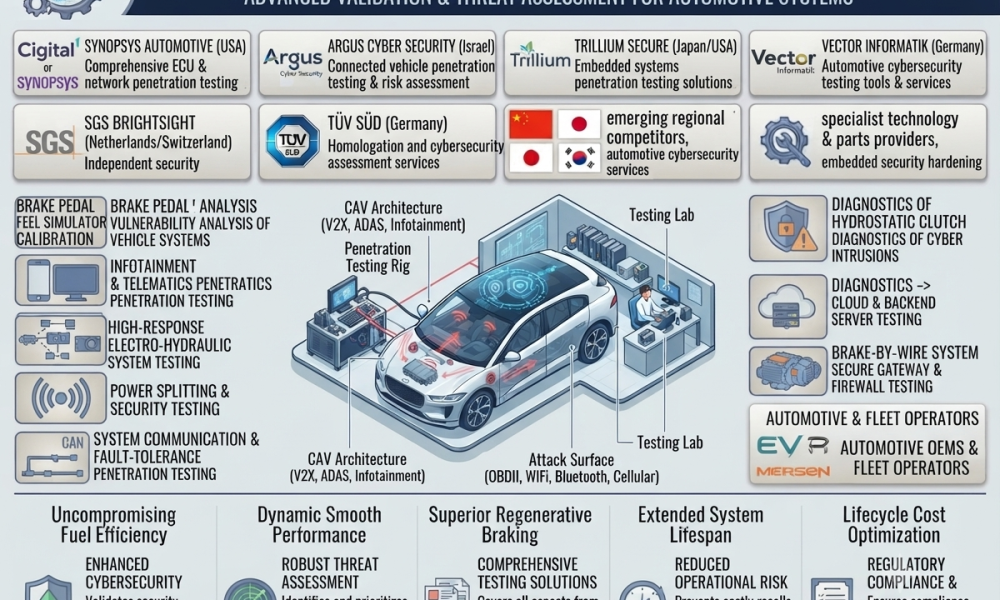
The global vehicle cybersecurity penetration testing services market is projected to expand from USD 636.8 million in 2026 to USD 1,760.0 million by 2036, advancing at a 10.7% CAGR between 2026 and 2036. Market growth is being driven by rising vehicle connectivity, increasing software content, and the transition toward software-defined vehicle architectures that require cybersecurity validation throughout development, release, and corrective-action cycles.
Modern vehicles contain interconnected software, electronic control units, wireless interfaces, sensors, and cloud-connected services. NHTSA stated in September 2025 that software permeates modern vehicles and that expanding connectivity creates numerous potential attack surfaces. This growing exposure is giving automotive cybersecurity testing a defined role in release approval, vulnerability discovery, and corrective-action planning.
Software-defined vehicle platforms further increase the need for recurring testing because code revisions can change interfaces, dependencies, and potential attack paths. Independent testing laboratories can generate recurring assignments by providing reproducible findings and documented retesting that verifies whether corrective actions have addressed previously identified vulnerabilities.
Regulatory developments are also widening the addressable testing base. In October 2025, the European Union published Regulation 2025/1455, extending UN Regulation 155 cybersecurity requirements to specified L-category vehicles, including certain two-wheel, three-wheel, and quadricycle categories from scheduled dates. This expands cybersecurity evidence requirements beyond traditional passenger vehicle programs and increases the need for providers with specialized regulatory knowledge.
What Are the Key Segments in the Vehicle Cybersecurity Penetration Testing Services Market?
- OEMs lead by end use with 51.0% share, reflecting their responsibility for vehicle integration, cybersecurity validation, and approval submissions across connected vehicle platforms.
- Software accounts for the largest component share at 42.0%, supported by continuous code revisions, over-the-air updates, software dependencies, and recurring security assessment requirements.
- Battery Electric Vehicles hold 27.0% share by propulsion type, as charging systems, connected interfaces, and increasingly software-intensive vehicle architectures broaden the cybersecurity testing scope.
- Connected Vehicle Interfaces are becoming important testing targets as wireless communication, telematics, cloud services, and vehicle-to-external-system connections create additional attack surfaces.
- Independent Testing and Retesting Services are gaining relevance as manufacturers require reproducible vulnerability findings and documented evidence confirming that corrective actions have been implemented effectively.
Get detailed market forecasts, competitive benchmarking, and pricing trends:
https://www.futuremarketinsights.com/reports/sample/rep-gb-34338
Which Countries Are Showing the Strongest Growth in Vehicle Cybersecurity Penetration Testing Services?
China is projected to record the fastest growth among the profiled countries, advancing at a 14.4% CAGR through 2036. The country’s expanding connected vehicle ecosystem and rapid software integration are increasing demand for cybersecurity testing that can keep pace with compressed vehicle development cycles. Providers with local engineering access can help manufacturers identify vulnerabilities while supporting recurring validation following software and platform revisions.
South Korea is forecast to grow at a 13.4% CAGR, supported by a strong automotive electronics and connected-vehicle manufacturing ecosystem. Vehicle manufacturers and technology suppliers require testing capabilities that can examine electronic control systems, software interfaces, communication pathways, and connected services throughout vehicle development.
India is expected to advance at a 12.3% CAGR, reflecting increasing vehicle connectivity and software integration across automotive platforms. Local testing expertise can help manufacturers address cybersecurity requirements while reducing the time required to coordinate external laboratories and technical validation resources.
The United States is projected to register an 11.2% CAGR. Vehicle programs benefit from access to independent laboratories, complete-vehicle testing environments, and mature proving-ground networks. Federal research and regulatory activity around automated and connected vehicles continues to reinforce the importance of measurable cybersecurity and electronic-system performance.
Japan is forecast to grow at a 10.2% CAGR, with vehicle manufacturers placing emphasis on detailed model-level validation and service continuity. Long-running vehicle programs require repeatable cybersecurity testing when software, connected services, and electronic architectures are revised.
Germany is projected to advance at a 9.1% CAGR, supported by formal regulatory evidence requirements and the country’s established automotive engineering ecosystem. Testing providers need to demonstrate technical depth while helping manufacturers prepare cybersecurity documentation for regulated vehicle programs.
How Is Regional Demand Shaping the Vehicle Cybersecurity Penetration Testing Services Market?
Regional cybersecurity requirements are creating different testing priorities. United States programs can access mature independent laboratories and proving-ground infrastructure, allowing complete-vehicle testing across connected systems. European programs place greater emphasis on formal cybersecurity evidence and type-approval requirements across regulated vehicle categories.
The European regulatory expansion to L-category vehicles increases the number of vehicle types that require structured cybersecurity consideration. China emphasizes fast software integration and localized technical support, while Japan focuses on detailed qualification and long-term platform continuity. These differences increase the value of providers capable of combining technical penetration testing with region-specific regulatory knowledge.
What Is Changing the Competitive Landscape?
Competition is increasingly centered on the depth and reproducibility of cybersecurity testing rather than simple vulnerability scanning. Automotive manufacturers need providers that can test complete vehicle architectures, identify realistic attack paths, document findings, and perform retesting after corrective actions.
UL Solutions, DEKRA, and TÜV SÜD compete through automotive testing expertise, regulatory services, and technical assessment capabilities. Their established testing infrastructure allows them to support manufacturers that require cybersecurity evidence alongside broader vehicle validation programs.
SGS, NCC Group, and PlaxidityX contribute cybersecurity testing and specialized security capabilities across connected vehicle environments. Their opportunities are expanding as vehicle software becomes more complex and security assessments need to be repeated after major software or interface changes.
AVL and HORIBA MIRA add automotive engineering and testing capabilities that connect cybersecurity assessment with broader vehicle development and validation activities. Competitive differentiation increasingly depends on complete-vehicle access, specialized cybersecurity expertise, regulatory knowledge, and the ability to deliver documented findings without disrupting vehicle launch schedules.
What Does the Analyst Say About the Vehicle Cybersecurity Penetration Testing Services Market?
“Commercial demand ultimately depends on a testing provider’s ability to uncover real-world vulnerabilities across vehicle software, ECUs, wireless interfaces, and connected services without disrupting development timelines. Automotive manufacturers increasingly favor partners that combine deep technical testing expertise with regulatory evidence support, the objective is to strengthen cybersecurity resilience while maintaining compliance and accelerating vehicle program approvals.”
– Nikhil Kaitwade, Principal Analyst, Future Market Insights
What Is Driving Demand for Vehicle Cybersecurity Penetration Testing Services?
Vehicle Connectivity Is Expanding the Attack Surface
Connected vehicles rely on wireless communication, telematics, cloud services, mobile applications, and external digital interfaces. Each additional connection creates potential pathways that manufacturers need to assess before vehicle release and throughout the vehicle lifecycle.
Software-Defined Vehicles Require Recurring Security Validation
Software-defined architectures allow manufacturers to update vehicle functionality after production, but each major software revision can modify interfaces or dependencies. Penetration testing therefore needs to become a recurring activity rather than a one-time pre-launch assessment.
Regulatory Cybersecurity Requirements Are Increasing
Formal cybersecurity requirements are making documented security evidence an important part of vehicle development. Expanding regulation across vehicle categories increases the need for testing providers that understand both technical security assessment and approval documentation.
Independent Testing Supports Corrective-Action Verification
External laboratories can provide independent findings and repeat assessments after vulnerabilities are addressed. This creates a documented chain from vulnerability discovery through corrective action and final verification.
What Are the Key Market Restraints?
Vehicle cybersecurity penetration testing requires specialized knowledge of automotive software, electronic control units, communication protocols, wireless interfaces, and vehicle architectures. The shortage of professionals with both cybersecurity and automotive engineering expertise can constrain testing capacity.
Access to production-representative vehicles and systems can also be difficult. Manufacturers may need to provide controlled access to hardware, software, diagnostic interfaces, and connected services while protecting intellectual property and development programs.
Rapid software changes create another challenge. Testing results can become outdated after major code revisions, requiring additional assessments and increasing the cost and time associated with cybersecurity validation.
What Opportunities Exist for Vehicle Cybersecurity Penetration Testing Providers?
The transition toward software-defined vehicles creates opportunities for providers offering continuous or lifecycle-based security testing. Instead of relying exclusively on pre-launch assessments, manufacturers can engage testing partners for recurring validation following major software releases and architecture changes.
Regulatory expansion into additional vehicle categories also increases the potential customer base. Providers with knowledge of cybersecurity regulations across passenger vehicles, commercial vehicles, two-wheelers, and other categories can support manufacturers operating across multiple product lines.
There is also an opportunity to integrate penetration testing with broader cybersecurity management services. Combining vulnerability discovery, risk documentation, corrective-action tracking, and retesting can create a more continuous cybersecurity validation process.
Drive Your Business Growth Strategy: Checkout the Report for Key Insights!
https://www.futuremarketinsights.com/checkout/34338
How Is the Vehicle Cybersecurity Penetration Testing Services Market Segmented?
The vehicle cybersecurity penetration testing services industry is segmented by component type, vehicle type, propulsion, sales channel, and region.
By Component Type: Sensors, Modules, Connectors, Software, and Thermal Systems.
By Vehicle Type: Passenger Cars, Commercial Vehicles, Heavy Trucks, Two-Wheelers, and Buses.
By Propulsion: Battery Electric, Plug-in Hybrid, Fuel-cell, Hybrid, and ICE Retrofit Vehicles.
By Sales Channel: OEM, Aftermarket, Fleet Operators, Distributors, and Direct Sales.
By Region: North America, Latin America, Western Europe, Eastern Europe, South Asia & Pacific, East Asia, and Middle East & Africa.
Why Does Software Represent the Largest Component Category?
Software is continuously revised across modern vehicle platforms, making it a recurring target for cybersecurity assessment. Over-the-air updates, third-party dependencies, cloud connectivity, and changing application interfaces can create new vulnerabilities after initial vehicle validation.
Why Do OEMs Lead by End Use?
OEMs are responsible for integrating vehicle systems and preparing documentation required for vehicle approval. This makes them central buyers of penetration testing services covering complete vehicle architectures and the cybersecurity controls implemented across individual components.
How Does Battery Electric Propulsion Influence Cybersecurity Testing?
Battery electric vehicles rely heavily on electronically controlled powertrain, charging, energy-management, and connectivity systems. These additional digital interfaces can expand the scope of cybersecurity assessments beyond conventional vehicle control functions.
What Are the Drivers, Restraints and Opportunities in the Vehicle Cybersecurity Penetration Testing Services Market?
Vehicle cybersecurity testing is becoming a recurring engineering and compliance function as connected and software-defined vehicle platforms expand.
- Driver: Increasing vehicle connectivity is creating more software, communication, and external interfaces that require security validation.
- Restraint: Limited access to production-representative systems and shortages of specialized automotive cybersecurity expertise can increase testing complexity.
- Opportunity: Lifecycle penetration testing and recurring retesting can support software-defined vehicles through continuous platform and code revisions.
What Is the Vehicle Cybersecurity Penetration Testing Services Market Demand Outlook?
Demand is expected to remain closely linked to increasing software content and vehicle connectivity. As manufacturers introduce more digital functions, cybersecurity testing will become increasingly integrated into vehicle development, release approval, and post-release corrective-action processes.
The market is also moving toward continuous validation. Software-defined vehicles can receive updates throughout their operating life, requiring manufacturers to reassess attack surfaces when significant software, interfaces, or third-party dependencies change.
Why Is Retesting Becoming Important?
Retesting provides evidence that previously identified vulnerabilities have been addressed. It allows manufacturers to document the progression from initial finding to corrective action and final verification, supporting both engineering decisions and regulatory evidence requirements.
Why Does Regional Regulatory Expertise Matter?
Cybersecurity approval requirements vary by vehicle category and jurisdiction. Providers familiar with regional procedures can help manufacturers prepare appropriate evidence and reduce the risk of rework during compressed vehicle launch schedules.
How Fast Are Key Countries Growing in the Vehicle Cybersecurity Penetration Testing Services Market?
China is projected to grow at 14.4% CAGR, followed by South Korea at 13.4%, India at 12.3%, the United States at 11.2%, Japan at 10.2%, and Germany at 9.1% through 2036. The differences reflect variations in connected vehicle adoption, software-defined architectures, regulatory requirements, automotive cybersecurity expertise, testing infrastructure, and local technical support.
About Future Market Insights
Future Market Insights (FMI) is a global market intelligence and consulting firm providing syndicated research, custom research, and strategic consulting services across automotive, transportation, aerospace, technology, industrial, and emerging sectors. FMI’s research combines primary research, proprietary forecasting models, and industry analysis to help organizations evaluate market opportunities, technology adoption, competitive dynamics, and investment trends.



