
The aerial firefighting market has become a critical component of modern wildfire management strategies as fire seasons grow longer and more destructive. Aircraft such as water bombers, helicopters, and surveillance planes are increasingly deployed to contain fires quickly and prevent widespread damage. According to Persistence Market Research, governments and emergency agencies are strengthening aerial firefighting fleets to improve response efficiency. Climate change, urban expansion near forests, and prolonged drought conditions are intensifying wildfire frequency. These conditions make aerial firefighting essential for rapid containment and reducing environmental and economic losses. Technological integration, including advanced navigation and precision drop systems, is also enhancing firefighting effectiveness. Demand is especially high in regions experiencing recurring wildfire disasters. The market is transitioning from reactive emergency response to proactive fire management planning. This shift is expected to drive sustained investment in aerial suppression solutions.
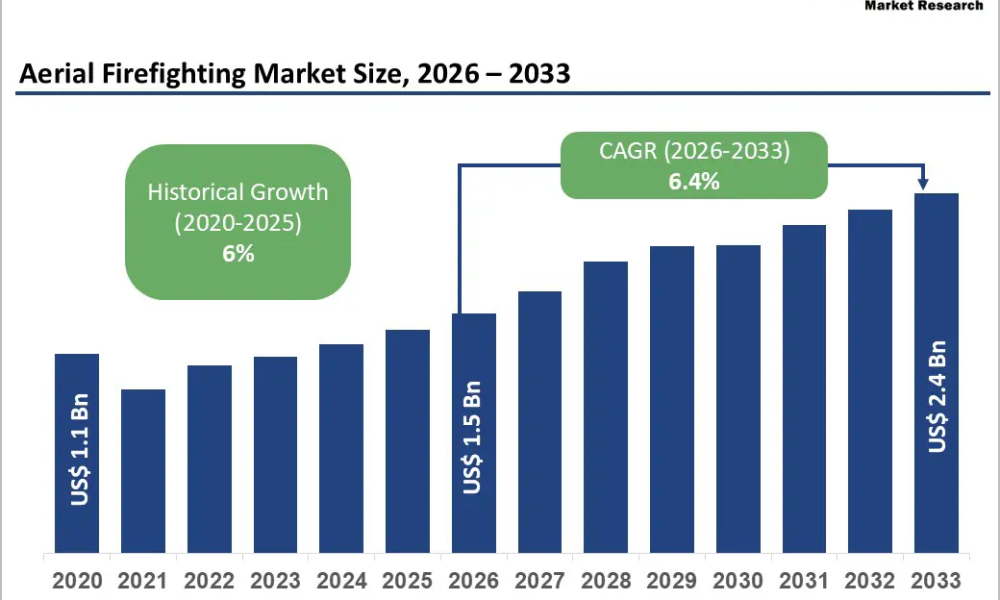
The global aerial firefighting market size is likely to be valued at US$ 1.5 billion in 2026, and is projected to reach US$ 2.4 billion by 2033, growing at a CAGR of 6.4% during the forecast period 2026 – 2033. This steady expansion reflects increasing wildfire intensity and expanding fire suppression budgets worldwide. Public agencies are allocating more funding to modernize aerial fleets and improve readiness. Fixed-wing aircraft remain the leading segment due to their ability to carry large volumes of fire retardants across vast distances. North America represents the leading regional market because of frequent wildfires, large forest coverage, and strong government funding. The region also benefits from established aerial firefighting infrastructure and experienced service providers. Meanwhile, other regions are accelerating investments to match evolving wildfire risks. These factors collectively reinforce the long-term growth outlook of the aerial firefighting industry.
Get Your FREE Sample Report Instantly Click Now: https://www.persistencemarketresearch.com/samples/36107
The key players studied in the report include:
- Conair Group Inc.
- Coulson Aviation (USA) Inc.
- Erickson Incorporated
- Neptune Aviation Services, Inc.
- 10 Tanker Air Carrier, LLC
- Bridger Aerospace Group Holdings, Inc.
- Air Spray Ltd.
- Dauntless Air, Inc.
- Aero-Flite, Inc.
- Babcock International Group PLC
- Viking Air Limited
- Textron Inc.
- Lockheed Martin Corporation
- Airbus SE
Key Highlights from the Report
➤ The aerial firefighting market is projected to grow from US$ 1.5 billion in 2026 to US$ 2.4 billion by 2033 at a CAGR of 6.4%
➤ Rising wildfire intensity is driving sustained government investment in aerial firefighting aircraft and suppression programs
➤ Fixed-wing firefighting aircraft dominate due to higher payload capacity and operational efficiency over large fire zones
➤ North America leads the aerial firefighting market due to extensive wildfire exposure and strong institutional support
➤ Increasing public safety priorities are accelerating procurement of advanced firefighting aircraft and helicopters
➤ Integration of surveillance technology and precision dropping systems is improving operational efficiency and fire containment
➤ Expanding wildfire risk in emerging regions is creating long-term demand for aerial firefighting services and equipment
Market Segmentation
By Platform Type
- Fixed-Wing Aircraft
- Helicopters
- Unmanned Aerial Systems (UAS)/Drones
- Hybrid/Optionally-Piloted Aircraft
By Service Model
- Government-Owned & Operated
- Government-Contracted Private Operators
- On-Demand/Call-When-Needed (CWN) Leasing
- Original Equipment Manufacturer (OEM) Direct Sales
- Software/Subscription-Based
By Technology
- Delivery Systems
- Sensors & Imaging Systems
- Mission Planning & Command Software
- Autonomy Systems
- Communication Systems
- Fire Retardant Solutions
By Region
- North America
- Europe
- East Asia
- South Asia & Oceania
- Latin America
- Middle East & Africa
Regional Insights
North America dominates the aerial firefighting market due to frequent wildfire incidents and large forest landscapes. The United States and Canada invest heavily in aerial suppression infrastructure. Government funding supports aircraft procurement, pilot training, and emergency readiness. Strong coordination between federal and regional agencies improves firefighting efficiency. The region also hosts leading aircraft manufacturers and firefighting service providers. Increasing wildfire severity continues to drive fleet modernization. Advanced technology adoption enhances firefighting effectiveness. Insurance and disaster management priorities also support aerial firefighting investment. These factors ensure North America remains the leading regional market.
Europe represents another significant market, driven by recurring wildfires in southern countries. Governments are strengthening aerial firefighting capabilities to protect forests and urban areas. Cross-border cooperation improves resource sharing and emergency response efficiency. Investments in aircraft modernization are increasing across the region. Climate-related fire risks are prompting proactive preparedness measures. Regional firefighting alliances are strengthening aerial suppression networks. Asia Pacific is also emerging as a growing market due to rising wildfire awareness. Governments are allocating new budgets for aerial firefighting programs. These developments indicate expanding global adoption.
Customize This Report for Your Exact Requirements: https://www.persistencemarketresearch.com/request-customization/36107
Market Drivers
The primary driver of the aerial firefighting market is the rising frequency and intensity of wildfires worldwide. Climate change has increased temperatures and drought conditions, creating highly flammable environments. Forest-urban interface expansion has also increased fire risks near populated areas. Governments are prioritizing rapid fire suppression to protect communities and ecosystems. Aerial firefighting provides faster response compared to ground-based methods. Aircraft can access remote and difficult terrain quickly. This rapid deployment capability is essential for minimizing fire spread. Increased disaster management budgets are supporting aircraft procurement. These trends are strengthening long-term market growth.
Another important driver is technological advancement in firefighting aircraft systems. Modern aircraft feature advanced navigation, targeting, and communication tools. Precision drop technology improves water and retardant delivery accuracy. Surveillance systems help identify fire hotspots and monitor spread patterns. Enhanced aircraft performance improves operational efficiency. Governments are replacing older aircraft with advanced models. These improvements reduce response time and operational costs. Integration with emergency management systems enhances coordination. Technology adoption is expected to drive sustained demand.
Market Restraints
High operational and maintenance costs represent a major restraint in the aerial firefighting market. Aircraft acquisition requires significant capital investment. Maintenance, fuel, and pilot training costs add ongoing expenses. Budget limitations can restrict fleet expansion in developing regions. Smaller countries may rely on shared or rented aircraft. Financial constraints may delay procurement decisions. Operating specialized aircraft requires skilled personnel. Maintenance complexity also increases operational costs. These factors can slow adoption in cost-sensitive markets.
Limited availability of specialized aircraft also restricts market growth. Manufacturing aerial firefighting aircraft requires technical expertise. Production capacity constraints can delay delivery timelines. Converting commercial aircraft for firefighting is complex. Regulatory approvals add additional challenges. Aircraft shortages may reduce response readiness. Service providers face fleet expansion limitations. This supply constraint can impact market scalability. Addressing aircraft availability remains essential for growth.
Market Opportunities
Expanding wildfire risk in emerging regions presents significant growth opportunities. Governments are recognizing the importance of aerial firefighting preparedness. New investments in aircraft procurement are increasing globally. Developing countries are strengthening disaster response infrastructure. International partnerships are supporting aircraft acquisition. Private contractors are expanding service offerings. These developments are opening new revenue streams. The market is expected to benefit from expanding global adoption.
Technological innovation also creates new opportunities for market expansion. Advanced aircraft designs improve firefighting efficiency. Digital monitoring systems enhance fire detection and response. Automation and predictive analytics improve resource allocation. Governments are investing in modern firefighting solutions. Aircraft upgrades and retrofits are increasing demand. Innovation supports long-term operational efficiency. These advancements strengthen market potential.
Recent Developments
- In July 2025, Airbus expanded aerial firefighting aircraft support services to enhance wildfire response readiness.
- In March 2026, Lockheed Martin strengthened aerial firefighting aircraft upgrade programs to improve operational efficiency.
Ready to Dive Deep? Buy Full Report Today: https://www.persistencemarketresearch.com/checkout/36107
Frequently Asked Questions
➤ What are the main factors influencing the Aerial Firefighting Market growth through 2033?
➤ Which companies are the major sources in the Aerial Firefighting Market industry?
➤ What are the market’s opportunities, risks, and general structure in the Aerial Firefighting Market?
➤ Which of the top Aerial Firefighting Market companies compare in terms of sales, revenue, and prices?
➤ How are market types and applications and deals, revenue, and value explored in the Aerial Firefighting Market?
Future Opportunities and Growth Prospects
The aerial firefighting market is expected to witness sustained expansion due to rising wildfire risks and growing suppression budgets. Governments will continue prioritizing aerial firefighting readiness and fleet modernization. Emerging economies are expected to increase investment in aerial firefighting infrastructure. Private contractors will play a larger role in service delivery. Technological advancements will improve aircraft performance and operational efficiency. International collaboration will strengthen wildfire response capabilities. Innovation in aircraft design will support market scalability. These trends will create long-term growth opportunities. The market outlook remains strong through 2033.




