
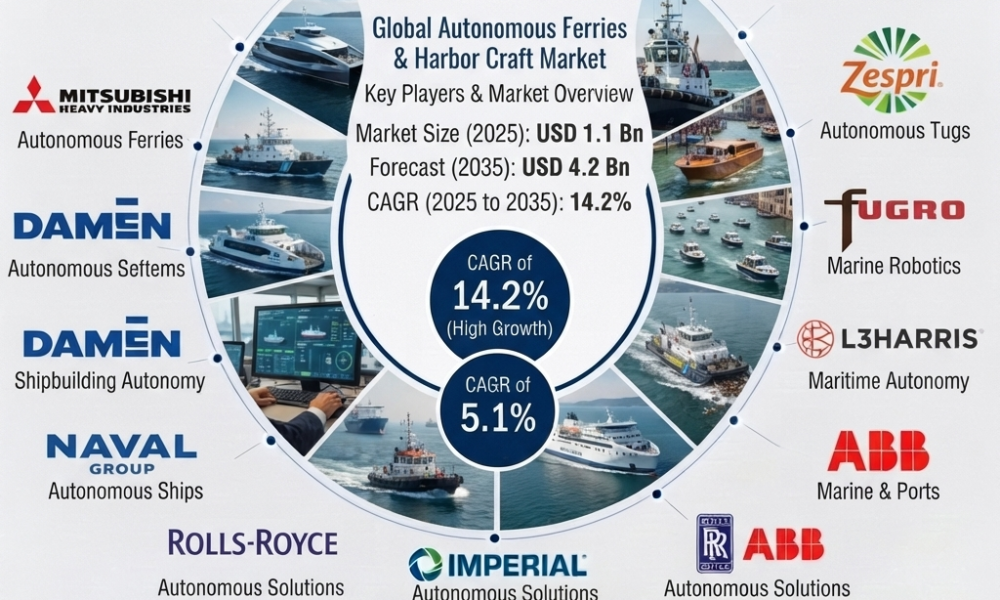
The global autonomous ferries & harbor craft market is projected to increase from USD 210.0 million in 2026 to USD 6,074.0 million by 2036, advancing at a 40.0% CAGR during the forecast period. Market expansion is being shaped by scheduled-route automation, remote shore supervision, automated docking, and the growing need to maintain dependable vessel service despite crew availability pressures and rising operating costs.
Autonomous ferry development is increasingly moving from technology demonstrations toward route-specific commercial planning. DNV launched four functional categories within its AROS class notations for autonomous vessels in January 2025, separating navigation, engineering, operations, and safety requirements. The framework provides developers with a clearer basis for demonstrating vessel capability and supports the development of approval cases for autonomous operations.
Commercial programs are also drawing technical lessons from the unmanned marine vehicles sector while maintaining distinct commercial requirements for passenger and harbor craft. Norway and Japan are pursuing autonomous vessel deployment through different operating and approval models. Norway is building around fixed public ferry contracts and scheduled crossings, while Japan is using certified autonomous ships to demonstrate navigation capabilities across passenger and cargo operations.
Electric propulsion and shore infrastructure are becoming important elements of autonomous vessel economics. Frequent ferry crossings require dependable charging windows, while remote supervision systems must remain available throughout scheduled operations. Investment in electric ships and marine power battery systems is therefore influencing vessel selection, route planning, reserve-power requirements, and overall fleet utilization.
What Are the Key Segments in the Autonomous Ferries & Harbor Craft Market?
- Urban Passenger Ferries are expected to lead the vessel application landscape with a 46.0% share in 2026, supported by repeatable routes, fixed terminals, and predictable boarding locations that create suitable operating conditions for autonomous service.
- Urban Waterway Transit is projected to account for 44.0% share in 2026, reflecting the suitability of frequent short-distance crossings for automated navigation, docking, and centralized operational oversight.
- Autonomy Systems are estimated to hold 44.0% share of the technology category in 2026, as navigation software, control systems, and automated decision-making become central to autonomous vessel deployment.
- Electric Propulsion is gaining relevance on short and repetitive routes where charging schedules can be incorporated into vessel timetables and shore infrastructure planning.
- Shore Control and Communication Systems are becoming essential to commercial deployment because operators need continuous visibility into vessel status, route progress, abnormal conditions, and intervention requirements.
Get detailed market forecasts, competitive benchmarking, and pricing trends:
https://www.futuremarketinsights.com/reports/sample/rep-gb-34100
Which Countries Are Showing the Strongest Growth in Autonomous Ferries & Harbor Craft?
China is projected to record a 43.0% CAGR through 2036, supported by intelligent-vessel development, autonomous navigation programs, and growing interest in integrating automated control systems into commercial marine operations. The country’s large maritime manufacturing base also provides an ecosystem for testing vessel automation, communication systems, and electric propulsion technologies.
Japan is forecast to advance at a 42.0% CAGR, driven by certified autonomous vessel programs and efforts to demonstrate autonomous navigation across passenger and cargo applications. Route validation and vessel certification remain important as operators assess how automated systems can function within established maritime operating procedures.
European Union demand is projected to grow at a 40.0% CAGR, reflecting interest in maritime automation, lower-emission vessel technologies, and structured operating frameworks. Fixed routes and regulated port environments can provide suitable conditions for testing autonomous navigation and automated docking.
Norway is expected to expand at a 39.0% CAGR, with scheduled ferry services providing a practical environment for autonomous crossing and docking technologies. Fixed public-service routes allow operators to evaluate vessel performance against established timetables, terminal arrangements, and recurring passenger demand.
South Korea is projected to grow at a 38.0% CAGR, supported by intelligent vessel development and technology integration across maritime operations. The country’s shipbuilding capabilities create opportunities for combining autonomous navigation, communications, propulsion, and vessel-control technologies.
Singapore is also forecast to register a 38.0% CAGR, with its concentrated port environment creating opportunities for automated harbor operations, controlled vessel movements, and digitally supervised marine services.
India is expected to advance at a 37.0% CAGR, supported by expanding maritime infrastructure and increasing interest in technology-enabled vessel operations. Commercial adoption can benefit from autonomous systems designed around defined routes, controlled terminals, and clearly established shore-based operating responsibilities.
How Is Regional Demand Shaping the Autonomous Ferries & Harbor Craft Market?
Regional adoption is being influenced by the operating environment in which autonomous vessels are deployed. Norway’s scheduled ferry structure provides an opportunity to integrate autonomous crossing and docking into established public-service contracts. Japan is emphasizing certified autonomous ships and practical navigation validation across different vessel categories.
In Asia, China, South Korea, Singapore, and Japan are developing opportunities around intelligent maritime infrastructure and controlled operating environments. These markets can support repeated testing of autonomous navigation, communication, and docking systems. European markets are placing greater attention on regulatory readiness, emissions reduction, and integration with existing ferry and port operations.
What Is Changing the Competitive Landscape?
Competition is shifting from autonomous navigation demonstrations toward evidence of dependable commercial service. Vendors are increasingly required to show how their systems perform during repeated crossings, docking sequences, changing weather conditions, and abnormal operating events.
Kongsberg Maritime is positioned within the market through its marine automation, navigation, and vessel-control capabilities. Zeabuz is associated with autonomous passenger vessel development, targeting repeatable waterway operations where automated navigation and docking can be integrated into commercial service models.
Fjord1 represents the vessel-operator side of the ecosystem, where scheduled ferry operations provide a practical environment for evaluating automation, route performance, and operational continuity. Mitsui O.S.K. Lines is involved in broader autonomous shipping development, supporting the transition of automated navigation technologies toward commercial maritime applications.
Other important participants include Furuno Electric, Anschütz, Wärtsilä, and DNV, with competition spanning navigation systems, bridge equipment, vessel automation, propulsion integration, and vessel assurance. Differentiation increasingly depends on operational evidence, system integration, automated docking capability, and the ability to provide qualification and assurance support.
What Does the Analyst Say About the Autonomous Ferries & Harbor Craft Market?
“The autonomous passenger ferries market is being evaluated on service reliability rather than autonomous navigation alone. Operators are assessing whether autonomous vessels can sustain scheduled operations across varying weather, traffic, and harbor conditions while maintaining clear operational oversight. Market adoption will depend on proven fleet performance, well-defined remote operating models, and documented service experience under routine commercial conditions.”
– Nikhil Kaitwade, Principal Analyst at Future Market Insights
Source: FMI’s proprietary forecasting model and primary research
What Is Driving Demand for Autonomous Ferries & Harbor Craft?
Scheduled Routes Create Favorable Conditions for Automation
Autonomous ferries benefit from operating environments where routes, terminals, departure windows, and docking locations remain relatively predictable. These characteristics allow operators to collect route data and evaluate autonomous navigation against measurable service requirements.
Crew Availability Is Increasing the Focus on Remote Operations
Crew pressure is encouraging operators to examine technologies that can shift selected vessel-management tasks toward shore-based supervision. Remote control centers can provide oversight while allowing trained personnel to intervene when weather, traffic, or technical conditions require additional support.
Automated Docking Supports Repeatable Passenger Service
Docking represents one of the most repetitive and operationally sensitive parts of ferry service. Automated docking systems can use fixed terminal layouts and recurring approach patterns to improve consistency while reducing the operational burden associated with repeated maneuvering.
Electric Propulsion Connects Vessel Design with Route Economics
Short ferry routes can be compatible with electric propulsion when charging infrastructure is positioned around scheduled operating cycles. Battery capacity, charging time, reserve power, and shore-side electrical infrastructure therefore become part of the same commercial planning process as vessel acquisition.
What Are the Key Market Restraints?
Autonomous ferry deployment requires more than navigation software. Operators must establish procedures for remote intervention, passenger safety, emergency response, communications, and vessel recovery. These requirements can increase the engineering and approval burden before a service becomes commercially repeatable.
Infrastructure requirements can also constrain adoption. Charging systems, communication networks, shore control centers, and upgraded terminal equipment may need to be installed alongside autonomous vessels. For operators with established fleets, the cost and complexity of coordinating these systems can influence deployment timing.
Weather and harbor traffic introduce additional operational challenges. Passenger ferries must maintain reliable service despite changing visibility, wind, currents, vessel movements, and unexpected obstacles. Autonomous systems therefore require extensive validation before operators can depend on them for routine scheduled service.
What Opportunities Exist for Autonomous Ferry and Harbor Craft Manufacturers?
The strongest opportunities are emerging around route-specific autonomous operations rather than unrestricted vessel autonomy. Manufacturers can develop systems optimized for fixed passenger routes, controlled harbor movements, and repeatable docking environments where operating parameters can be clearly defined.
There is also an opportunity to combine autonomy with electric propulsion, remote fleet monitoring, predictive maintenance, and shore-based control. Integrated solutions can allow operators to evaluate vessel readiness, battery condition, route status, and intervention requirements through a unified operating platform.
Service-based business models could further reduce the initial integration burden for ferry operators. Technology licensing, managed autonomous operations, and long-term service contracts can provide alternatives to complete technology ownership while allowing vendors to retain responsibility for software updates and system performance.
Drive Your Business Growth Strategy: Checkout the Report for Key Insights!
https://www.futuremarketinsights.com/checkout/34100
How Is the Autonomous Ferries & Harbor Craft Market Segmented?
The autonomous ferries & harbor craft industry is segmented by vessel type, application, component, end-use, business model, and region.
By Vessel Type: Urban Passenger Ferries, Harbor Tugs and Workboats, Inter-Island Ferries, and Coastal Ferries.
By Application: Urban Waterway Transit, Port Operations, Inter-Island Passenger Transport, and Scheduled Coastal Services.
By Component: Autonomy Systems, Propulsion Systems, Communication Suites, and Supporting Vessel Equipment.
By End Use: Public Transit Authorities, Port Operators, and Private Commercial Companies.
By Business Model: Operations Contracts, Technology Licensing, and Direct Vessel Sales.
Which Vessel Type Is Creating the Largest Commercial Opportunity?
Urban passenger ferries provide a particularly structured environment for autonomy because they often operate on repeatable routes with defined boarding points and predictable departure schedules. This allows autonomous navigation and docking technologies to be evaluated against recurring commercial service requirements.
Why Is Urban Waterway Transit Important?
Urban waterway transit involves frequent crossings and visible public operations, making service reliability central to adoption. Operators must demonstrate that autonomous vessels can maintain schedules while responding safely to changing traffic, weather, and passenger-service conditions.
How Are Autonomy Systems Changing Vessel Operations?
Autonomy systems connect navigation, vessel control, communications, and remote supervision. Their commercial value depends on how effectively these functions work together during routine operation and how clearly operators can intervene during abnormal situations.
What Are the Drivers, Restraints and Opportunities in the Autonomous Ferries & Harbor Craft Market?
Autonomous ferries are transitioning from experimental marine platforms toward route-specific commercial transportation assets.
- Driver: Repeatable ferry routes and fixed terminals provide measurable operating environments for autonomous navigation and docking.
- Restraint: Regulatory approval, passenger safety requirements, and shore-control infrastructure can increase deployment complexity.
- Opportunity: Integrated autonomous and electric ferry platforms can combine navigation, energy management, remote supervision, and predictive maintenance.
What Is the Autonomous Ferries & Harbor Craft Market Demand Outlook?
Demand is expected to increasingly concentrate on commercial routes where autonomous technology can demonstrate measurable improvements in service continuity, operating efficiency, and vessel utilization. Fixed routes provide operators with repeatable conditions for validating autonomous navigation and automated docking.
Electric propulsion will remain closely connected to autonomous ferry deployment because route economics depend on charging availability and battery reserve. Operators will need to evaluate vessel acquisition, charging infrastructure, shore power, and remote supervision as a combined investment rather than as separate technology decisions.
Why Are Urban Passenger Ferries a Key Focus?
Urban passenger ferries operate on repeatable schedules and established terminal infrastructure, creating conditions in which autonomous systems can be validated through recurring service. Their public-facing nature also places greater importance on safety procedures, operational transparency, and reliable intervention mechanisms.
Why Is Shore Control Becoming Essential?
Shore control provides operators with a mechanism to supervise autonomous vessels, monitor route conditions, respond to technical alerts, and intervene when required. As commercial fleets expand, centralized supervision can also help operators coordinate multiple vessels and standardize operational procedures.
How Fast Are Key Countries Growing in the Autonomous Ferries & Harbor Craft Market?
China is projected to grow at 43.0% CAGR, followed by Japan at 42.0%, the European Union at 40.0%, Norway at 39.0%, South Korea and Singapore at 38.0%, and India at 37.0% through 2036. These differences reflect varying approaches to intelligent vessel development, certification, scheduled ferry services, harbor automation, maritime infrastructure, and commercial route deployment.
About Future Market Insights
Future Market Insights (FMI) is a global market intelligence and consulting firm providing syndicated research, custom research, and strategic consulting services across automotive, transportation, aerospace, maritime, technology, industrial, and other high-growth sectors. FMI’s research combines primary research, proprietary forecasting models, and industry analysis to help organizations evaluate emerging markets, technology adoption, competitive dynamics, and investment opportunities.



