
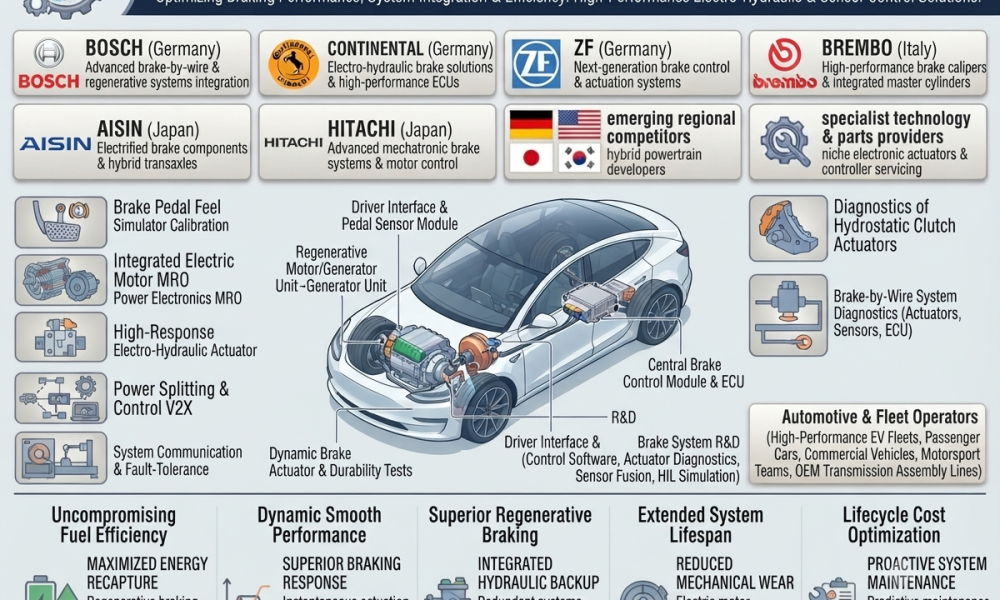
The global regenerative brake-by-wire systems market is projected to grow from USD 1,060.0 million in 2026 to USD 2,930.0 million by 2036, advancing at a 10.7% CAGR between 2026 and 2036. Market expansion is being supported by the increasing electrification of passenger vehicles and the need for braking architectures that can coordinate motor recuperation and friction braking across changing battery conditions, road surfaces, vehicle speeds, and emergency scenarios.
Electrified vehicles require software-controlled braking systems capable of continuously distributing deceleration between regenerative braking and conventional friction braking. The International Energy Agency reported in May 2026 that electric-car sales exceeded 20 million units during 2025, accounting for approximately one quarter of global car sales. The expanding electric vehicle population is creating a wider installed base for regenerative braking systems that require dependable blending, pedal response, actuator control, and fault management.
Commercial value is increasingly linked to the ability to validate one control architecture across multiple electrified vehicle platforms. Brake-by-wire systems must maintain consistent driver response while providing independent fallback capability when electrical or software-related faults occur. This is placing greater emphasis on software ownership, calibration support, functional-safety validation, and regional engineering capabilities.
What Are the Key Segments in the Regenerative Brake-by-Wire Systems Market?
- Module is expected to account for 41.0% of the component category in 2026, reflecting the concentrated value of integrated actuation and control hardware within regenerative brake-by-wire architectures.
- Passenger Cars are estimated to represent 66.0% share in 2026, supported by repeated deployment and qualification of braking technologies across high-volume electrified vehicle platform families.
- Battery Electric Vehicles are forecast to capture 48.0% of demand in 2026, owing to their direct dependence on coordinated regenerative and friction braking to manage vehicle deceleration and energy recovery.
- Integrated Control Architectures are becoming increasingly important as automakers seek braking systems that combine actuator commands, sensor information, regenerative braking logic, and friction-brake control.
- Functional-Safety and Redundant Actuation Systems are gaining importance as braking suppliers address emergency stopping requirements and electrical-fault scenarios before series-production approval.
Get detailed market forecasts, competitive benchmarking, and pricing trends:
https://www.futuremarketinsights.com/reports/sample/rep-gb-34316
Which Countries Are Showing the Strongest Growth in Regenerative Brake-by-Wire Systems?
India is projected to record the fastest growth among the profiled countries, advancing at a 14.4% CAGR through 2036. Expanding vehicle electrification and increasing local engineering activity are creating demand for braking architectures that can be calibrated to regional vehicle platforms. Suppliers with local technical support can help automakers address platform-specific braking behavior while maintaining documentation required for production approval.
China is forecast to expand at a 13.4% CAGR, supported by rapid electric vehicle platform development and demand for localized software integration. Chinese automakers operate on relatively short platform cycles, increasing the importance of calibration support and software development capabilities that can keep pace with vehicle launches while maintaining fault documentation.
South Korea is expected to grow at a 12.3% CAGR, supported by its strong automotive manufacturing base and continued development of electrified vehicle technologies. Brake suppliers serving Korean automakers need to integrate regenerative braking, electronic actuation, and vehicle-control software while meeting platform-level validation requirements.
The United States is projected to advance at an 11.2% CAGR. Federal braking and electronic-stability requirements remain important reference points for automated and unconventional vehicle architectures. NHTSA reported in December 2025 that its completed research examined braking and electronic-stability methods across several federal standards relevant to automated vehicle designs.
Germany is forecast to register a 10.2% CAGR, reflecting demand from established automotive manufacturers developing increasingly software-defined electrified platforms. Qualification, functional safety, and documented braking performance remain central considerations for production programs.
Japan is expected to grow at a 9.1% CAGR, with automakers placing emphasis on model-level qualification and service continuity. Long-running hybrid and electrified vehicle programs require repeated validation to ensure braking behavior remains consistent across vehicle generations and operating conditions.
How Is Regional Demand Shaping the Regenerative Brake-by-Wire Systems Market?
Regional requirements are creating different commercialization pathways for brake-by-wire developers. United States programs place emphasis on federal stopping tests and measurable actuator performance, particularly as automated and unconventional vehicle layouts are evaluated. Chinese programs prioritize rapid software integration and localized calibration, while Japanese manufacturers tend to emphasize model-specific qualification and long-term service continuity.
These differences make regional engineering support increasingly important. Approval evidence, calibration data, software ownership, and testing procedures may not transfer directly between markets. Brake-system developers therefore need technical organizations capable of adapting control strategies while maintaining traceable validation records.
What Is Changing the Competitive Landscape?
Competition is shifting toward integrated braking architectures that combine regenerative control, electronic actuation, software, sensors, and redundant fallback paths. Automakers are evaluating suppliers not only on hardware capability but also on their ability to support calibration, validation, software maintenance, and regional production launches.
Bosch and ZF remain important participants in electronically controlled braking and vehicle-control architectures. Their capabilities span braking hardware, electronic systems, software, and integration support, allowing them to address the increasing overlap between braking and broader vehicle-control functions.
AUMOVIO, Brembo, and Astemo are also participating in the evolving electronic braking ecosystem, with opportunities linked to the integration of braking hardware and software across electrified platforms. As regenerative braking becomes more closely connected with vehicle energy management, component suppliers are increasingly required to demonstrate compatibility with broader electronic architectures.
ADVICS, BWI Group, and Hyundai Mobis add further competition through braking systems, electronic control capabilities, and vehicle-platform integration. Competitive differentiation is increasingly influenced by actuation redundancy, software ownership, calibration capability, functional-safety evidence, and support throughout the vehicle development cycle.
What Does the Analyst Say About the Regenerative Brake-by-Wire Systems Market?
“Regenerative brake-by-wire programs succeed through one control strategy that blends motor recuperation with friction braking across full batteries and low-speed operation under electrical faults. Automakers should judge each architecture through pedal consistency and independent fallback paths alongside clear software ownership throughout the vehicle program. Production awards will favor braking groups that prove these functions locally and support calibration throughout every regional launch.”
– Nikhil Kaitwade, Principal Analyst, Future Market Insights
What Is Driving Demand for Regenerative Brake-by-Wire Systems?
Electric Vehicle Growth Is Expanding the Need for Brake Energy Recovery
Battery electric and hybrid vehicles depend on regenerative braking to recover kinetic energy that would otherwise be dissipated as heat. As electrified vehicle volumes increase, automakers require braking architectures capable of coordinating energy recovery with conventional braking without creating inconsistent pedal behavior.
Software Is Becoming Central to Braking Control
Brake-by-wire architectures increasingly depend on software to determine how braking force is distributed between electric motors and friction brakes. This requires precise calibration across battery state-of-charge, vehicle speed, road conditions, and thermal conditions.
Redundancy Is Becoming a Core Safety Requirement
Electronic braking architectures must preserve stopping capability when sensors, actuators, power supplies, or software functions encounter faults. Independent fallback paths and redundant actuation therefore add importance to functional-safety engineering during vehicle development.
Multi-Platform Architecture Reduces Development Complexity
Automakers can gain commercial value from braking architectures that can be adapted across multiple electrified models. A reusable control strategy can reduce duplicated engineering work while allowing calibration to reflect vehicle mass, battery configuration, motor characteristics, and driving behavior.
What Are the Key Market Restraints?
The development of regenerative brake-by-wire systems requires extensive validation because braking performance must remain consistent across normal operation and fault conditions. Integrating regenerative and friction braking also creates additional software-calibration requirements compared with conventional hydraulic braking architectures.
Functional-safety requirements can increase development costs and extend qualification timelines. Suppliers must demonstrate that braking remains available during electrical faults while documenting software behavior and fallback mechanisms before automakers approve systems for series production.
Regional regulatory differences can create additional engineering work. Braking systems validated in one market may require additional testing, calibration, or documentation before deployment on another vehicle platform or in another jurisdiction.
What Opportunities Exist for Regenerative Brake-by-Wire System Manufacturers?
The expansion of software-defined and electrified vehicle architectures creates opportunities for suppliers capable of combining braking hardware with control software, sensor integration, and functional-safety services. Modular architectures that can be adapted across vehicle platforms can help automakers manage increasingly complex electrified product portfolios.
Another opportunity lies in regional calibration and engineering support. Local teams can shorten development cycles by adapting braking strategies to vehicle specifications and market requirements while maintaining common software foundations and traceable validation documentation.
Suppliers can also expand their role through lifecycle support. Software updates, diagnostic systems, calibration services, and predictive fault monitoring can create recurring commercial relationships beyond the initial brake-system award.
Drive Your Business Growth Strategy: Checkout the Report for Key Insights!
https://www.futuremarketinsights.com/checkout/34316
How Is the Regenerative Brake-by-Wire Systems Market Segmented?
The regenerative brake-by-wire systems industry is segmented by component type, vehicle type, propulsion, sales channel, and region.
By Component Type: Sensors, Modules, Connectors, Software, and Thermal Systems.
By Vehicle Type: Passenger Cars, Light Commercial Vehicles, Heavy Trucks, Buses, and Two-Wheelers.
By Propulsion: Battery Electric Vehicles, Plug-in Hybrid Electric Vehicles, Fuel-cell Vehicles, Hybrid Vehicles, and ICE Retrofit Vehicles.
By Sales Channel: OEMs, Aftermarket, Fleet Operators, Distributors, and Direct Sales.
By Region: North America, Latin America, Western Europe, Eastern Europe, South Asia & Pacific, East Asia, and Middle East & Africa.
Why Are Modules Important to the Market?
Modules combine key electronic and actuation functions within the braking architecture, making them an important concentration of system value. Their ability to coordinate braking commands and communicate with wider vehicle-control systems makes module integration increasingly important for electrified platforms.
Why Do Passenger Cars Dominate Demand?
Passenger cars represent the largest application base for regenerative brake-by-wire systems because automakers are deploying electrified powertrains across high-volume model families. Reusing validated braking architectures across multiple passenger vehicle platforms can help manufacturers manage development and qualification requirements.
How Does Battery Electric Propulsion Influence Adoption?
Battery electric vehicles rely heavily on regenerative braking because motor-based energy recovery directly contributes to vehicle efficiency. Brake-by-wire systems allow software to coordinate regenerative braking with friction braking while preserving required stopping performance when energy recovery is limited.
What Are the Drivers, Restraints and Opportunities in the Regenerative Brake-by-Wire Systems Market?
Regenerative brake-by-wire technology is becoming a platform-level control function as automakers integrate braking, energy recovery, and electronic vehicle architectures.
- Driver: Increasing electric vehicle adoption is expanding demand for coordinated regenerative and friction braking.
- Restraint: Functional-safety validation, redundant actuation, and regional approval requirements increase development complexity.
- Opportunity: Reusable software architectures and local calibration services can support multiple electrified vehicle platforms and regional launches.
What Is the Regenerative Brake-by-Wire Systems Market Demand Outlook?
Demand is expected to remain closely connected to electrification as automakers expand battery electric and hybrid vehicle portfolios. The ability to blend regenerative and friction braking smoothly will remain central to vehicle efficiency, pedal feel, and stopping performance.
The market is also moving toward software-led braking architectures. Automakers increasingly need control systems that can be updated, calibrated, and integrated with broader electronic vehicle platforms while maintaining documented safety behavior throughout the vehicle lifecycle.
Why Is Software Ownership Becoming Important?
Software determines how regenerative and friction braking interact under different vehicle and battery conditions. Clear software ownership allows automakers and suppliers to manage calibration, updates, diagnostics, and regional adaptations throughout long vehicle programs.
Why Are Redundant Actuation Paths Critical?
Redundancy provides an additional layer of protection when an electronic braking function encounters a fault. Independent fallback paths help preserve braking capability and are becoming an important part of functional-safety validation for electronically controlled braking systems.
How Fast Are Key Countries Growing in the Regenerative Brake-by-Wire Systems Market?
India is projected to grow at 14.4% CAGR, followed by China at 13.4%, South Korea at 12.3%, the United States at 11.2%, Germany at 10.2%, and Japan at 9.1% through 2036. The differences reflect varying electric vehicle adoption patterns, vehicle-platform development cycles, regulatory requirements, software integration capabilities, and local engineering support.
About Future Market Insights
Future Market Insights (FMI) is a global market intelligence and consulting firm providing syndicated research, custom research, and strategic consulting services across automotive, transportation, aerospace, technology, industrial, and other emerging sectors. FMI’s research combines primary research, proprietary forecasting models, and industry analysis to help organizations evaluate market opportunities, technology adoption, competitive dynamics, and investment trends.



