
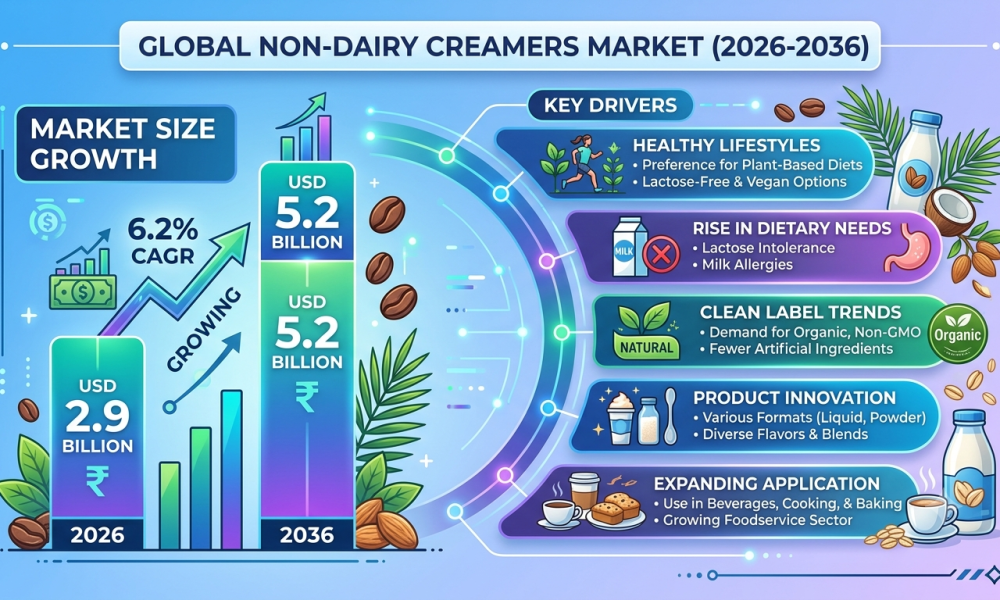
The global non-dairy creamers market is projected to grow from USD 2.9 billion in 2026 to USD 5.2 billion by 2036, expanding at a 6.2% CAGR over the forecast period, according to Future Market Insights (FMI). Demand is supported by recurring coffee consumption across households, cafés, restaurants, foodservice operations, and industrial beverage applications.
Coffee consumption outside the home remains an important demand driver. Cafés, restaurants, and beverage-service operators purchase creamers on a recurring basis, creating consistent demand for products that can deliver reliable mixing, whitening, and flavor performance. The wider familiarity with plant-based beverages in several markets is also creating opportunities for dairy-free creamer formulations.
Get detailed market forecasts, competitive benchmarking, and pricing trends: https://www.futuremarketinsights.com/reports/sample/rep-gb-8691
Market Snapshot
Powder products are expected to hold 62.0% of the market in 2026, supported by ambient storage, measured dosing, and suitability for instant beverage mixes and bulk processing. Powder formats can also move efficiently through distribution networks without refrigerated handling.
By base, vegetable oil is projected to account for 55.0% in 2026. Spray-dried systems allow formulators to control fat levels and whitening performance while fitting established production processes.
Food and beverage processing is forecast to represent 48.0% of end use in 2026. Once a creamer is qualified against a finished formulation, processors can place repeat orders, making consistent dispersibility and flavor behavior important commercial considerations.
Indirect sales/B2C is expected to lead the distribution channel with a 58.0% share in 2026, reflecting the role of grocery and digital retail channels in household purchases.
Formulation, Labeling and Performance Shape Market Opportunities
The market is being shaped by a balance between formulation performance and dairy-free positioning. Milk-derived caseinate can create additional compliance considerations because products positioned as non-dairy may still contain milk-derived ingredients requiring accurate allergen disclosure.
FDA Import Alert 99-22, updated in April 2026, lists non-dairy creamer entries containing whey or caseinate with undeclared milk. This reinforces the importance of ingredient disclosure and allergen documentation when developing and distributing formulations.
Plant-based recipes present another area of opportunity. Formulators are seeking products that provide dairy-free positioning while maintaining the taste, foam, and mixing characteristics expected from conventional creamers. Recent product launches and reformulations show continued attention to ingredient lists and plant-based alternatives.
Nandini Roy Choudhury, Principal Consultant at Future Market Insights, notes: “Creamer economics improve when a formulation survives the customer’s actual coffee temperature and mixing process without repeated adjustment. The strongest commercial offers also reduce label review work while fitting the storage method used by the processor or café.”
Country Growth Outlook
Growth varies across the profiled markets. South Korea is projected to record a 7.6% CAGR, followed by the United Kingdom at 6.6%, Japan at 6.2%, Germany at 5.8%, and the USA at 4.9% during the assessment period.
South Korea’s café and convenience channels create demand for creamers that can mix quickly during frequent beverage preparation. In the United Kingdom, established familiarity with alternative beverages supports the development of plant-based creamer products.
Japan’s convenience-led coffee consumption and compact household formats support market expansion, while clear ingredient statements remain important during distributor and retail review. Germany’s established alternative-food market creates opportunities for plant-based creamers, although product naming and dairy terminology require careful consideration.
In the United States, strong coffee consumption and broad availability of plant-based products support demand for non-dairy creamers. Clear product descriptions and accurate ingredient communication remain important for retail distribution.
Competitive Landscape
The competitive landscape includes branded consumer platforms, private-label manufacturers, plant-based specialists, and foodservice-focused suppliers. Key companies profiled by FMI include Nestlé S.A., Danone S.A., TreeHouse Foods, Inc., Laird Superfood, Inc., Califia Farms, LLC, CROPP Cooperative (Organic Valley), Flora Food Group B.V., and Rich Products Corporation.
Recent developments include Rich Products Corporation’s June 2026 packaging and screw-cap update for All-In-One Creamer, Danone’s June 2025 opening of a USD 65 million production line in Jacksonville supporting International Delight creamers and other beverages, and Nestlé’s January 2025 opening of its Glendale beverage factory and distribution center supporting Coffee mate, natural bliss, and Starbucks creamers.
Access full Report in PDF Format@ https://www.futuremarketinsights.com/reports/brochure/rep-gb-8691
Report Scope
The FMI study analyzes the non-dairy creamers market by form, base, end use, and distribution channel. The report covers powder and liquid forms; vegetable oil and plant-based milk bases; food and beverage processing, HoReCa/foodservice, and household/retail end uses; and indirect sales/B2C and direct sales/B2B distribution channels.
The study provides country-level analysis across North America, Latin America, Europe, East Asia, South Asia, Oceania, and the Middle East and Africa.
Read the complete Non-Dairy Creamers Market analysis and forecast: https://www.futuremarketinsights.com/reports/non-dairy-creamer-market
About Future Market Insights
Future Market Insights (FMI) is a global market intelligence and consulting firm providing syndicated research, custom research, and consulting services across multiple industries. FMI’s research helps business leaders understand market dynamics, emerging opportunities, competitive developments, and long-term growth patterns.



