
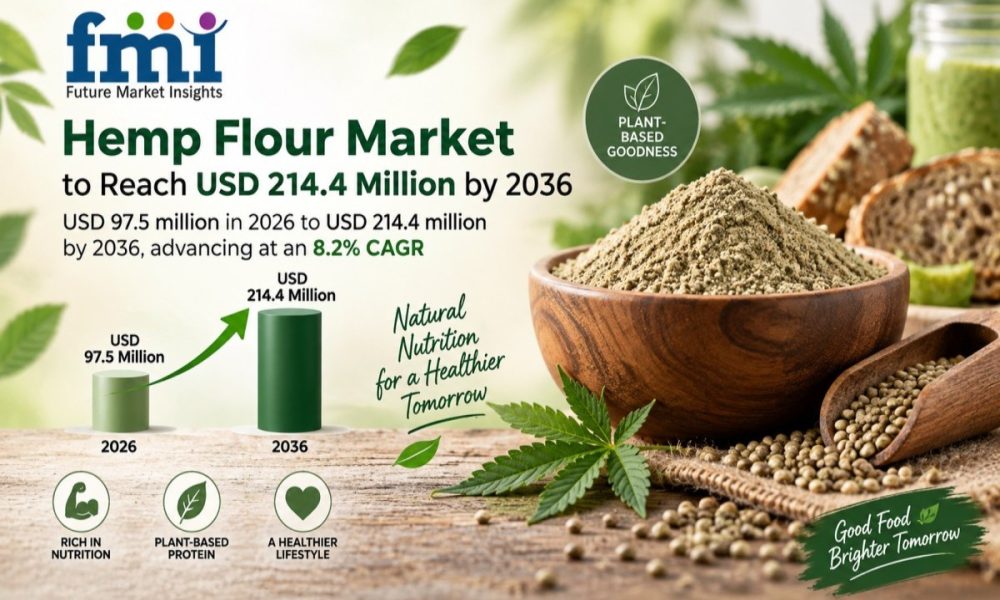
Global hemp flour market projected to grow from USD 97.5 million in 2026 to USD 214.4 million by 2036 at an 8.2% CAGR, according to Future Market Insights
The global Hemp Flour Market is projected to reach USD 214.4 million by 2036, up from an estimated USD 97.5 million in 2026, expanding at a compound annual growth rate (CAGR) of 8.2% during the forecast period, according to the latest analysis by Future Market Insights (FMI).
The market is expected to generate an incremental opportunity of USD 116.9 million between 2026 and 2036. Growth is primarily driven by industrial bakery reformulation, the incorporation of seed-derived functional protein and dietary fiber into everyday food staples, expanding domestic grain hemp cultivation, and increasing consumer preference for clean-label, plant-based nutrition.
Hemp flour is a nutrient-dense ingredient derived from milled or defatted hemp seed material, offering a balanced profile of amino acids, minerals, and dietary fiber without gluten. The market encompasses standard milling and fine patisserie grades available in dry powder, liquid, paste, and granule forms, used extensively across commercial bakery production, snacks, and specialized dietary formulations.
Get Detailed Market Forecasts, Competitive Benchmarking, and Pricing Trends:
https://www.futuremarketinsights.com/reports/sample/rep-gb-35223
Standard Milling Grade Anchors Industrial Qualification Standard milling grade is expected to account for 40.0% of the grade segment in 2026, maintaining its position as the largest and most widely adopted product tier.
Commercial bakeries rely on standard milling grade as their baseline qualification specification due to its predictable moisture content and consistent particle size distribution. Establishing a repeatable baseline reduces trial variables before industrial bakeries evaluate premium organic or identity-preserved claims.
Adoption is further reinforced by government procurement guidelines, such as the USDA AMS Bakery Flour Mix specification, which emphasizes specification-led buying for commercial flour and improver systems.
Powder-Dry Form Commands Processing Lines The powder – dry form is estimated to hold a 42.0% volume share in 2026, leading the form category.
Dry powdered hemp flour integrates directly into existing commercial flour-handling, bulk-storage, and pneumatic dosing equipment without requiring cold-chain logistics or emulsification infrastructure. This mechanical compatibility allows millers to adjust particle specifications within standard dry milling processes, significantly lowering trial failure rates during bakery batch runs.
Bread & Rolls Segment Drives Repeat Application Demand The bread & rolls segment is projected to account for 29.0% of total application demand in 2026.
Bread and rolls provide the strongest repeat-use commercial base for hemp flour, as partial flour substitution (typically 5% to 15%) fits standard mixing, proofing, and baking schedules. While higher inclusion rates alter dough hydration and gluten network strength, targeted inclusion delivers plant protein claims without compromising consumer texture expectations. Additional applications gaining traction include cakes & muffins, biscuits & cookies, and viennoiserie.
Direct-to-Industrial Sales Lead Distribution Direct sales to industrial bakeries are estimated to represent 51.0% of distribution in 2026, while conventional claims are projected to hold 53.0% of the claim category.
Direct commercial arrangements shorten the technical qualification cycle, enabling millers and industrial bakers to conduct joint line trials, align certificates of analysis (CoAs), and negotiate multi-year supply agreements. Conventional flour remains the dominant volume channel because it circumvents the administrative complexities and supply-chain scrutiny tied to organic certification.
Regulatory Qualification Remains the Critical Gate Market expansion remains closely tethered to evolving cannabinoid thresholds and lot-to-lot consistency.
Authorities worldwide are establishing rigorous regulatory parameters, including EFSA’s safe intake levels for combined delta-8 and delta-9 THC in Europe, Japan’s 10 mg/kg residual delta-9-THC threshold, and South Korea’s mandatory dehulling and testing documentation. Because legal release and dough rheology must both remain repeatable, documented testing records and seed-only traceability have transitioned from administrative checks into core competitive differentiators.
Country-Level Growth Rates FMI’s country analysis reveals strong demand across emerging Middle Eastern and Asian markets alongside established Western bakery channels:
- UAE is projected to register a 9.7% CAGR through 2036, though commercial execution remains contingent on clarifying food-status regulations following recent decree updates.
- Saudi Arabia follows at a 9.4% CAGR, supported by formal SFDA food clearance protocols and rising institutional interest in alternative protein ingredients.
- South Korea is anticipated to expand at a 9.0% CAGR, driven by established plant-protein retail channels and stringent MFDS import verification standards.
- The United States is projected to grow at an 8.7% CAGR, benefiting from domestic grain-hemp cultivation (reported at 7.26 million pounds by USDA NASS in 2025) and specialized milling capacity.
- The United Kingdom is forecast to grow at an 8.4% CAGR, supported by extended six-season industrial hemp licensing terms.
- Germany is projected to expand at an 8.1% CAGR, backed by domestic organic cultivation and advanced analytical testing infrastructure, followed by France at 7.7% and Japan at 7.4%.
Competitive Landscape The global Hemp Flour Market features multinational grain processors, industrial milling groups, and specialized bakery ingredient suppliers.
Key companies profiled by FMI include Ardent Mills, Archer Daniels Midland (ADM), Bay State Milling, Limagrain Ingredients, GoodMills Group, King Arthur Baking, Bob’s Red Mill, Doves Farm, Manildra Group, and Scoular.
Competitive positioning centers on seed access, identity-preserved processing, and dedicated technical bakery support. Major players are expanding infrastructure to address reformulation demand, exemplified by ADM’s facility expansion in Erlanger, Scoular’s food-grade dehulling investments in Ohio, and Limagrain’s plant-protein milling expansions in Europe.
Analyst Perspective “Hemp flour earns a place in industrial bakery formulas after mills prove lawful seed-derived status and repeatable dough behavior. Unit price matters less than a failed production run caused by changing particle size or cannabinoid records.”— Nandini Roy Choudhury, Principal Consultant, Future Market Insights
Exclusive Discounts on Full Report: https://www.futuremarketinsights.com/reports/hemp-flour-market
Report Scope The FMI study segments the global Hemp Flour Market by grade, form, application, claim, sales channel, and region:
- Grade: Standard milling grade, fine – patisserie grade, organic certified, and identity-preserved specialty.
- Form: Powder – dry, liquid, paste – semi-solid, and granules – pieces.
- Application: Bread & rolls, cakes & muffins, biscuits & cookies, viennoiserie & pastry, and other bakery & snacks.
- Claim: Conventional, clean label, organic, and non-GMO – identity preserved.
- Sales Channel: Direct to industrial bakeries, ingredient distributors, foodservice & artisan supply, and online B2B.
- Regions Covered: North America, Latin America, Western Europe, Eastern Europe, East Asia, South Asia & Pacific, and Middle East & Africa.
FMI’s research methodology combines primary interviews with procurement managers, master millers, and bakery technologists with secondary analysis of regulatory standards, agricultural statistics (USDA, Destatis), and trade association databases to deliver validated market models.
Key Executive Benefits
- Decision-Ready Insights
- Reduced Strategic Risk
- Market Entry Confidence
- Competitive Advantage
- Faster Growth Decisions
- Primary Market Validation
To explore how FMI Custom Research can support your strategic priorities, connect with our team at – [email protected]
About Future Market Insights (FMI)
Future Market Insights, Inc. is an ESOMAR-certified, ISO 9001:2015 market research and consulting organization trusted by Fortune 500 companies. With a global presence across the U.S., UK, India, and Dubai, FMI delivers data-driven insights across 30+ industries and 1,200 markets worldwide.



