
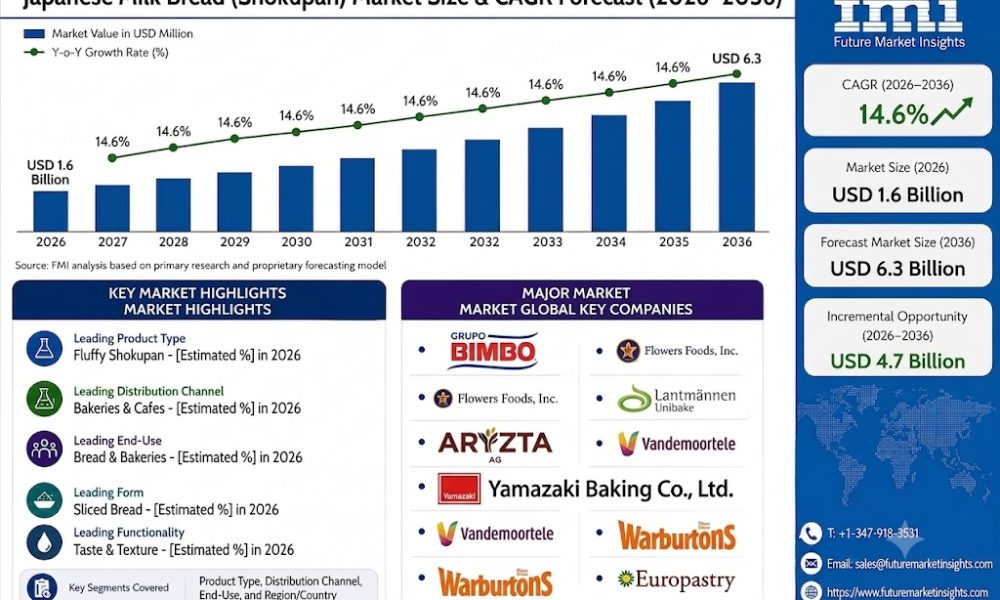
The Japanese Milk Bread (Shokupan) Market is projected to expand from USD 1.6 billion in 2026 to USD 6.3 billion by 2036, advancing at a 14.6% CAGR during the forecast period. Growth is being supported by consumer interest in exceptionally soft, thick-sliced bread formats that fit breakfast, toast, and sandwich occasions. Commercial success increasingly depends on preserving crumb softness through slicing, packaging, and distribution while maintaining replenishment efficiency across modern retail channels.
Get Detailed Market Forecasts, Competitive Benchmarking, and Pricing Trends: https://www.futuremarketinsights.com/reports/sample/rep-gb-34856
Square (Kaku) Shokupan Leads Product Type Demand
Square (kaku) shokupan is estimated to account for 34.0% of the market by product type in 2026, supported by its uniform slices and compatibility with packaged-bread merchandising. The consistent loaf structure also makes the format suitable for household toast and sandwich preparation, strengthening its role as a repeat-use product.
The commercial opportunity extends beyond novelty-driven trial. Consumers purchasing shokupan for recurring breakfast and sandwich occasions can generate stronger household replenishment when the product consistently delivers the expected soft crumb and thick-slice eating experience.
Conventional Products Maintain Mainstream Claim-Nature Share
Conventional products are expected to hold a 52.0% share by claim-nature in 2026. Flexible conventional recipes allow manufacturers to prioritize the characteristic softness of shokupan while keeping the product positioned for mainstream bakery consumption.
For mass-market distribution, the ability to maintain sensory quality without introducing unnecessary product complexity can help brands protect accessibility and support wider retail placement. Conventional positioning also allows shokupan to compete as an everyday bread rather than remaining limited to specialty bakery occasions.
Fresh Formats Capture Demand for Immediate Softness
Fresh formats are projected to account for 32.0% of the market in 2026, reflecting consumer preference for the immediate crumb softness associated with bakery-quality shokupan.
Freshness is simultaneously a major selling point and a distribution challenge. Short freshness windows can increase waste when turnover is insufficient, particularly in retail locations where premium bread demand is still developing. Producers therefore need replenishment schedules, packaging approaches, and channel selection that preserve quality while keeping inventory losses within commercially manageable levels.
Premium Softness Supports Breakfast and Sandwich Consumption
The defining softness of Japanese milk bread provides a clear point of differentiation within the broader packaged-bread category. Thick slices can be positioned for breakfast toast, sandwiches, snacks, and other everyday consumption occasions.
Repeat purchase depends on consumers receiving a consistent sensory experience after purchase. If the crumb dries before the household’s second or subsequent use, the premium associated with shokupan can become less compelling. As a result, quality consistency from production through retail shelves remains central to long-term category development.
Retail Expansion Requires Efficient Fresh-Bread Distribution
Wider retail penetration depends on balancing premium pricing with the economics of short-shelf-life products. Retailers require sufficient turnover to justify frequent replenishment and minimize unsold inventory.
Modern retail channels can provide greater consumer visibility, but expansion is likely to remain dependent on localized demand forecasting and dependable supply routes. Specialist bakeries and niche retailers can continue to play an important role in markets where consumer familiarity with Japanese bakery products is still developing.
International Food Exposure Creates New Trial Opportunities
Market development varies according to consumer familiarity with international bakery products. The United Arab Emirates, for example, benefits from significant exposure to global food trends through retail, hospitality, and tourism channels.
Dubai recorded 18.72 million international overnight visitors in 2024, according to the Department of Economy and Tourism. A large international visitor base creates opportunities for hotels, cafés, and retailers to introduce premium bakery formats to consumers already familiar with diverse global food products.
In markets with lower exposure to international bakery trends, specialist bakeries and niche retail distribution may remain important routes for building awareness, encouraging sampling, and developing repeat demand.
Supply Consistency Becomes a Competitive Differentiator
The market’s growth trajectory highlights the importance of consistent production and distribution. Yamazaki Baking reported 3.7% growth in bread sales during fiscal 2025, demonstrating the continued potential for premium sliced-bread formats within mature bakery markets.
For shokupan producers, supply consistency extends beyond ensuring product availability. Maintaining softness after slicing, controlling freshness during transport, and coordinating replenishment with retailer demand are increasingly important for protecting the premium positioning of the category.
Premium Pricing and Freshness Remain Key Commercial Considerations
Although premium softness provides a strong differentiation point, higher pricing can limit purchase frequency among price-sensitive consumers. Short freshness windows create an additional challenge because retailers must balance premium product availability with potential waste.
Manufacturers can therefore focus on pack sizes and distribution models that align with household consumption patterns. Efficient replenishment can help preserve freshness while reducing the risk that unsold inventory erodes retailer margins.
Competitive Landscape
The Japanese Milk Bread (Shokupan) Market features established bakery and food manufacturers competing across packaged bread, fresh bakery, and premium bread formats. Key companies identified in the market include Grupo Bimbo, Flowers Foods, Inc., ARYZTA AG, Lantmännen Unibake, Vandemoortele, Yamazaki Baking Co., Ltd., Warburtons, and Europastry.
Competition is centered on product consistency, softness retention, distribution reach, freshness management, and the ability to translate a premium bakery experience into repeat household consumption.
Analyst Perspective
“Shokupan should be judged on softness retention after slicing and distribution, because the premium disappears quickly if the crumb dries before the second household use. The stronger commercial offers pair that sensory standard with pack sizes and supply routes that keep retailer waste within ordinary bread-category economics.”
— Nandini Roy Choudhury, Principal Consultant, Future Market Insights
Report Scope: Japanese Milk Bread (Shokupan) Market
The Japanese Milk Bread (Shokupan) Market report provides detailed analysis of market growth, product types, claim nature, formats, competitive dynamics, and regional opportunities. The market is estimated at USD 1.6 billion in 2026 and is projected to reach USD 6.3 billion by 2036, expanding at a 14.6% CAGR.
Key Segmentation Highlights
- By Product Type: Square (Kaku) Shokupan — 34.0% share in 2026
- By Claim-Nature: Conventional — 52.0% share in 2026
- By Format: Fresh — 32.0% share in 2026
- Forecast Period: 2026–2036
- Market Size, 2026: USD 1.6 billion
- Market Size, 2036: USD 6.3 billion
- CAGR: 14.6%
Related Studies
Future Market Insights provides comprehensive market intelligence across bakery, packaged food, ingredients, and consumer food categories, covering emerging product formats, changing consumer preferences, competitive strategies, and evolving distribution channels.
To explore how FMI Custom Research can support your strategic priorities, please connect with our team at – [email protected]
About Future Market Insights (FMI)
Future Market Insights, Inc. (FMI) is a leading provider of market intelligence and consulting services, serving clients across more than 150 countries. FMI delivers syndicated and customized research covering consumer products, food and beverage, healthcare, chemicals, technology, and other major industries.
Through its research, consulting, and data-driven insights, FMI supports organizations in identifying growth opportunities, understanding market dynamics, and developing strategies for evolving competitive environments.
For Press & Corporate Inquiries
Rahul Singh AVP – Marketing and Growth Strategy
Future Market Insights, Inc.
Web: https://www.futuremarketinsights.com/



