
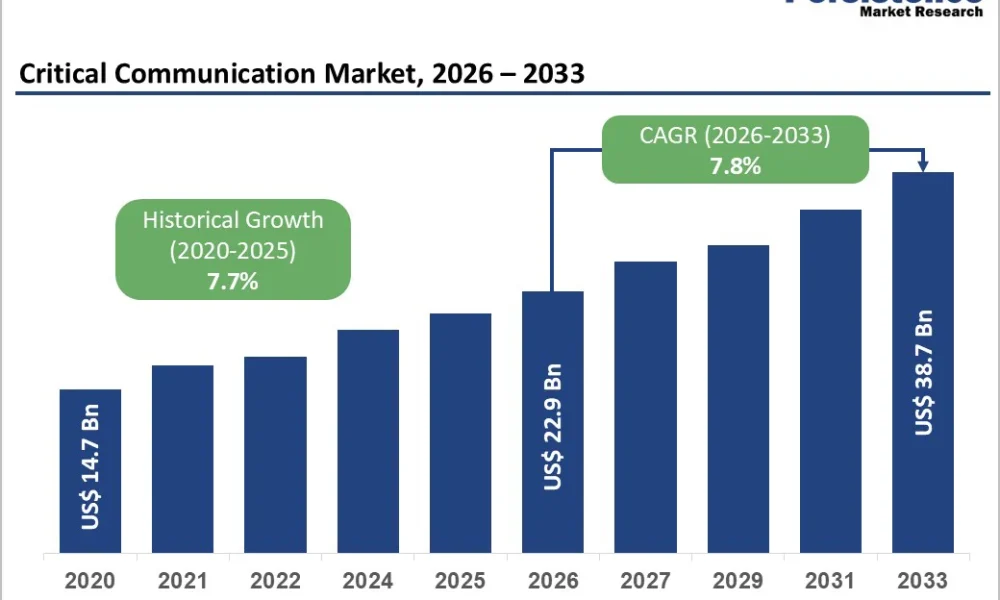
The global critical communication market is poised for sustained expansion, reflecting the growing need for secure, resilient, and real-time communication systems across mission-sensitive environments. The market is likely to be valued at US$ 22.9 billion in 2026 and is projected to reach US$ 38.7 billion by 2033, expanding at a CAGR of 7.8% during 2026–2033.
Mission-critical communication infrastructure has become indispensable across public safety agencies, government bodies, transportation networks, utilities, and industrial operations. Increasing natural disasters, cybersecurity risks, and infrastructure emergencies are elevating the importance of interoperable and highly reliable communication platforms.
Governments worldwide are accelerating modernization programs, transitioning from traditional Land Mobile Radio (LMR) systems to broadband-enabled LTE and emerging 5G-based mission-critical services.
Market Overview: The Backbone of Emergency and Infrastructure Operations
Critical communication systems are designed to provide uninterrupted, secure, and instant communication during emergencies or operational disruptions. These systems ensure:
- Network redundancy and reliability
- Real-time voice, video, and data transmission
- Interoperability across agencies
- Secure encryption protocols
- Rapid deployment in disaster scenarios
Unlike commercial networks, mission-critical platforms must operate with minimal latency and near-zero failure tolerance. This requirement has driven innovation across hardware, software, and managed service ecosystems.
Primary Growth Drivers
- Increasing Frequency of Natural Disasters
Climate-related events, floods, wildfires, and earthquakes demand rapid emergency coordination and resilient communication systems.
- Cybersecurity Threats & Infrastructure Protection
Critical infrastructure sectors such as energy grids, airports, and rail systems require secure and encrypted communication channels.
- Network Modernization Initiatives
Governments are phasing out legacy LMR systems and migrating toward LTE and broadband-based mission-critical networks to enhance data capabilities.
- Regulatory Mandates
Compliance requirements emphasizing spectrum efficiency, reliability, and redundancy are accelerating system upgrades globally.
- 5G and Broadband Integration
The introduction of 5G-based mission-critical communication enables high-bandwidth video transmission, drone integration, and IoT-based monitoring.
Elevate your business strategy with comprehensive market data. Request a sample report now: https://www.persistencemarketresearch.com/samples/21004
Regional Analysis
North America: Dominant Market
North America is predicted to hold a dominant 40% market share in 2026.
This leadership is supported by:
- Strong public safety budgets
- Early LTE-based mission-critical deployments
- Advanced emergency response infrastructure
- Federal and state modernization initiatives
Significant investments in FirstNet and public safety broadband networks continue to reinforce the region’s leadership position.
Asia Pacific: Fastest-Growing Region
Asia Pacific is forecasted to be the fastest-growing region during 2026–2033.
Key drivers include:
- Expanding transportation infrastructure
- Smart city initiatives
- Industrial modernization programs
- Government investments in emergency response networks
Rapid urbanization and megaproject development across India, China, and Southeast Asia are significantly increasing demand for interoperable communication systems.
End-User Insights
Public Safety & Government: Market Leader
Public safety and government agencies are expected to command around 50% market share in 2026, making them the leading end-user segment.
Key applications include:
- Emergency response coordination
- Police and firefighting operations
- Border security management
- Disaster relief communication
Modernization of emergency communication networks remains a top strategic priority for governments worldwide.
Transportation & Logistics: Fastest-Growing Segment
The transportation and logistics sector is projected to grow the fastest through 2033.
Growth is driven by:
- Rail network expansion
- Airport modernization
- Port infrastructure upgrades
- Fleet communication integration
Mission-critical systems in transportation ensure operational continuity, passenger safety, and real-time coordination across large infrastructure ecosystems.
Technology Evolution: From LMR to LTE & 5G
The shift from legacy Land Mobile Radio (LMR) systems to LTE-based and broadband-enabled networks marks a transformative phase for the industry.
Modern mission-critical networks now support:
- Push-to-talk over LTE (PoC)
- Real-time video streaming
- Geographic positioning services
- AI-driven situational analytics
- IoT device integration
Technological convergence between hardware devices, communication software platforms, and managed network services ensures scalable and flexible deployments.
Competitive Landscape & Strategic Developments
Market participants are focusing on:
- Broadband mission-critical solutions
- Cloud-based command center platforms
- Strategic partnerships with telecom providers
- Integration of AI and analytics
- Cross-border infrastructure expansion
In December 2025, Google and RapidSOS enabled live video streaming from Android devices during 911 emergency calls. This innovation allows dispatchers to receive real-time visual context, improving response accuracy and situational awareness.
Such advancements highlight the growing convergence between consumer mobile ecosystems and public safety infrastructure.
Emerging Trends Shaping the Market
- Interoperability Across Agencies
Modern systems enable seamless communication between police, medical, fire, and transportation authorities.
- Cloud-Based Command Centers
Cloud integration enhances scalability and remote coordination capabilities.
- AI-Enabled Incident Management
Artificial intelligence is increasingly used for real-time threat detection and predictive response modeling.
- Edge Computing for Low Latency
Deploying edge nodes ensures rapid data processing during high-pressure emergency scenarios.
- Integration with Smart Infrastructure
Critical communication systems are being embedded into smart grids, autonomous transport systems, and industrial IoT networks.
Market Challenges
Despite strong growth potential, certain barriers persist:
- High capital expenditure for network upgrades
- Complex integration with legacy systems
- Spectrum allocation challenges
- Data privacy and cybersecurity concerns
However, long-term public investment programs and regulatory backing continue to provide strong support for modernization initiatives.
Future Outlook: Resilient & Intelligent Communication Ecosystems
The critical communication market is transitioning from voice-centric systems to comprehensive, data-rich ecosystems. Future deployments will emphasize:
- Ultra-reliable low-latency communication (URLLC)
- Satellite-enabled backup connectivity
- AI-powered decision support systems
- Autonomous emergency drones
- Unified mission-critical platforms
As urbanization intensifies and infrastructure complexity grows, resilient communication networks will become foundational to public safety and industrial continuity.
Conclusion
The global critical communication market is projected to grow from US$ 22.9 billion in 2026 to US$ 38.7 billion by 2033, expanding at a steady 7.8% CAGR. Strong investments in public safety, transportation infrastructure, and government modernization initiatives are shaping sustained demand.
North America remains the dominant region, while Asia Pacific emerges as the fastest-growing market. Public safety agencies continue to lead adoption, with transportation and logistics gaining rapid momentum.
As the world faces increasingly complex emergencies and infrastructure challenges, mission-critical communication systems will remain central to ensuring operational resilience, real-time coordination, and national security preparedness.
Related Reports:




