
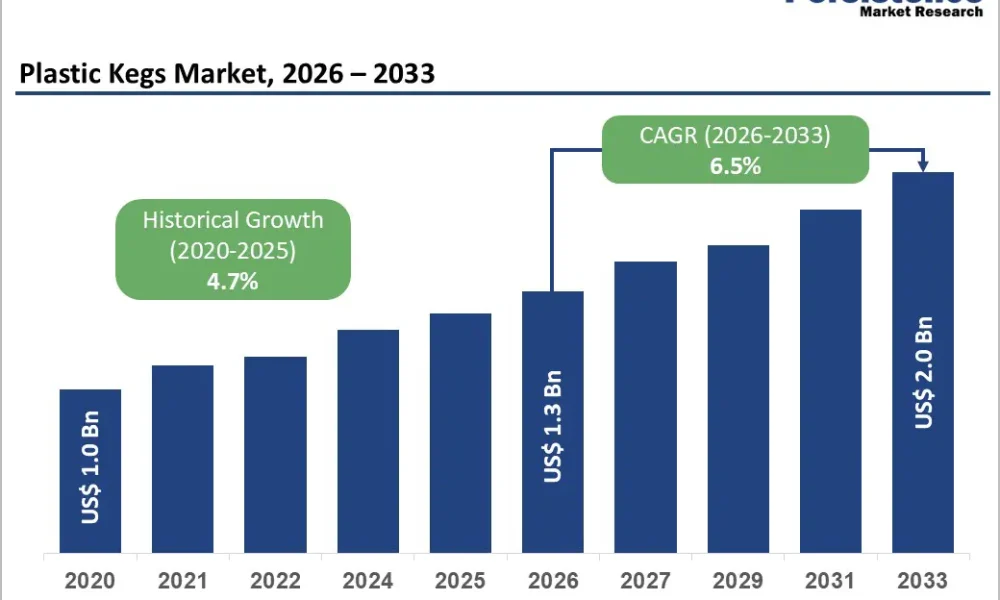
The Plastic Kegs Market is witnessing steady expansion as beverage manufacturers increasingly adopt lightweight and cost efficient dispensing solutions. According to Persistence Market Research, the global plastic kegs market size is likely to be valued at US$ 1.3 billion in 2026 and is expected to reach US$ 2.0 billion by 2033, growing at a CAGR of 6.5% between 2026 and 2033. The surge in draft beverage consumption across on trade and off trade channels is a central growth catalyst. Breweries, wineries, and soft drink producers are prioritizing packaging formats that reduce transportation costs while maintaining product freshness. Plastic kegs, especially one way variants, offer hygiene, durability, and operational convenience. Their stackable design and lower weight compared to traditional metal kegs are reshaping logistics efficiency. As beverage distribution networks globalize, demand for sustainable and flexible keg solutions continues to rise.
From a statistical perspective, the upward trajectory from US$ 1.3 billion in 2026 to US$ 2.0 billion by 2033 highlights strong long term market confidence. The 6.5% CAGR underscores sustained adoption rather than short term spikes. Growth is driven by rising consumption of beer and other draft beverages in hospitality venues and retail chains. The leading segment within the plastic kegs market remains one way plastic kegs due to their reduced reverse logistics costs and minimal contamination risks. Geographically, developed beverage markets lead adoption as breweries invest in efficient supply chains and brand expansion. The combination of operational efficiency, improved shelf life, and lower total cost of ownership positions plastic kegs as a preferred alternative to stainless steel formats.
Discover Exclusive Data – Request Your Free Sample : https://www.persistencemarketresearch.com/samples/36069
Key Highlights from the Report
➤ The Plastic Kegs Market is projected to expand from US$ 1.3 billion in 2026 to US$ 2.0 billion by 2033 at a CAGR of 6.5%
➤ Rising draft beverage consumption across on trade and off trade channels is accelerating demand for one way plastic kegs
➤ Lightweight construction significantly reduces logistics complexity and total cost of ownership for beverage producers
➤ One way plastic kegs are emerging as the leading product segment due to hygiene and operational efficiency benefits
➤ Growing adoption among breweries and beverage distributors is strengthening long term market expansion
➤ Enhanced storage, stackability, and supply chain optimization are key value propositions driving industry growth
Market Segmentation
The plastic kegs market can be segmented based on product type into one way plastic kegs and reusable plastic kegs. One way plastic kegs dominate due to their operational simplicity and elimination of return logistics. Beverage manufacturers favor these solutions for export and long distance distribution where reverse supply chain management becomes complex. Reusable plastic kegs are preferred by regional brewers seeking cost savings over multiple usage cycles. Capacity variations further differentiate offerings, allowing producers to cater to small craft breweries as well as large scale beverage companies. The flexibility in volume and dispensing mechanisms enhances market adaptability.
Segmentation by end user includes breweries, wineries, soft drink manufacturers, and other beverage producers. Breweries represent the largest consumer base due to growing draft beer culture across hospitality and retail outlets. On trade channels such as bars and restaurants rely on efficient dispensing systems that ensure product freshness and consistency. Off trade retail expansion also fuels packaged draft solutions for events and home consumption. The increasing number of craft beverage producers entering the market further strengthens demand for scalable and hygienic keg packaging solutions.
Get Custom Insights Designed for Your Business : https://www.persistencemarketresearch.com/request-customization/36069
Regional Insights
Developed beverage markets are at the forefront of plastic keg adoption due to structured distribution networks and established draft consumption trends. Beverage companies in these regions prioritize cost reduction and operational efficiency, encouraging the transition from traditional metal kegs to lightweight plastic formats. Strong hospitality infrastructure and high consumer spending on premium beverages continue to support demand. The presence of established breweries and expanding craft segments amplifies product penetration.
Emerging markets are gradually integrating plastic kegs into their supply chains as beverage consumption grows across urban centers. Expanding retail networks and rising disposable income are creating favorable conditions for draft beverage sales. Import and export activities also support one way keg usage by minimizing cross border logistics challenges. As beverage brands focus on scalable packaging solutions, regional growth opportunities are expected to strengthen over the forecast period.
Market Drivers
The primary driver of the Plastic Kegs Market is the rising consumption of draft beverages across hospitality venues and retail channels. Bars, restaurants, and event spaces are increasing their draft offerings to meet evolving consumer preferences. Plastic kegs support this shift by offering lightweight handling and easier storage. The reduction in freight costs compared to traditional kegs significantly enhances profit margins. Beverage companies benefit from simplified supply chain management and reduced breakage risks. Additionally, hygienic one way formats minimize contamination concerns, ensuring consistent product quality. These operational benefits directly translate into higher adoption rates.
Another critical growth driver is the accelerating adoption of one way plastic kegs to reduce total cost of ownership. Manufacturers seek packaging that eliminates the need for reverse logistics and cleaning processes. Plastic kegs streamline distribution by lowering return freight expenses and inventory management complexity. Their stackable design optimizes warehouse space utilization. As global beverage trade expands, companies increasingly require packaging solutions compatible with export operations. The economic and logistical efficiencies of plastic kegs reinforce sustained market demand.
Market Restraints
Despite strong growth prospects, certain limitations could influence market expansion. Some beverage producers remain reliant on traditional stainless steel kegs due to established infrastructure and long term contracts. Transitioning to plastic formats may require adjustments in dispensing equipment and operational processes. This initial shift can slow adoption among conservative industry participants. Additionally, perceptions regarding durability and long term storage performance may create hesitation among certain producers.
Another restraint stems from competitive packaging alternatives within the beverage industry. Producers often evaluate cost structures carefully before switching formats. If operational benefits do not outweigh perceived risks, adoption rates may moderate. Market participants must continuously emphasize performance, hygiene, and logistics advantages to sustain momentum. Addressing these concerns through innovation and education will remain essential for industry stakeholders.
Market Opportunities
Significant opportunities lie in expanding draft beverage consumption across new distribution channels. As hospitality sectors recover and retail chains diversify beverage offerings, plastic kegs can capture incremental demand. Emerging craft breweries represent a dynamic growth avenue, requiring scalable and flexible packaging formats. One way kegs provide entry level convenience for small producers entering export markets. This adaptability strengthens overall market resilience.
There is also potential in enhancing product innovation focused on improved barrier properties and sustainability considerations. Manufacturers investing in advanced materials and lightweight engineering can further reduce costs and environmental impact. Partnerships between beverage brands and packaging providers may accelerate technology integration. By aligning with evolving consumer expectations for quality and convenience, the plastic kegs market can unlock long term expansion opportunities.
Exclusive Data Awaits – Continue to Checkout : https://www.persistencemarketresearch.com/checkout/36069
Company Insights
Key players operating in the Plastic Kegs Market include
- Petainer
- MicroStar
- Kegstar
- THIELMANN
- OneCircle
- PolyKeg
- i-Keg
- KegPlast
- Konvoy
- BevPak
- Blefa
- NDL Keg
- Kegco
- KegLand
- Pet Technologies
- Schäfer Container Systems
- Ardagh Group
- Mauser Packaging Solutions
Recent Developments
In March 2024 Petainer expanded its lightweight keg production capacity to support rising draft beverage demand.
In July 2023 SCHÄFER Container Systems introduced enhanced plastic keg solutions focused on logistics efficiency.
Future Opportunities and Growth Prospects
The Plastic Kegs Market is positioned for stable and sustained expansion through 2033. With valuation rising from US$ 1.3 billion in 2026 to US$ 2.0 billion by 2033 at a CAGR of 6.5%, the industry reflects consistent demand fundamentals. Growth will continue to be anchored in draft beverage consumption, lightweight packaging innovation, and supply chain optimization. As beverage companies pursue operational efficiency and global reach, plastic kegs will remain a strategic packaging solution supporting long term profitability and distribution agility.




