
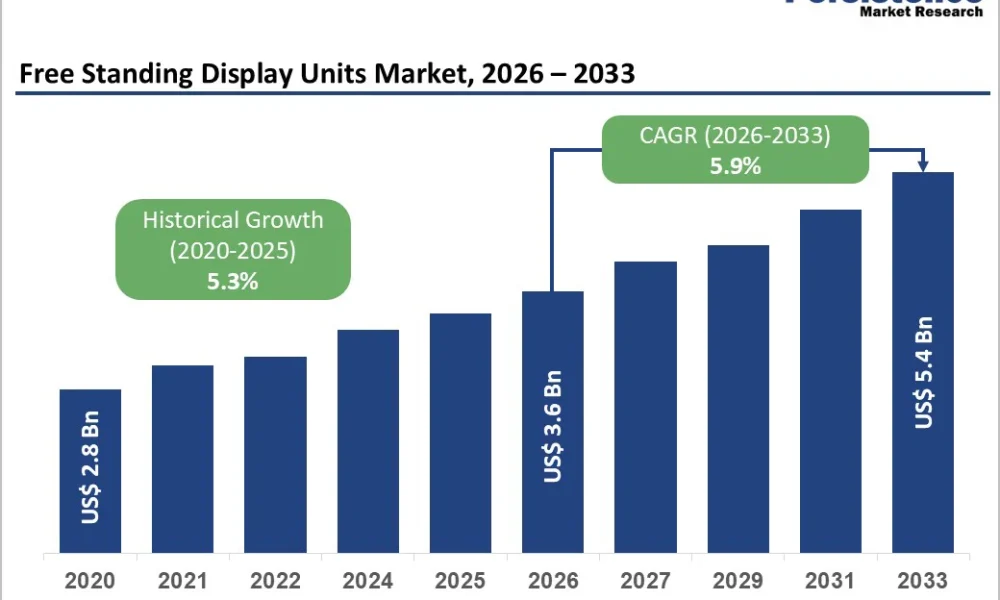
The global Free Standing Display Units (FSDU) market is projected to maintain steady growth over the next decade, reflecting sustained investments in physical retail engagement. The market size is likely to be valued at US$ 3.6 billion in 2026 and is expected to reach US$ 5.4 billion by 2033, growing at a CAGR of 5.9% between 2026 and 2033.
Despite the rapid expansion of e-commerce, retailers and brand owners continue to prioritize in-store conversion strategies and impulse purchasing opportunities. Continuous material innovation, modular design advancements, and increasing adoption of sustainable and digitally enabled display solutions are reinforcing structural demand for point-of-purchase (POP) merchandising systems.
Free standing display units remain a core pillar of physical retail marketing — bridging brand visibility, consumer engagement, and last-mile conversion.
Market Overview: The Power of Physical Retail Engagement
Free standing display units are temporary or semi-permanent retail fixtures positioned strategically within stores to promote products, seasonal campaigns, or new launches. These units:
- Encourage impulse purchases
- Enhance brand visibility
- Support cross-selling strategies
- Maximize promotional turnover
- Improve category navigation
Retailers across grocery, pharmacy, convenience, and specialty formats are increasing per-store merchandising investments to drive footfall monetization.
As retail environments become more competitive, brands are allocating larger budgets toward experiential and data-driven in-store displays.
Structural Growth Drivers
- Sustained Focus on In-Store Conversion
Brick-and-mortar retailers continue to emphasize point-of-purchase strategies to increase basket size and impulse buying rates. FSDUs offer flexibility and high-impact product placement.
- Retail Modernization & Store Expansion
New store formats and hybrid retail models are creating incremental demand for modular and adaptable display systems.
- Sustainable Material Innovation
Growing environmental regulations and corporate sustainability targets are encouraging recyclable corrugated materials, hybrid plastics, and reusable modular systems.
- Digitally Enabled Display Units
Integration of QR codes, NFC tags, small digital screens, and smart sensors is enhancing consumer engagement and data collection.
Elevate your business strategy with comprehensive market data. Request a sample report now: https://www.persistencemarketresearch.com/samples/35976
Regional Insights
North America: Market Leader
North America is expected to lead the global FSDU market with an estimated 39% market share.
Key factors supporting regional dominance include:
- Presence of large-format retail chains
- Centralized merchandising programs
- High per-store promotional deployments
- Strong brand marketing budgets
The United States and Canada continue to invest heavily in promotional displays across grocery, pharmacy, and big-box retail formats.
Asia Pacific: Fastest-Growing Market
Asia Pacific is likely to emerge as the fastest-growing regional market during the forecast period.
Growth is driven by:
- Rapid retail modernization in China and India
- Expansion of organized retail in ASEAN economies
- Rising consumer spending
- Increasing brand competition for shelf visibility
As modern trade formats replace traditional retail channels, demand for professional display systems is accelerating.
Investment Trends: Sustainability & Smart Merchandising
Manufacturers and brand owners are increasingly allocating 30–35% of new display program budgets toward:
- Recyclable corrugated structures
- Hybrid sustainable materials
- Modular reusable display systems
- Smart display features (LED lighting, embedded sensors, QR engagement tools)
Retailers are seeking solutions that reduce lifecycle costs while improving environmental compliance and operational efficiency.
Reusable modular displays, in particular, are gaining traction as brands pursue multi-cycle promotional strategies.
Material Analysis
Plastic Displays: Market Dominance
Plastic-based FSDUs are expected to account for approximately 41.2% of total market share, making them the dominant material segment.
Key advantages include:
- Durability
- Moisture resistance
- Multi-cycle usability
- Structural stability in high-traffic environments
Plastic displays are particularly suitable for long-term promotions and heavy product categories.
Corrugated & Hybrid Materials on the Rise
Corrugated cardboard remains widely used for short-term promotional campaigns due to cost efficiency and recyclability. Hybrid materials combining plastic and corrugated components are gaining adoption as brands seek both durability and sustainability.
End-Use Industry Analysis
Food & Beverages: Leading Segment
The food and beverages industry is projected to remain the largest end-use segment, accounting for approximately 30.8% market share.
This dominance is driven by:
- High impulse purchasing behavior
- Frequent product launches
- Seasonal promotions
- Rapid promotional turnover in grocery and convenience formats
Snack foods, beverages, confectionery, and packaged foods rely heavily on FSDUs for front-of-store promotions.
Other Growing End-Use Segments
- Personal care & cosmetics
- Pharmaceuticals
- Consumer electronics accessories
- Household products
Retail competition in these categories is intensifying, increasing demand for customized display units.
Competitive Landscape
The market is moderately fragmented, with regional manufacturers and global display solution providers competing on:
- Design customization
- Sustainable material innovation
- Logistics optimization
- Cost efficiency
- Integration of digital features
Strategic partnerships between packaging companies and brand owners are becoming common to ensure faster deployment and improved campaign ROI.
Emerging Trends Shaping the Market
- Modular & Reusable Systems
Brands are shifting toward modular display systems that can be reconfigured across campaigns, reducing waste and improving ROI.
- Digital Integration
Smart FSDUs with small LED panels, motion sensors, and interactive features enhance consumer engagement and data analytics.
- Lightweight Engineering
Advanced structural design reduces material consumption while maintaining load-bearing strength.
- Omnichannel Integration
Displays now include QR codes and NFC features that link physical retail with digital marketing campaigns.
Market Challenges
While growth remains stable, the industry faces certain challenges:
- Rising raw material costs
- Supply chain disruptions
- Environmental compliance pressures
- Space optimization constraints in compact retail formats
However, continuous design innovation and operational efficiency improvements are mitigating these risks.
Future Outlook: Physical Retail Remains Strategically Relevant
The FSDU market’s trajectory reflects a broader reality — physical retail remains essential for brand storytelling and impulse conversion.
Even as e-commerce expands, retailers recognize that:
- In-store experiences influence purchase decisions
- Physical displays drive unplanned buying
- Promotional visibility increases brand recall
The convergence of sustainable materials and digital engagement tools is likely to define the next phase of innovation.
Conclusion
The global free standing display units market is projected to grow from US$ 3.6 billion in 2026 to US$ 5.4 billion by 2033, expanding at a 5.9% CAGR. North America continues to dominate due to mature retail infrastructure, while Asia Pacific emerges as the fastest-growing region.
Plastic displays lead in material share, and food & beverages remain the largest end-use segment. Meanwhile, sustainability and digital enablement are reshaping investment strategies.
As retailers double down on in-store conversion and impulse merchandising, FSDUs will remain a vital tool in driving sales performance and enhancing brand visibility in competitive retail landscapes.
Related Reports:




