
Vanadium Pentoxide Market Overview :
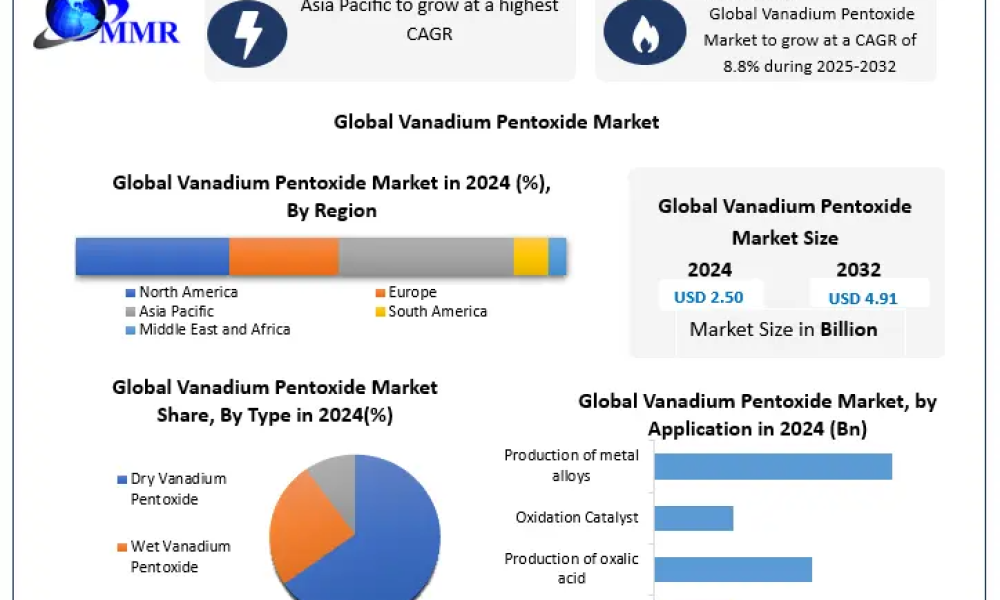
Vanadium Pentoxide Market was valued at USD 2.50 billion in 2024 and is projected to grow at a compounded annual growth rate (CAGR) of 8.8% from 2025 to 2032, reaching nearly USD 4.91 billion by 2032. The increasing applications in energy storage, metallurgy, chemicals, and glass industries drive this robust growth, supported by technological advancements in extraction, purification, and demand for high-purity, battery-grade vanadium pentoxide.
Key Highlights & Insights
Market Size & Growth: Valued at USD 2.50 billion in 2024; projected to nearly double to USD 4.91 billion by 2032, growing at 8.8% CAGR.
Dominating Region: Asia Pacific dominates the market driven by its vast steel and construction sectors, rising energy storage needs, abundant vanadium resources, and a strong presence of major regional and global producers.
Leading Segment: Dry vanadium pentoxide is the preferred type segment due to its high purity, ease of handling, and compatibility with ferrovanadium production and energy storage technologies such as Vanadium Redox Flow Batteries (VRFBs).
Key Driver: Rising demand for vanadium pentoxide in production of metal alloys, use as catalysts in industrial chemical processes, and fast-expanding energy storage markets.
Recent Developments
June 2025: Largo Inc. (Canada) expanded vanadium processing capacity at Maracas Menchen Mine, Brazil to meet surging demand for battery-grade vanadium for energy storage and specialty alloys.
April 2025: HBIS Group (China) collaborated with Chinese battery manufacturers to develop advanced battery-grade vanadium pentoxide products.
March 2025: Vanchem Vanadium Products (South Africa) initiated testing of low-carbon refining processes supported by government sustainability grants.
February 2025: Australian Vanadium Limited secured USD 49 million federal funding to enhance vanadium processing facilities targeting steel and battery sectors.
Market Dynamics
Growth Drivers:
Surge in vanadium redox flow batteries (VRFBs) for grid-scale renewable energy storage boosting demand for battery-grade vanadium pentoxide.
Increasing industrial applications, including catalysis for sulfuric acid production, ceramic pigments, and metallurgical alloys.
Technological innovations and automation improving yield, purity, and scalability of vanadium pentoxide production.
Emphasis on sustainable and environmentally responsible production processes.
Challenges:
Complex refining processes and fluctuating raw vanadium ore prices.
Environmental and regulatory compliance pressures increasing operational costs.
Supply-demand imbalances in emerging battery markets.
For full access to the data, request a sample report now :https://www.maximizemarketresearch.com/request-sample/103305/
Regional Analysis
Asia Pacific: Market leader due to rapid industrialization in China and India, combined with robust steel industries and growing energy storage infrastructure.
North America: Significant growth region driven by investments in renewable energy and battery development technologies.
Europe: Steady market with stringent environmental regulations fostering advancements in cleaner production and battery technologies.
South America, Middle East & Africa: Emerging markets tied to resource availability and developing industrial sectors.
Product Segmentation
By Type: Dry vanadium pentoxide (dominant), wet vanadium pentoxide, others.
By Application: Metal alloys production (largest segment), oxidation catalysts, oxalic acid production, energy storage, others.
Key Trends
Rising investments in VRFB technologies driving demand for high-purity battery-grade vanadium pentoxide.
Growing adoption of eco-friendly refining and extraction techniques in compliance with global sustainability goals.
Expansion of vanadium applications in industrial chemicals and durable, high-strength metal alloys.
Increasing collaborations between vanadium producers and battery manufacturers to optimize supply chains.
Quote
Asia Pacific’s dominance in the vanadium pentoxide market reflects its integral role in global steel manufacturing and energy infrastructure growth. Technological innovation and sustainability commitments among key industry players are poised to drive the market toward a resilient, high-growth future.




