Monoclonal Antibodies Market Overview :
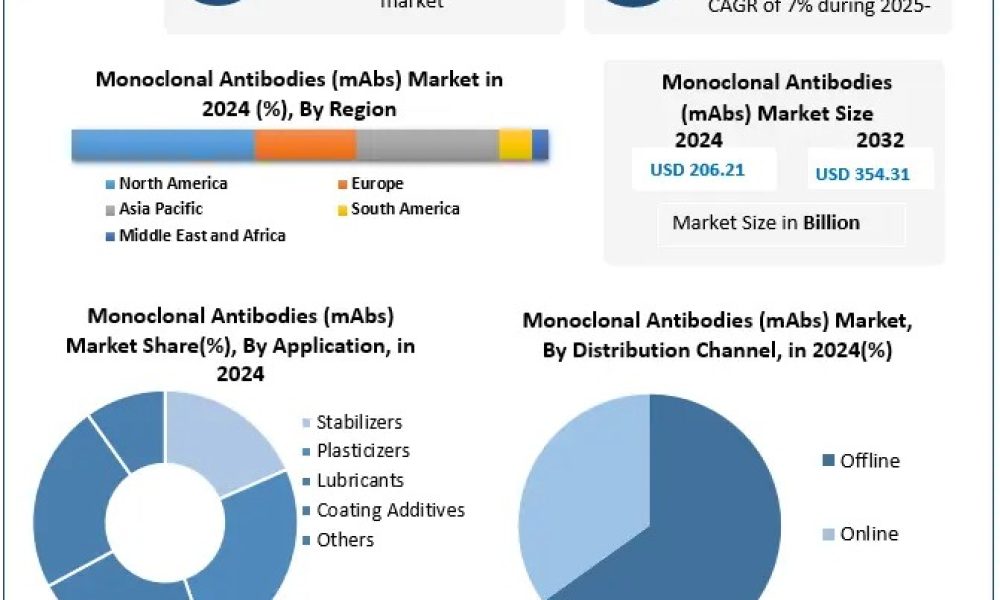
The global monoclonal antibodies market, valued at USD 206.21 billion in 2024, is forecast to grow at a compound annual growth rate (CAGR) of 7% from 2025 to 2032, reaching nearly USD 354.31 billion. Increasing investments in genomics and advanced genetic platforms like next-generation sequencing, coupled with a growing prevalence of chronic diseases, are major growth drivers. Adoption of monoclonal antibody therapies for cancer, autoimmune, and infectious diseases continues to accelerate.
Key Highlights & Insights
Market Size & Growth: Expected to expand from USD 206.21 billion in 2024 to USD 354.31 billion by 2032 with a CAGR of 7%.
Dominating Region: North America holds the largest market share, driven by a well-established healthcare infrastructure, substantial R&D expenditure, and government support for cancer and chronic disease research.
Leading Segment: The in vivo production category dominates due to its ability to generate high-affinity, fully functional antibodies essential for therapeutic efficacy.
Key Driver: Increasing approval of blockbuster mAbs such as Avastin, Herceptin, and Rituxan, rising patient awareness, and expanding applications in oncology and autoimmune therapy fuel market growth.
Recent Developments
2024-2025: Novartis AG, Pfizer, Amgen, and Roche focused on developing next-generation mAbs with enhanced specificity and fewer side effects.
Increasing partnerships between pharmaceutical companies and biotechnology firms to accelerate pipeline development.
Integration of AI and machine learning in mAb discovery and drug design to improve efficiency and reduce costs.
Expansion in emerging markets like Asia Pacific with rising healthcare spending and growing therapeutic adoption.
Market Dynamics
Growth Drivers:
Rising incidence of cancer, autoimmune diseases, and infectious diseases worldwide.
Advances in therapeutic techniques providing targeted and effective treatment options.
Expanding product pipelines and approvals increasing availability and patient access.
Increasing patient and physician awareness of the benefits of mAbs therapies.
Challenges:
High cost of mAbs development and manufacturing.
Complex regulatory frameworks and long approval processes.
Potential immunogenicity and side effects impacting patient adherence.
Market competition from biosimilars and alternative therapies.
Regional Analysis
North America: Market leader due to advanced healthcare systems, R&D investments, and high adoption rates.
Europe: Significant market driven by aging populations and supportive regulatory environment.
Asia Pacific: Rapid growth expected, fueled by increasing healthcare infrastructure, disposable incomes, and patient awareness.
Middle East & Africa and Latin America: Emerging markets with expanding healthcare services and improving access to biologics.
Product Segmentation
By Type: Naked monoclonal antibodies, conjugated monoclonal antibodies, bispecific antibodies, others.
By Category: In vivo, in vitro.
By Application: Cancer, organ transplant rejection, inflammatory diseases, eye conditions, infections, others.
By Distribution Channel: Offline (hospitals, clinics), online.
Key Trends
Growing focus on personalized medicine and targeted biologics for diverse therapeutic areas.
Development of bispecific antibodies and antibody-drug conjugates offering enhanced efficacy.
Integration of digital tools and AI in mAb research and clinical trials.
Emphasis on biosimilars to increase access and reduce therapy costs.
Expansion of mAb use beyond oncology into autoimmune and infectious disease treatment.
Quote
North America’s leadership in the monoclonal antibodies market highlights the region’s robust healthcare ecosystem and research capabilities. Continued innovation, regulatory support, and growing patient demand will propel the mAbs market towards new horizons in precision medicine.
With increasing innovation and rising prevalence of chronic diseases, the monoclonal antibodies market is poised for substantial growth. As advancements continue in biotechnology and therapeutic development, market leaders and emerging players will play key roles in shaping the future of targeted therapies globally by 2032.




