Metal Casting Market Overview :
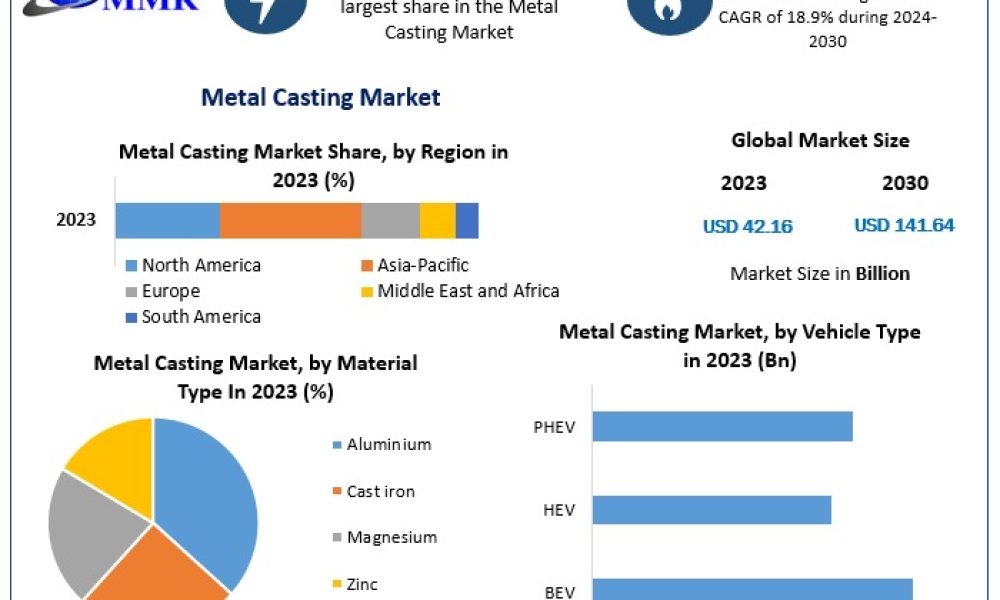
Metal Casting Market, valued at approximately USD 145 billion in 2023, is anticipated to expand at a robust CAGR of 7.5% between 2024 and 2032, reaching a projected market size of USD 213 billion by 2032. Metal casting, a pivotal industrial process involving molten metal poured into molds, supports wide-ranging manufacturing sectors including automotive, aerospace, construction, and heavy machinery.
Key Highlights & Insights
Market Size & Growth: The metal casting market is projected to grow from USD 145 billion in 2023 to USD 213 billion by 2032, at a CAGR of 7.5%.
Dominating Region: Asia Pacific holds dominance with a 65.2% volume share due to major production hubs in China and India, buoyed by significant demand from automotive, construction, and oil & gas sectors.
Leading Segment: Iron casting accounts for the largest volume share (~70.2% in 2023) with applications in engine blocks, pipelines, and heavy equipment, driven by emerging market demands.
Key Driver: Booming automotive manufacturing, infrastructure growth, and innovations in lightweight alloys like aluminum and magnesium to meet stringent emissions and efficiency standards.
Recent Developments
2024-2025: Leading global players such as Ryobi Limited, Arconic, Hitachi Ltd., and Dynacast have expanded production capacities and integrated advanced casting technologies like automation, 3D printing, and eco-friendly manufacturing methods.
Increased focus on sustainability has driven companies to incorporate green manufacturing practices, including metal recycling and process optimization to reduce environmental impact.
Asian manufacturers are capitalizing on expanding automotive and construction sectors, with China producing 49,400 kilotons and India 12,055 kilotons in 2023.
Market Dynamics
Growth Drivers:
Extensive automotive sector growth demanding lightweight, durable cast components.
Rapid infrastructural development in emerging economies increasing demand for metal castings in building and construction.
Innovation in aluminum and magnesium casting enhances fuel efficiency and emission compliance in vehicles.
Emphasis on environmental sustainability promoting recyclable metal usage and energy-efficient casting processes.
Challenges:
Energy-intensive nature of casting processes presents environmental and cost challenges.
Fluctuations in raw material prices affect profitability and investment.
Technical skill shortages impact efficient operation and technology adoption.
Regulatory compliance requiring adaptation to evolving environmental and safety standards.
Regional Analysis
Asia Pacific: Largest regional market leader with 65.2% share, driven by production powerhouses China and India, supporting automotive, construction, and heavy industry demands.
Europe: Steady growth with anticipated CAGR of 4.9%, bolstered by automotive giants and industrial manufacturing hubs primarily in Germany, France, and the UK.
North America: Significant presence with leading companies innovating in light metal casting and advanced manufacturing techniques.
Middle East Africa & Latin America: Emerging markets showing promising growth linked to expanding infrastructure projects.
Product Segmentation
By Material Type: Aluminum (fastest growing), cast iron (largest volume share), magnesium, zinc, others.
By Process Type: Sand casting, die casting (high-pressure and low-pressure), gravity casting, investment casting, shell mold casting.
By Vehicle Type: Battery electric vehicles (BEV), hybrid electric vehicles (HEV), plug-in hybrid electric vehicles (PHEV).
By Application: Automotive & transportation (majority share), industrial, building & construction, others.
Key Trends
Growing adoption of lightweight metals like aluminum and magnesium to improve automotive fuel efficiency.
Increasing implementation of automation and digitalization including CAD, simulation software, and additive manufacturing in casting workflows.
Greater use of sustainable, eco-friendly casting methods aligned with global environmental regulations.
Expansion of metal casting applications in renewable energy infrastructure such as wind turbines.
Quote
Asia Pacific’s dominance in the metal casting market reflects its massive industrial base, growing automotive and construction sectors, and investment in advanced, sustainable casting technologies. As global demand for precision and environmentally friendly components rises, Asia Pacific’s position will continue to strengthen.
The metal casting market is set for transformative growth over the next decade as manufacturers evolve to meet the demands of a rapidly transitioning industrial landscape. Strategic investment in innovation, sustainability, and regional expansion will define market leaders and shape the future of metal casting worldwide by 2032.




