
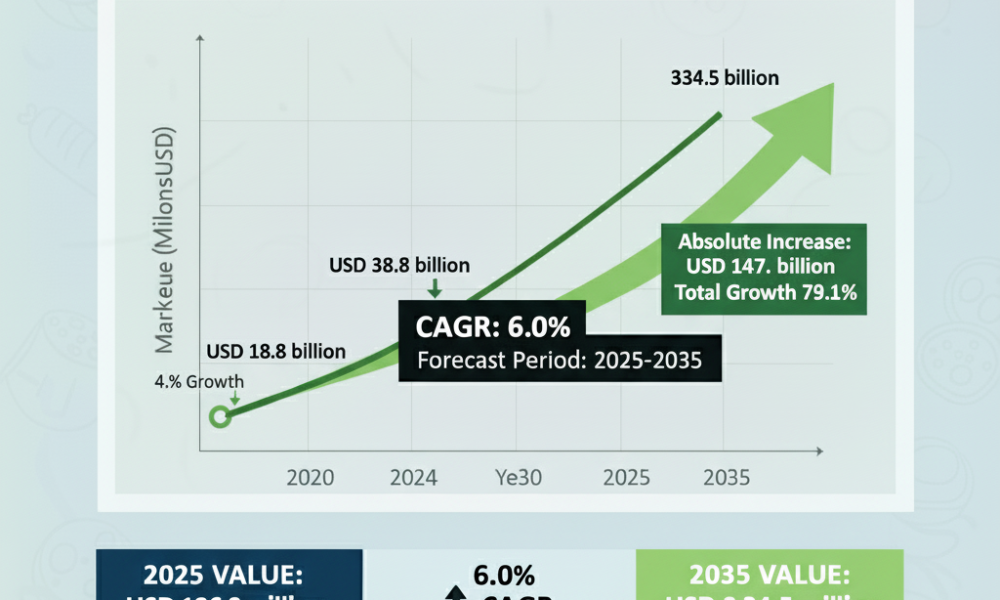
The global sodium lactate market is poised for consistent growth through 2035, driven by rising clean-label trends, natural preservation needs, and pharmaceutical-grade applications. According to Future Market Insights (FMI), the market is valued at USD 186.8 million in 2025 and is projected to expand to USD 334.5 million by 2035, achieving a compound annual growth rate (CAGR) of 6.0%.
The FMI report, “Sodium Lactate Market Size, Share, and Forecast 2025–2035,” projects an incremental revenue increase of USD 147.7 million over the decade, propelled by multifunctional uses in food preservation, cosmetics, and clinical formulations.
A Decade of Growth Anchored by Clean-Label Adoption and Biocompatibility:
The shift toward natural, bio-based additives is accelerating market momentum. From 2025 to 2030, the sodium lactate market is expected to grow by approximately USD 70 million, supported by processed food expansion and skincare innovations. Between 2030 and 2035, FMI anticipates an additional USD 77.7 million in growth, driven by emerging market localization, regulatory approvals for pharmaceutical buffers, and integration with multi-hurdle preservation systems.
“High-purity liquid formulations are dominating due to ease of integration and antimicrobial efficacy,” said an FMI research analyst. “Manufacturers prioritizing fermentation efficiency and clean-label certification are gaining traction in cost-sensitive and premium segments alike.”
Sodium Lactate Key Market Insights at a Glance:
Market Value (2025): USD 186.8 million
Forecast Value (2035): USD 334.5 million
CAGR: 6.0%
Leading Product Form: Liquid (65% share)
Primary Application: Food & Nutritional Supplements (38.5% share)
Key Growth Regions: Europe (34% share in 2025), Asia Pacific, North America
India: The Fastest-Growing Sodium Lactate Market:
FMI identifies India as the global growth leader with a 6.6% CAGR, fueled by packaged food surge, electrolyte solution demand, and local fermentation investments. Government food safety initiatives and pharmaceutical localization are enabling domestic producers to capture import substitution opportunities. Liquid grades dominate, supporting processed meat preservation and clinical nutrition applications
Sodium Lactate Five Forces Driving Market Expansion:
- Clean-Label Movement: Natural antimicrobial properties extend shelf-life without synthetic additives, aligning with consumer preferences.
- Pharmaceutical Buffering: Biocompatible pH control in IV fluids, dialysis solutions, and injectables meets rising healthcare standards.
- Personal Care Hydration: Humectant efficacy boosts moisture retention in skincare and cosmetics formulations.
- Fermentation Optimization: Cost reductions and high-purity outputs enhance supply chain reliability.
- Regional Localization: Asia Pacific and European investments in on-shore production reduce logistics costs and ensure compliance.
Sodium Lactate Market Segment Overview:
By Product Form: Liquid systems hold 65% share, with 60% solutions (44%) for standard food use and 80% concentrates (14%) for efficiency. Powder forms (35%) target pharmaceutical excipients.
By Application: Food & nutritional supplements lead at 38.5%, including processed meats (17%) and dairy (9.5%). Personal care & cosmetics (17%) and clinical nutrition (16%) follow.
By End User: Food & beverages industry commands 40%, driven by processors (30%). Pharmaceuticals manufacturers hold 22%.
By Region: Europe leads in 2025; Asia Pacific shows highest CAGR momentum.
Sodium Lactate Market Regional Overview:
Asia Pacific: India (6.6% CAGR), South Korea (6.4%), Japan (6.2%), and China (6.1%) drive clean-label and K-beauty demand.
Europe: Germany (21% intra-regional share) excels in pharma-grade and meat processing.
North America: U.S. at 5.8% CAGR, anchored by listeria control in ready-to-eat meats.
Emerging Markets: Packaged food growth and healthcare infrastructure fuel adoption.
Subscribe for Year-Round Insights → Stay ahead with quarterly and annual data updates: https://www.futuremarketinsights.com/reports/brochure/rep-gb-4021
Request for Discount: https://www.futuremarketinsights.com/reports/sample/rep-gb-4021
Sodium Lactate Market Competitive Landscape:
– Corbion N.V.
– Jungbunzlauer Suisse AG
– Galactic S.A.
– Merck KGaA
– Jindan Lactic Acid Technology Co., Ltd.
Top players control 50-55% share, emphasizing proprietary fermentation, USP/EP certifications, and technical support for food safety compliance.
Sodium Lactate Market Outlook: Sustaining Bio-Based Momentum:
Over the forecast period, sodium lactate will transition from preservative to multifunctional platform, integrating with smart preservation and sustainable sourcing. Advances in crystallization, anhydrous powders, and circular fermentation will support premium positioning. “As clean-label and biocompatibility standards converge, sodium lactate’s role in food security and patient safety will solidify long-term demand,” the FMI analyst concluded.
About Future Market Insights (FMI)
Future Market Insights, Inc. (FMI) is an ESOMAR-certified, ISO 9001:2015 market research and consulting organization, trusted by Fortune 500 clients and global enterprises. With operations in the U.S., UK, India, and Dubai, FMI provides data-backed insights and strategic intelligence across 30+ industries and 1200 markets worldwide.
Why FMI: Decisions that Change Outcomes- https://www.futuremarketinsights.com/why-fmi
Contact Us:
Future Market Insights Inc.
Christiana Corporate, 200 Continental Drive,
Suite 401, Newark, Delaware – 19713, USA
T: +1-347-918-3531
Website: https://www.futuremarketinsights.com
LinkedIn| Twitter| Blogs | YouTube
Have a specific Requirements and Need Assistant on Report Pricing or Limited Budget please contact us – [email protected]



