
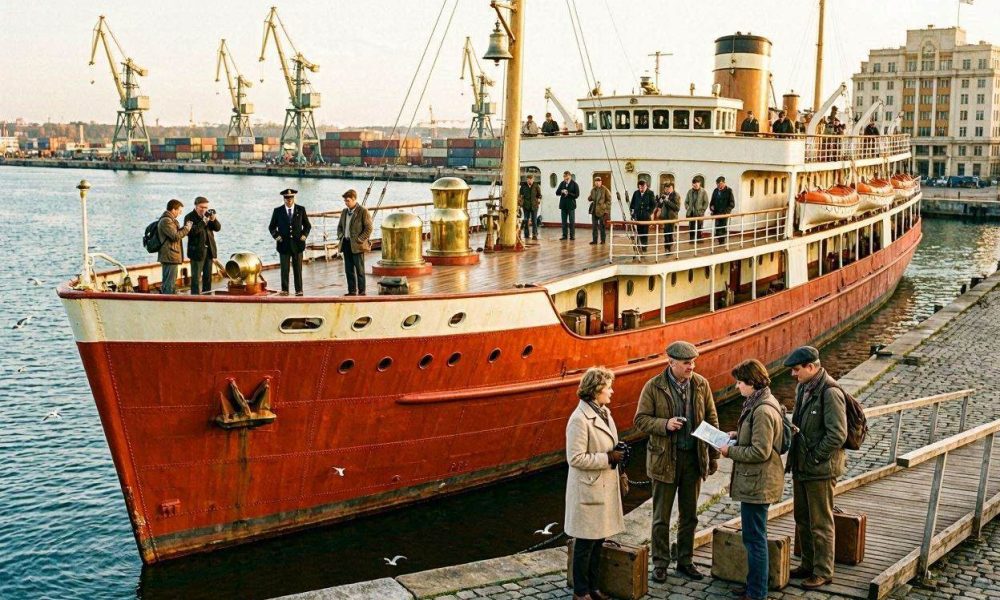
Tracing the evolution from early mail-carrying steamships to modern mega-container vessels, and why slow travel has captured the imagination of modern, eco-conscious explorers.
WASHINGTON, DC, June 3, 2026, Long before freighter travel became a niche escape for privacy-minded slow travelers, cargo ships carried mail, goods, officials, emigrants, merchants, and occasional passengers across oceans where transportation, commerce, and adventure were inseparable.
Freighter travel began before tourism learned to separate comfort from commerce.
The earliest passenger-cargo voyages were not marketed as lifestyle experiences because steamship lines, mail routes, and merchant vessels existed primarily to connect empires, ports, colonies, businesses, and families across distances that no aircraft could compress.
Travelers who boarded those vessels were often entering a working transportation system where freight, correspondence, immigration, trade, and diplomacy moved together, making the ship a practical bridge between economies rather than a leisure product.
The romance came later, after aviation made ocean travel less necessary and people began looking back at long sea passages as symbols of patience, dignity, adventure, and distance properly experienced.
In those earlier decades, a passenger did not expect floating entertainment because the voyage itself, the meals, the weather, the deck walks, the port calls, and the conversation formed the experience.
That mixed-purpose world became the ancestor of today’s freighter travel niche, where passengers once again seek access to ships whose main purpose is not entertaining them, but moving the world’s material life.
Mail steamships helped create the culture of passenger-cargo travel.
The mail-carrying steamship was one of the great hybrid vessels of maritime history, connecting ports through letters, newspapers, packages, government communications, commercial cargo, and passengers who accepted that sea travel belonged to schedules larger than themselves.
These ships helped standardize routes, timetables, and port expectations, creating early forms of reliable international travel long before commercial aviation turned distance into something measured in hours rather than weeks.
Passengers traveled inside systems built around official communication and freight, which meant their comfort mattered, but their convenience remained secondary to the broader duty of connecting economies and governments.
That early model still echoes in contemporary passenger-cargo voyages, especially on regional vessels where freight, mail, supplies, and limited passenger cabins support communities that cannot rely entirely on roads or airports.
The history matters because it shows that freighter tourism is not an invention of modern nostalgia, but a return to an older understanding that travel and trade once shared the same deck.
Passenger liners made ocean travel glamorous, but freighters kept it honest.
The great ocean liners turned sea travel into status, architecture, cuisine, and spectacle, building a culture of grand staircases, formal dining, celebrity crossings, and national prestige on the world’s most famous routes.
Freighters developed a quieter identity because they continued to carry goods, machinery, mail, vehicles, and raw materials, and fewer travelers who valued passage over pageantry.
That contrast still defines the emotional difference between cruise travel and freighter travel, because one is designed to surround passengers with experience, while the other allows passengers to observe a working world.
A cruise vessel often tries to make the sea feel like a resort, while a freighter reminds passengers that the sea is still a route, a workplace, and a force that shapes every decision.
The modern niche traveler often chooses the freighter precisely because it has not been fully transformed into entertainment, which gives the voyage an honesty that mass tourism sometimes struggles to preserve.
Containerization changed the ship, but not the fascination.
The arrival of container shipping transformed global trade by making cargo movement faster, more standardized, and more efficient, shifting ports, labor systems, vessel design, and commercial expectations across the maritime world.
Mega-container vessels now carry enormous volumes of goods along routes connecting factories, ports, retailers, and households, making them among the most important machines in the global economy.
The U.S. Maritime Administration underscores the official importance of maritime transportation to trade, security, and economic infrastructure, reminding travelers that cargo ships are not curiosities but essential components of national and global systems.
For passengers, the modern container ship can feel almost surreal because the vessel is industrial, massive, and highly organized, yet the civilian experience aboard may remain intimate, quiet, and strangely personal.
That contrast between scale and solitude is one reason contemporary freighter travel fascinates explorers: a person can cross oceans within a giant commercial system while still spending days in near-monastic quiet.
The tourist niche grew because aviation made slowness optional.
When flying became the dominant mode of international passenger travel, ocean travel lost its practical necessity for most people and gradually became a choice rather than a necessity.
That shift changed the meaning of a cargo ship berth because the passenger was no longer taking the obvious route, but making a deliberate statement about time, pace, observation, and personal preference.
The traveler who chooses a freighter today often does so because flying is too fast, too crowded, too public, too stressful, or too disconnected from the real geography between departure and arrival.
The ship becomes attractive because it restores distance, allowing the traveler to feel the ocean as weather, routine, horizon, and time rather than as an invisible space crossed overnight.
Modern freighter tourism, therefore, exists because speed won, and a small group of travelers began looking for the slower world that speed left behind.
The golden age is partly memory and partly modern reinvention.
People often speak of a golden age of freighter travel as if there was once an open, affordable, and widely available world of casual cargo-ship passage waiting for any adventurous traveler.
That memory contains truth, but it can also become exaggerated because passenger access has always depended on ship policy, route availability, safety rules, cabin space, insurance conditions, and commercial priorities.
Modern freighter travel is more restricted, specialized, and uncertain than mythology suggests, especially after pandemic-era disruptions that reduced civilian access to many deep-sea routes.
A recent account of the limited cargo travel market described how passenger freighter options have become more fragile even as public interest in slow travel has grown.
The golden age may therefore be less a fixed historical period than a recurring desire, a longing for travel that feels useful, quiet, real, and connected to the physical world.
Slow travel captured modern imaginations because speed became exhausting.
The modern traveler is surrounded by speed, from booking platforms and mobile check-ins to overnight flights, instant navigation, real-time reviews, and itineraries optimized until very little unplanned time remains.
Freighter travel pushes against that culture because it asks passengers to accept uncertainty, limited connectivity, shifting schedules, simple routines, and a slower relationship with distance.
That slower rhythm appeals to people who are tired of vacations that feel like performance, where every day must be documented, rated, consumed, and converted into social proof.
On a cargo ship, the traveler may spend hours reading, walking permitted decks, watching the horizon, writing privately, and eating at fixed times without the pressure to turn every moment into content.
The appeal is not that the voyage provides more stimulation, but that it provides less, which has become a rare luxury for people overwhelmed by digital life.
Eco-conscious explorers see freight travel as a behavioral reset.
Many eco-conscious travelers are drawn to cargo ships because maritime freight is inherently efficient at moving goods, and a passenger occupying an existing cabin may add only a small marginal footprint to a scheduled route.
That argument should be handled carefully because shipping still produces emissions, consumes fuel, relies on port infrastructure, and remains part of a global industry undergoing a difficult decarbonization transition.
The strongest environmental case for freighter travel is not that it is perfectly green, but that it encourages fewer journeys, longer stays, and a more respectful understanding of distance.
A traveler who spends days crossing an ocean is less likely to treat faraway places as casual weekend destinations, which can change the overall rhythm of travel more powerfully than any single ticket comparison.
For eco-conscious explorers, the freighter’s value lies in forcing a question that aviation often hides: whether every journey truly needs to be fast enough to make distance feel meaningless.
The passenger becomes an observer of global trade.
One of the most unusual pleasures of freighter travel is that passengers see the machinery behind everyday life, including containers, cranes, pilots, terminals, crew routines, port paperwork, and the physical movement of goods.
This perspective can be humbling because the objects that seem readily available in stores or on doorsteps suddenly become connected to fuel, labor, weather, ships, ports, schedules, and international coordination.
The voyage makes supply chains visible, making the traveler aware that modern convenience depends on industrial systems operating beyond most consumers’ notice.
A passenger who watches containers being loaded may begin thinking differently about consumption, distance, waste, and the hidden labor that makes ordinary life feel effortless.
That educational quality separates freighter travel from many leisure journeys, because the ship does not hide the working world behind the travel experience; it makes the working world the experience.
Privacy remains one of the modern reasons passengers choose cargo ships.
Freighter travel also attracts privacy-minded passengers because the voyage reduces exposure to airport crowds, public terminals, hotel lobbies, tourist districts, and the constant social intensity of mainstream travel.
A detailed article on freighter travel, privacy, and slow mobility explains why cargo ship movement can support lawful discretion when paired with accurate documents, proper planning, and realistic expectations.
That distinction is important because freighter travel is not invisibility, not evasion, and not a way around immigration, customs, carrier approval, or port-security requirements.
The privacy comes from lower public circulation, fewer passengers, quieter routines, and a working environment where personal space is easier to protect respectfully.
For travelers who want solitude without illegality, the freighter can offer a rare balance of lawful movement, reduced exposure, and enough time to think, free from the noise of mass transportation.
The niche survives because it is not easy.
Freighter travel remains compelling partly because it resists the instant accessibility that has made other travel experiences feel overproduced and overexposed.
Booking can require specialist agents, medical clearance, flexible timing, insurance review, patience, route compromises, and acceptance that cargo always outranks passenger preference.
That difficulty limits the audience, but it also protects the experience from becoming another crowded travel product marketed until its original meaning disappears.
The traveler who finally boards a freighter has usually chosen the journey deliberately, understanding that uncertainty, silence, and simplicity are not obstacles but defining features.
In a travel culture built around convenience, the freighter’s inconvenience becomes part of its authenticity, because the ship still belongs to cargo, weather, ports, and crew.
Modern mega-ships make the experience feel more paradoxical.
The contemporary container ship can be enormous, technologically sophisticated, and commercially important, yet a passenger aboard may spend most of the crossing in a small world of cabin, meals, decks, and horizon.
That paradox gives modern freighter travel its distinctive emotional power, because the passenger is surrounded by global scale while living through a surprisingly simple daily rhythm.
The vessel may carry thousands of containers across major trade routes, but the passenger may remember one sunrise, one conversation with an officer, one quiet afternoon reading, and one port approach more than the ship’s statistics.
This contrast between mega-scale logistics and intimate human experience is one reason freighter travel continues to attract writers, retirees, remote workers, slow travelers, and people seeking unusual forms of retreat.
The ship is massive, but the journey can feel private, making the experience unlike almost any other form of international travel.
Passenger-cargo routes also reveal the value of coastal communities.
Beyond deep-sea container ships, regional passenger-cargo vessels and coastal supply routes show how freight movement can remain intimately connected to local life.
In remote coastal regions, vessels may deliver groceries, fuel, mail, equipment, building materials, and passengers to communities where marine transport functions as a lifeline rather than a leisure option.
These routes remind travelers that cargo ships are not only global machines, but also community infrastructure in places where geography makes roads impossible or unreliable.
For travelers who board such vessels, the experience can feel especially meaningful because every stop reveals freight as a human necessity rather than an abstract commercial category.
The tourist niche grows richer when passengers understand that cargo movement connects both mega-economies and small communities whose survival depends on reliable ships.
Freighter travel can support deeper life transitions.
Some travelers choose cargo ships out of curiosity, but others use the voyage as part of a sabbatical, retirement plan, relocation process, personal reset, or a desire for a quieter international lifestyle.
For people considering lawful privacy, secure residence, or long-term mobility, professional anonymous living planning can support compliant strategies without confusing discretion with avoidance.
That planning matters because a cargo ship can provide time, quiet, and movement, but it cannot replace immigration status, banking access, tax planning, health coverage, or destination-country compliance.
The ship may serve as a bridge between chapters of life, giving passengers days to read, write, recover, and think before arriving in a new jurisdiction or a new personal phase.
Freighter travel is most powerful not merely as transportation, but as a deliberate pause between what the traveler is leaving and what they are preparing to build.
The bottom line is that freighter tourism endures because it feels real.
The evolution from mail-carrying steamships to modern mega-container vessels shows how passenger-cargo travel has moved from necessity to nostalgia, then from nostalgia into a serious niche for slow travelers.
Its appeal rests on the rare combination of history, privacy, simplicity, environmental reflection, maritime realism, and the emotional power of crossing distance without erasing it.
Modern travelers drawn to freighters are not always chasing luxury, because many are seeking quiet, authenticity, lawful discretion, reduced digital noise, and a more mindful relationship with movement.
The golden age of freighters may not be a lost period so much as a recurring hunger for travel that feels connected to work, water, weather, and the hidden systems that keep the world moving.
For the public record, cargo shipping became a niche for tourists because some travelers still want to see the world from the working deck, where distance remains real, time remains visible, and the horizon belongs to those patient enough to meet it slowly.




