
Talc Market: Trends, Growth, and Future Outlook
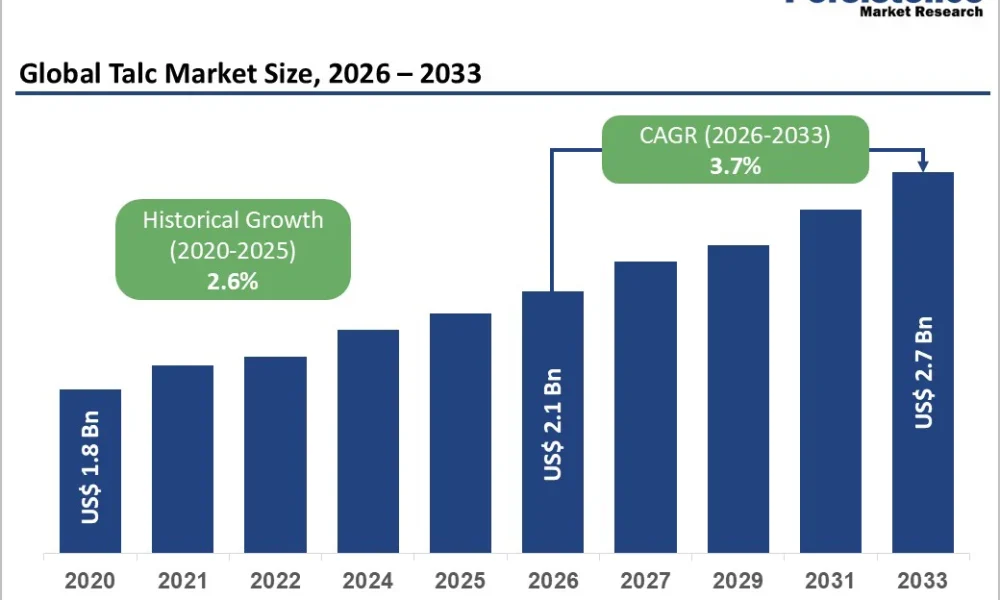
The global talc market is poised for steady growth over the coming years, supported by expanding industrial demand and diversified applications across multiple sectors. Talc, a naturally occurring mineral known for its softness, lamellar structure, chemical inertness, and high heat resistance, continues to find extensive use as a functional filler and performance-enhancing additive in plastics, cosmetics, paint & coatings, paper, ceramics, and other end markets. According to Persistence Market Research, the talc market size is projected to grow from around US$ 2.1 billion in 2026 to approximately US$ 2.7 billion by 2033, exhibiting a compound annual growth rate (CAGR) of about 3.7 % during this period.
What Is Talc and Why It Matters
Talc is a hydrated magnesium silicate mineral that is widely used in industrial and consumer applications due to its unique physical and chemical properties. It is characterized by its extreme softness (the lowest rating on the Mohs scale), lamellar morphology, and excellent thermal and chemical stability. These attributes make talc an ideal functional filler, reinforcing agent, extender pigment, and lubricant in numerous product formulations. Whether improving stiffness and dimensional stability in polymers or enhancing tactile sensation in personal care products, talc has become a critical ingredient across a broad array of industries.
Get Your FREE Sample Report Instantly – Click Now: https://www.persistencemarketresearch.com/samples/4609
Key Market Drivers
Several important factors are driving the growth of the talc market. One of the most significant drivers is the increasing demand for lightweight and high-performance materials in the automotive and plastics industries. Talc-filled polypropylene and other talc-reinforced polymers impart enhanced stiffness, impact resistance, and dimensional stability, making them valuable in automotive interior components, packaging, and consumer goods. As the automotive sector strives for fuel efficiency and lighter vehicles — including electric vehicles — the use of talc-enhanced composites continues to grow.
Another driver is the expanding application of talc in cosmetics and personal care products. Talc’s smooth texture, moisture-absorbing properties, and inert nature make it highly desirable for body powders, face powders, blushes, foundations, and other makeup formulations. Rising disposable incomes, increased beauty consciousness, and demand for mineral-based products, especially in emerging markets, are boosting talc consumption in this segment. Consequently, cosmetics and personal care applications are forecasted to register one of the fastest growth rates through 2033.
Beyond plastics and cosmetics, talc is also widely used in paint & coatings, paper & pulp, and ceramics, where it functions as an extender, opacity enhancer, and processing aid. This diversification of applications helps stabilize overall market growth, even amid fluctuations in individual end-use sectors.
Market Challenges and Regulatory Pressure
Despite its broad utility, the talc market also faces notable challenges. One of the most significant issues is the potential for asbestos contamination in natural talc deposits. Talc and asbestos can occur naturally in proximity; without rigorous testing and purification, batches of talc may contain trace amounts of asbestos fibers. This association has prompted stringent safety mandates and compliance requirements, particularly in cosmetics, pharmaceuticals, and food applications. Manufacturers must invest in advanced purification technologies and quality control systems to meet regulatory standards, which increases operational costs and complexity.
In addition, environmental and community concerns around mining activities — including ecosystem disruption and waste management — have placed additional pressure on producers to adopt sustainable mining practices and stakeholder engagement initiatives. These pressures, coupled with raw material cost volatility and stringent regulatory landscapes in developed markets, can constrain short-term growth despite long-term opportunities.
Get a Customized Market View in One Click: https://www.persistencemarketresearch.com/request-customization/4609
Product Type Insights
The talc market is segmented by product type into talc carbonate, talc chlorite, and other variants. Among these, talc carbonate is expected to remain the dominant product type due to its exceptional mechanical properties, thermal stability, and versatility across plastics, coatings, paper, and ceramics applications. Its established supply chains and widespread acceptance in large-scale manufacturing further reinforce its market leadership.
However, talc chlorite is projected to expand at a faster CAGR than talc carbonate through 2033. This accelerated growth is driven by emerging niche applications that demand specialized thermal and electrical properties — such as in aerospace components, electronics, energy storage materials, and ultra-high-purity applications — where conventional talc types may not be ideal. Technological advances in ore-sorting and purification are enabling chlorite talc to serve higher-value markets, offering a strategic opportunity for producers willing to innovate and specialize.
Application Trends and Growth Opportunities
By application, plastics represent the largest segment of talc consumption, accounting for over 30 % of market revenues in 2026. This is driven by talc’s effectiveness as a reinforcing filler in polypropylene and other polymers, which are extensively used in automotive interiors, consumer products, and industrial parts. The ongoing shift toward electric vehicles and lightweighting initiatives is expected to reinforce this position.
In addition to plastics, cosmetics and personal care applications are on the rise, with the segment expected to grow at a stronger pace compared to more mature applications like plastics and ceramics. This growth reflects consumer demand for clean-label and mineral-based products, as well as ongoing product innovation in premium beauty segments that leverage finely milled, high-purity talc.
Other segments like paint & coatings, paper & pulp, and ceramics continue to contribute meaningfully to the talc market. In paints and coatings, talc improves surface finish, opacity, and weather resistance, making it a valued extender pigment in decorative and protective coatings. In paper manufacturing, talc enhances printability, opacity, and processing performance. These diversified applications help buffer the market against downturns in any single end use.
Regional Market Dynamics
Regionally, Asia Pacific is slated to be the largest and fastest-growing talc market, accounting for more than 45 % of global demand by 2026. This dominance is propelled by rapid industrialization, urbanization, robust automotive and plastics manufacturing, and a growing middle class with rising consumption of personal care products. Countries like China and India are key contributors due to large-scale production capacity, low-cost mining operations, and proximity to major consuming industries.
In North America, the talc market is mature but heavily regulated. Demand is supported by plastics, automotive, packaging, and specialty industrial applications, though growth is moderate due to stringent asbestos-related safety standards and litigation risks. Nonetheless, there is sustained interest in high-purity talc for pharmaceuticals and cosmetics.
Europe’s talc market is shaped by strong industrial bases in automotive, coatings, and ceramics, as well as comprehensive regulatory frameworks that emphasize safety and low-impurity talc in consumer products. The region’s focus on innovation and compliance supports premium talc consumption even amid slower volume growth.
For In-Depth Competitive Analysis, Buy Now: https://www.persistencemarketresearch.com/checkout/4609
Competitive Landscape and Industry Outlook
The talc market is characterized by global producers with extensive mining and processing capacities, strong R&D capabilities, and broad distribution networks. Leading companies include Imerys, Mondo Minerals, Minerals Technologies, Golcha Group, LKAB Minerals, Rio Tinto, and Luzenac, among others. These players emphasize quality, regulatory compliance, and product innovation to strengthen market presence and serve diverse end markets.
Looking ahead, the talc market’s future remains promising but nuanced. Growth will continue to be driven by demand in plastics, cosmetics, and industrial applications, while opportunities in high-purity talc grades and specialty uses may command premium pricing and offer strategic differentiation. At the same time, navigating regulatory complexities, sustainability expectations, and community concerns will be essential for long-term success in this evolving global landscape.
About Persistence Market Research:
At Persistence Market Research, we specialize in creating research studies that serve as strategic tools for driving business growth. Established as a proprietary firm in 2012, we have evolved into a registered company in England and Wales in 2023 under the name Persistence Research & Consultancy Services Ltd. With a solid foundation, we have completed over 3600 custom and syndicate market research projects, and delivered more than 2700 projects for other leading market research companies’ clients.
Our approach combines traditional market research methods with modern tools to offer comprehensive research solutions. With a decade of experience, we pride ourselves on deriving actionable insights from data to help businesses stay ahead of the competition. Our client base spans multinational corporations, leading consulting firms, investment funds, and government departments. A significant portion of our sales comes from repeat clients, a testament to the value and trust we’ve built over the years.
Contact Us:
Persistence Market Research
Second Floor, 150 Fleet Street,
London, EC4A 2DQ, United Kingdom
USA Phone: +1 646-878-6329
UK Phone: +44 203-837-5656
Email: [email protected]
Web: https://www.persistencemarketresearch.com




