
The color detection sensors market is steadily gaining momentum as industries place growing emphasis on quality assurance, automation, and visual accuracy. Color detection sensors are designed to identify, differentiate, and measure color variations with high precision, making them indispensable in manufacturing environments where even slight color deviations can compromise product quality, regulatory compliance, or brand reputation. These sensors are widely deployed across food processing, automotive manufacturing, pharmaceuticals, textiles, and consumer electronics.
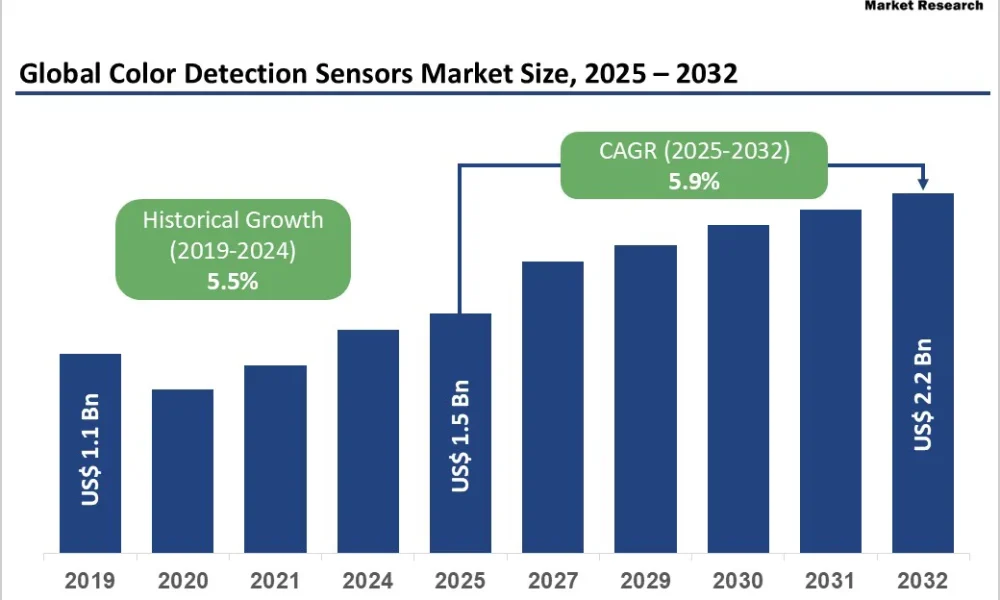
In 2025, the global color detection sensors market is valued at US$ 1.5 billion and is projected to reach US$ 2.2 billion by 2032, growing at a CAGR of 5.9% during the forecast period. This consistent growth reflects the increasing reliance on automated inspection systems, rising demand for defect-free production, and the integration of color-sensing technologies into smart manufacturing and Industry 4.0 ecosystems.
Market Statistics, Growth Momentum, and Industry Leadership
The market’s expansion is closely tied to the evolution of modern manufacturing, where manual inspection is being replaced by real-time, sensor-driven quality control. Color detection sensors enable manufacturers to ensure product uniformity, detect contamination, and verify labeling accuracy at high speeds. Industries such as food and beverage, pharmaceuticals, and automotive manufacturing rely heavily on these systems to meet stringent regulatory and safety standards.
From a segmentation perspective, RGB sensors dominate the market with approximately 34% share, owing to their technological maturity, cost efficiency, and wide applicability across industrial and consumer applications. Regionally, North America leads the global market with around 29% share in 2025, supported by advanced manufacturing infrastructure and strict quality compliance requirements. Meanwhile, Asia Pacific emerges as the fastest-growing region, driven by rapid industrialization, expanding pharmaceutical production, and increasing automation investments.
Key Highlights from the Color Detection Sensors Market Report
- • The global market is projected to grow steadily, reaching US$ 2.2 billion by 2032.
- • Industry 4.0 adoption is accelerating the use of automated color inspection systems.
- • North America remains the largest market due to stringent quality control regulations.
- • Asia Pacific records the fastest growth, supported by manufacturing expansion.
- • RGB sensors continue to dominate due to cost-effectiveness and versatility.
- • Pharmaceutical manufacturing presents a high-growth opportunity for advanced sensors.
Color Detection Sensors Market Segmentation Analysis
Market segmentation by sensor type highlights strong demand for RGB sensors, spectral sensors, and color contrast sensors. RGB sensors are widely used in industrial automation due to their simplicity, reliability, and compatibility with existing systems. Spectral sensors, while smaller in market share, are gaining traction in high-precision applications where detailed color analysis and differentiation are required, particularly in pharmaceuticals and specialty manufacturing.
Based on end-user industries, the market spans food and beverage processing, automotive manufacturing, pharmaceuticals, textiles, consumer electronics, and packaging. Food processing and pharmaceuticals represent major demand centers, as color consistency is directly linked to product safety, compliance, and consumer trust. Automotive and electronics manufacturers also rely on color detection sensors to ensure visual uniformity across components and finished products.
Application-Based and Technology-Based Segmentation
From an application standpoint, color detection sensors are widely deployed in quality inspection, color detection and sorting, packaging verification, and labeling inspection. The color detection and sorting application segment is the fastest growing, expanding at a CAGR of 7.1% through 2032, as automated sorting systems become essential in food processing and material recovery facilities.
Technologically, the market is evolving with the integration of artificial intelligence and machine vision systems. AI-enabled color sensors enhance accuracy by learning from historical data and adapting to variations in lighting, surface texture, and material composition. This technological convergence significantly improves inspection reliability and reduces false rejection rates in high-speed production environments.
Elevate your business strategy with comprehensive market data. Request a sample report now: https://www.persistencemarketresearch.com/samples/22393
Regional Insights: North America and Europe
North America continues to dominate the color detection sensors market due to its advanced industrial base and strict regulatory landscape. The U.S. leads regional demand, particularly in automotive manufacturing, food processing, and consumer electronics, where quality assurance standards are among the highest globally. Regulatory oversight from agencies such as the FDA further drives adoption in pharmaceutical and food applications.
Europe follows closely, supported by strong industrial automation adoption and a focus on precision manufacturing. Countries such as Germany, France, and the U.K. are investing heavily in smart factories and digital quality control systems. The region’s emphasis on sustainability and waste reduction also supports the use of automated color sorting technologies in recycling and material recovery processes.
Regional Insights: Asia Pacific and Rest of the World
Asia Pacific is the fastest-growing regional market, expanding at a 6.7% CAGR through 2032. China’s large-scale manufacturing ecosystem, India’s rapidly growing pharmaceutical sector, and increasing automation adoption across ASEAN economies are key growth drivers. Governments across the region are actively promoting smart manufacturing initiatives, further boosting demand for advanced sensing technologies.
In the Rest of the World, including Latin America and the Middle East, market growth is moderate but promising. Expanding food processing industries, rising consumer goods manufacturing, and gradual adoption of automation technologies are creating new opportunities for color detection sensor vendors in these regions.
Market Drivers Supporting Growth
One of the primary drivers of the color detection sensors market is the growing emphasis on product quality and consistency. In industries where color accuracy directly impacts brand perception and regulatory compliance, automated color sensing systems provide unmatched reliability compared to manual inspection.
Another major driver is the integration of Industry 4.0 and smart manufacturing frameworks. Real-time data collection, automated decision-making, and predictive quality control rely heavily on advanced sensors, including color detection technologies. The increasing use of AI and machine vision further enhances sensor performance and adoption.
Market Restraints Limiting Adoption
Despite steady growth, the market faces certain challenges. High initial costs associated with advanced color detection systems can be a barrier for small and medium-sized manufacturers, particularly in emerging economies. Integration complexity with legacy production systems may also slow adoption.
Additionally, environmental sensitivity, such as variations in lighting conditions and surface reflectivity, can affect sensor accuracy if systems are not properly calibrated. These technical challenges require skilled personnel and ongoing maintenance, adding to operational costs.
Emerging Market Opportunities
The rapid expansion of pharmaceutical manufacturing, particularly in Asia Pacific, presents a significant opportunity for the color detection sensors market. Strict regulatory requirements for tablet and capsule verification are driving demand for high-precision color sensing solutions that ensure compliance and patient safety.
Furthermore, the growing focus on automated sorting and waste reduction in food processing and recycling industries opens new avenues for innovation. Advanced color detection systems capable of real-time sorting and classification are increasingly essential for improving efficiency and sustainability across industrial operations.
Reasons to Buy the Color Detection Sensors Market Report
✔ Access detailed market size, growth forecasts, and trend analysis through 2032
✔ Understand key drivers, restraints, and opportunities shaping the industry
✔ Identify high-growth segments and regional investment hotspots
✔ Gain insights into competitive strategies and recent technological developments
✔ Support strategic planning with reliable, data-driven market intelligence
Company Insights: Key Players in the Market
- • Keyence Corporation
- • Omron Corporation
- • Sick AG
- • Panasonic Corporation
- • Balluff GmbH
- • Banner Engineering Corp.
- • IFM Electronic GmbH
Recent Developments:
Leading manufacturers are increasingly integrating AI-driven analytics and machine vision capabilities into color detection sensors to improve accuracy and adaptability. Additionally, strategic collaborations between sensor manufacturers and automation solution providers are accelerating innovation and expanding application scope across industries.
Final Perspective
The color detection sensors market is evolving steadily as industries demand higher accuracy, automation, and compliance in production processes. With consistent growth, expanding applications, and technological advancements, color detection sensors are becoming a critical component of modern manufacturing ecosystems. As smart factories and quality-centric production models continue to rise, the market is well-positioned for sustained long-term growth. 🎯
Related Reports:




