
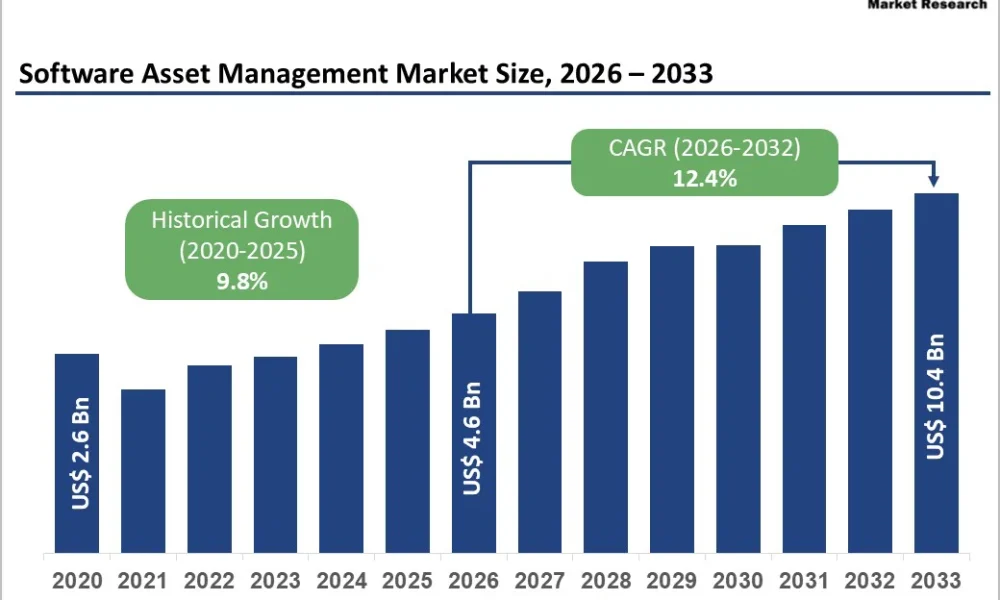
The global Software Asset Management (SAM) market is entering a high-growth phase as enterprises race to control escalating software and cloud costs. Valued at US$ 4.6 billion in 2026, the market is projected to reach US$ 10.4 billion by 2033, expanding at a CAGR of 12.4% between 2026 and 2033. Historical growth from 2020 to 2025 stood at 9.8%, underscoring accelerating adoption as digital transformation intensifies.
Rapid enterprise digitization, SaaS proliferation, multi-cloud complexity, and mounting audit pressures are transforming SAM from a back-office compliance function into a strategic financial and governance discipline. Today, CIOs and CFOs increasingly view SAM as a cornerstone of cost optimization, risk mitigation, and operational transparency.
Market Dynamics
Rising Software Complexity and Cloud Expansion
Enterprises today operate hybrid IT estates spanning SaaS platforms, on-premise systems, cloud-native workloads, containers, and remote endpoints. As organizations embrace multi-cloud ecosystems, software environments become fragmented and difficult to track.
Subscription-based pricing models, consumption-driven billing, and Bring-Your-Own-License (BYOL) frameworks complicate entitlement management. Without centralized visibility, enterprises risk overspending, over-licensing, or violating contractual terms.
SAM platforms provide automated discovery, usage metering, entitlement reconciliation, and rightsizing. By aligning software consumption with real demand, organizations reduce shelfware and eliminate redundant subscriptions. This is particularly critical as cloud spending becomes one of the largest IT budget categories.
The integration of SAM with FinOps frameworks further enhances value by enabling real-time cost optimization and governance across dynamic digital infrastructures.
Growing Audit Risk and Compliance Enforcement
Software audits have become more frequent and financially impactful. Vendors such as Microsoft Corporation, Oracle Corporation, IBM Corporation, SAP SE, and Adobe Inc. increasingly use audits as revenue recovery mechanisms.
Complex licensing metrics—per core, per user, concurrent usage, subscription tiers—create unintentional non-compliance risks. Organizations expanding globally face additional regulatory scrutiny around cybersecurity, intellectual property, and data governance.
Non-compliance can result in substantial true-up costs, penalties, reputational damage, and operational disruptions. SAM tools mitigate these risks by delivering:
- Continuous license monitoring
- Automated compliance reconciliation
- Audit-ready documentation
- Proactive alerting and remediation workflows
By maintaining an accurate Effective License Position (ELP), enterprises strengthen their compliance posture and reduce unexpected financial liabilities.
Key Market Restraints
Licensing Complexity and Fragmented IT Environments
Modern licensing structures are increasingly intricate. Enterprises must manage hybrid models combining perpetual, subscription, consumption-based, and region-specific usage rights.
Data silos across ITSM tools, CMDBs, procurement systems, and cloud platforms hinder entitlement reconciliation. Aligning processes with frameworks such as ISO/IEC 19770-1:2017 requires cross-functional coordination that many organizations still lack.
This operational complexity slows SAM implementation and limits value realization.
Limited Awareness and Budget Constraints Among SMEs
Small and medium enterprises (SMEs) often underestimate the savings and risk mitigation benefits of SAM. Budget limitations, lack of in-house expertise, and competing IT priorities delay adoption.
In emerging economies—especially across Asia Pacific—historically high rates of unlicensed software use increase compliance exposure. However, many SMEs implement SAM reactively following audit events rather than proactively for optimization.
Closing this awareness gap remains critical for broader market penetration.
Major Market Opportunities
Convergence of SAM, SaaS Management, and FinOps
A powerful opportunity lies in integrating Software Asset Management with SaaS Management Platforms (SMPs) and FinOps practices. Enterprises increasingly demand unified platforms that offer:
- Real-time software and cloud spend analytics
- Contract lifecycle management
- Vendor negotiation insights
- Cross-functional collaboration between IT, finance, and procurement
As cloud-first strategies mature, CIOs seek continuous optimization rather than periodic compliance checks. Unified SAM-FinOps solutions support strategic planning, eliminate duplication across SaaS subscriptions, and improve renewal forecasting.
AI-Driven Discovery and Predictive Analytics
Artificial intelligence is transforming SAM capabilities. AI-powered discovery tools autonomously identify assets, classify applications, detect anomalies, and predict compliance risks.
Machine learning enhances:
- Consumption forecasting
- Renewal planning
- Vendor audit simulation
- Optimization recommendations
Automation significantly reduces manual effort, increases accuracy, and ensures real-time visibility across distributed environments. Vendors embedding AI, natural language processing, and intelligent orchestration stand to gain competitive advantage.
Elevate your business strategy with comprehensive market data. Request a sample report now: https://www.persistencemarketresearch.com/samples/18409
Category-Wise Market Analysis
Component Insights
The software segment dominates, contributing approximately 74% of global revenues. Enterprises prioritize centralized platforms capable of:
- License management
- Software discovery
- Optimization and metering
- Compliance management
- Contract governance
Although professional and managed services are expanding rapidly, they complement rather than replace software-driven control architectures.
Deployment Model Insights
Cloud deployment leads new implementations and installed base revenues. Organizations favor cloud-native SAM solutions due to:
- Scalability
- Lower capital expenditure
- Automated updates
- Real-time analytics
- Simplified global rollout
While highly regulated industries maintain selective on-premise deployments, long-term growth strongly favors cloud-based SAM platforms.
Organization Size Insights
Large enterprises account for more than 74% of global SAM revenues. Their complex, multinational IT environments expose them to significant audit risk and cost leakage.
With annual software budgets often exceeding hundreds of millions of dollars, even modest optimization can generate substantial savings. Investments in enterprise-grade SAM platforms and dedicated governance teams reinforce this segment’s leadership.
Industry Vertical Insights
Manufacturing is one of the most prominent adopters of SAM solutions. The sector relies heavily on ERP, PLM, MES, and engineering design software with high-value, complex licensing.
Industry 4.0 initiatives, IoT integration, and digital supply chains have amplified software sprawl across factories and global sites. SAM ensures compliance, reduces operational risk, and optimizes high-cost engineering licenses.
Similar adoption patterns are emerging in BFSI, IT & telecom, and healthcare sectors.
Regional Insights
North America
North America holds approximately 44% of global SAM revenues, supported by advanced cloud adoption and stringent regulatory standards. The region’s mature enterprise ecosystem and concentration of leading SAM providers drive sustained demand.
Technology-intensive sectors such as BFSI, healthcare, telecom, and advanced manufacturing maintain extensive software portfolios requiring continuous governance.
Europe
Europe represents a substantial share of the global market, propelled by strict data-protection regulations and corporate governance standards. Enterprises increasingly align SAM processes with ISO/IEC frameworks to ensure compliance and operational discipline.
Countries such as Germany, the U.K., and France lead adoption as organizations strengthen digital oversight and cybersecurity controls.
Asia Pacific
Asia Pacific is the fastest-growing region, fueled by rapid digitalization across China, India, Japan, and ASEAN economies.
The region’s high density of SMEs, expanding cloud adoption, and historically elevated unlicensed software rates create strong growth potential. Governments promoting digital economy initiatives and cybersecurity enforcement further accelerate demand for SAM solutions.
Competitive Landscape
The global SAM market is moderately fragmented, featuring a mix of global technology providers and specialized vendors.
Leading players include:
- IBM Corporation
- Freshworks Inc.
- Ivanti
- SolarWinds
- Zoho Corporation
- Snow Software
- BMC Software
- Hewlett Packard Enterprise
- VMware Inc.
- Oracle Corporation
Competition increasingly centers on:
- Software recognition library depth
- AI-powered analytics
- Multi-cloud integration
- FinOps alignment
- Automation of complex licensing rules
Recent Strategic Developments
- In June 2024, IFS AB announced its agreement to acquire Copperleaf Technologies Inc., strengthening AI-driven asset lifecycle capabilities.
- In June 2024, Freshworks Inc. acquired Device42, enhancing infrastructure discovery and IT asset mapping.
- In February 2024, Softchoice Corporation introduced SAM+, expanding subscription license optimization services across North America.
These developments highlight consolidation and innovation trends focused on AI integration, infrastructure visibility, and subscription complexity management.
Future Outlook
The Software Asset Management market is transitioning from reactive compliance control to proactive digital financial governance. As enterprises continue expanding SaaS portfolios, containerized workloads, and multi-cloud deployments, centralized visibility and predictive optimization become mission-critical.
Key trends shaping the 2033 outlook include:
- AI-powered continuous compliance
- Integration with cybersecurity and risk frameworks
- SaaS sprawl governance
- Predictive vendor negotiation intelligence
- Automated lifecycle management
Organizations that adopt advanced, unified SAM platforms will gain measurable advantages in cost discipline, audit readiness, and digital agility.
Conclusion
The global Software Asset Management market is on a robust growth trajectory, projected to more than double from US$ 4.6 billion in 2026 to US$ 10.4 billion by 2033. Driven by cloud expansion, audit risks, and FinOps adoption, SAM is evolving into a strategic enabler of digital transformation.
As enterprises confront escalating software complexity and mounting compliance pressures, investments in AI-driven, cloud-native SAM platforms will define the next generation of IT governance. Vendors capable of delivering integrated, predictive, and automation-rich solutions will capture substantial opportunities in this rapidly maturing market.
Related Reports:




