
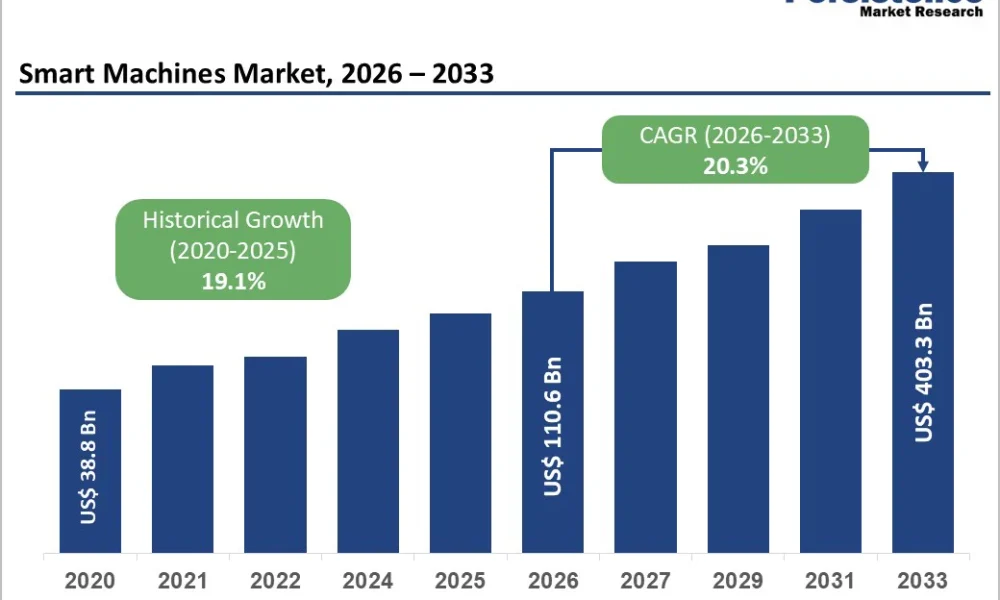
The global Smart Machines Market is entering a transformative growth phase, fueled by intelligent automation, AI-driven decision-making, and connected industrial ecosystems. The market is projected to grow from US$ 110.6 billion in 2026 to US$ 403.3 billion by 2033, registering a robust CAGR of 20.3% during 2026–2033. Historical growth between 2020 and 2025 stood at 19.1%, indicating sustained momentum.
Smart machines—encompassing intelligent robots, autonomous systems, AI-enabled platforms, and cloud-connected industrial equipment—are redefining productivity across manufacturing, healthcare, logistics, defense, and services. Advances in artificial intelligence, IoT, robotics, cloud computing, and edge analytics are converging to create systems capable of perception, learning, adaptation, and independent decision-making.
Market Dynamics
Automation-Driven Robotics Transform Manufacturing Efficiency
Automation remains a primary growth engine in the Smart Machines Market. Intelligent robots improve throughput, enhance precision, reduce energy consumption, and mitigate labor shortages across factories worldwide.
At CIIF 2025, ABB Limited introduced the IRB 6750S shelf robot, designed for elevated production-line installation with full vertical and horizontal motion capabilities. Powered by ABB’s OmniCore controller platform, the robot delivers:
- 20% reduction in energy consumption
- 0.9 mm path accuracy
- 0.06 mm repeatability
- Up to 50% cycle-time reduction with Automatic Path Planning
These advancements demonstrate how automation not only boosts productivity but also enhances energy efficiency and operational consistency.
Similarly, General Electric Company has reported substantial reductions in appliance manufacturing cycle times through automation investments, highlighting measurable gains in labor productivity and process optimization.
Autonomous Systems Enable Complex, Independent Operations
The rising deployment of autonomous systems across logistics, agriculture, manufacturing, and healthcare is accelerating market growth. Advances in AI, computer vision, and sensor fusion allow robots to operate independently in hazardous and high-precision environments.
According to the International Federation of Robotics, global robot installations rebounded strongly, supported by expanding healthcare and service-sector adoption.
In March 2025, Google DeepMind launched its Gemini Robotics models built on Gemini 2.0. These systems demonstrated complex, multi-step task execution—such as precision packing and origami folding—across various robotic embodiments, including humanoid platforms. Success rates improved two to three times compared to previous systems.
This leap in AI generalization strengthens the business case for deploying autonomous machines across dynamic industrial settings.
Elevate your business strategy with comprehensive market data. Request a sample report now: https://www.persistencemarketresearch.com/samples/8872
Market Restraints
High Upfront Costs Limit SME Adoption
Despite long-term ROI benefits, smart machine deployment involves significant capital investment. Costs include:
- Robotic hardware
- Software licenses
- System integration
- Infrastructure upgrades
- Ongoing maintenance
For small and medium-sized enterprises (SMEs), these expenses can reach several million dollars, creating adoption barriers. Rising interest rates and cautious capital spending further constrain investment.
Until financing models become more flexible—such as Robotics-as-a-Service (RaaS)—high upfront costs will slow penetration among smaller manufacturers.
Talent Shortages and Integration Complexity
Skill gaps remain a critical challenge. Approximately 70% of organizations report difficulty finding talent capable of managing AI-enabled systems.
Smart machine ecosystems require expertise in:
- Robotics programming
- Cloud computing
- Cybersecurity
- Data analytics
- AI model management
Additionally, integrating advanced systems with legacy infrastructure often requires process redesign and retrofitting, potentially increasing downtime during transition phases. Cybersecurity concerns further complicate deployment in regulated sectors.
Growth Opportunities
Healthcare Robotics Expands Rapidly
Healthcare robotics represents one of the strongest growth avenues. Aging populations, workforce shortages, and rising precision requirements are accelerating adoption of AI-powered systems in surgery, diagnostics, logistics, and patient monitoring.
Orders for life sciences and healthcare robotics have grown significantly, reflecting strong institutional demand.
In October 2025, Microsoft Corporation expanded its Dragon Copilot AI clinical assistant. Integrated into Microsoft Cloud for Healthcare, the system introduced ambient workflow support for nursing staff and automated patient triaging. Documentation time declined substantially, while patient responsiveness improved by up to 87%.
Smart machines in healthcare are improving clinical outcomes, reducing administrative burdens, and enabling more efficient care delivery models.
Cloud-Based Platforms Enable Scalable Intelligence
Cloud computing is central to next-generation smart machine ecosystems. Real-time analytics, predictive maintenance, and remote monitoring rely heavily on cloud-based architectures.
In 2025, Google Inc. launched Manufacturing Data Engine and Manufacturing Connect, integrating Pub/Sub ingestion, BigQuery analytics, and Vertex AI modeling. These solutions allow AI deployment in weeks rather than months.
Cloud-enabled anomaly detection analyzes vibration, temperature, and noise data in real time, enabling predictive maintenance and reducing downtime by nearly 25%.
Partnerships with ecosystem players such as Intel Corporation and Splunk Inc. strengthen closed-loop AI integration between factory floors and enterprise systems.
Category-Wise Insights
Component Analysis: Software Leads
Software dominates with approximately 40% market share. It powers AI algorithms, analytics engines, digital twins, and autonomous decision-making capabilities.
Leading vendors such as IBM Corporation and Microsoft Corporation continue introducing AI-driven platforms enhancing interoperability and scalability.
Software offers superior flexibility and upgrade potential compared to hardware, reinforcing its long-term investment appeal.
Machine Type Analysis: Robots Lead and Grow Fastest
Robots account for roughly 35% of total market share and remain the fastest-growing machine type.
Industrial and collaborative robots (cobots) are widely deployed in:
- Assembly lines
- Logistics warehouses
- Hazardous environments
- Quality inspection systems
Companies like Rethink Robotics and ABB Limited continue expanding multi-purpose robotic platforms to enhance flexibility and productivity.
Collaborative robots further support safe human-machine interaction, accelerating adoption across small and mid-sized factories.
Technology Analysis: Cloud Computing Leads
Cloud computing holds nearly 30% market share within enabling technologies. Its scalability and real-time analytics capabilities support connected IoT devices and distributed machine networks.
Cloud infrastructure reduces capital expenditures by minimizing on-premise hardware requirements while enabling advanced analytics and AI modeling at scale.
Regional Insights
North America: Innovation Powerhouse
North America leads with approximately 41% share of global revenues. Strong automation investment, advanced AI research, and mature cloud infrastructure drive dominance.
In Q3 2024, robot orders in the U.S. rose significantly, supported by life sciences and pharmaceutical sector expansion.
In April 2025, IBM Corporation announced a US$150 billion U.S. investment plan over five years, including US$30 billion allocated to advanced computing R&D and manufacturing.
Robust regulatory standards and strong venture ecosystems reinforce regional leadership.
Europe: Industrie 4.0 Momentum
Europe advances through Germany’s Industrie 4.0 initiative, which integrates cyber-physical systems and IoT-enabled manufacturing.
ABB Limited was recognized as a Leader in Gartner’s 2025 Magic Quadrant for Industrial IoT Platforms. Its Genix Industrial IoT Suite integrates operational and IT systems for digital twin-driven optimization.
Strong 5G infrastructure and public-private collaboration further accelerate smart factory adoption.
Asia Pacific: Fastest Growing Region
Asia Pacific is the fastest-growing market, driven by manufacturing scale, government policies, and robotics innovation.
China’s Made in China 2025 strategy promotes AI integration across industrial operations. Japan continues advancing robotics engineering excellence.
At the International Robot Exhibition 2025, Yamaha Motor Co., Ltd. introduced high-payload collaborative and SCARA robots, while Techman Robot showcased AI-driven inspection systems reducing setup times by 90%.
India and ASEAN economies further strengthen regional manufacturing ecosystems, positioning Asia Pacific as a major growth engine.
Competitive Landscape
The Smart Machines Market is moderately consolidated. Key players focus on AI integration, robotics innovation, and cloud scalability.
Major companies include:
- IBM Corporation
- Google Inc.
- Microsoft Corporation
- ABB Limited
- Rockwell Automation, Inc.
- Apple Inc.
- BAE Systems
- Rethink Robotics
Companies increasingly adopt platform-based strategies, expand AI ecosystems, and pursue acquisitions to strengthen capabilities.
Future Outlook
By 2033, smart machines will be central to Industry 4.0 and Industry 5.0 ecosystems. Key trends shaping the future include:
- Quantum-enhanced AI optimization
- Robotics-as-a-Service models
- AI-driven digital twins
- Edge-cloud hybrid intelligence
- Autonomous logistics networks
Enterprises investing early in AI-enabled automation will achieve measurable gains in productivity, resilience, and sustainability.
Conclusion
The Smart Machines Market is set for exponential expansion, projected to grow nearly fourfold to US$ 403.3 billion by 2033. Automation, AI innovation, robotics flexibility, and cloud intelligence form the foundation of this transformation.
As industries confront labor shortages, cost pressures, and demand volatility, intelligent machines offer scalable, adaptive, and data-driven solutions. Vendors delivering integrated, AI-powered, and interoperable platforms will shape the next decade of industrial and healthcare automation worldwide.
Related Reports:




