
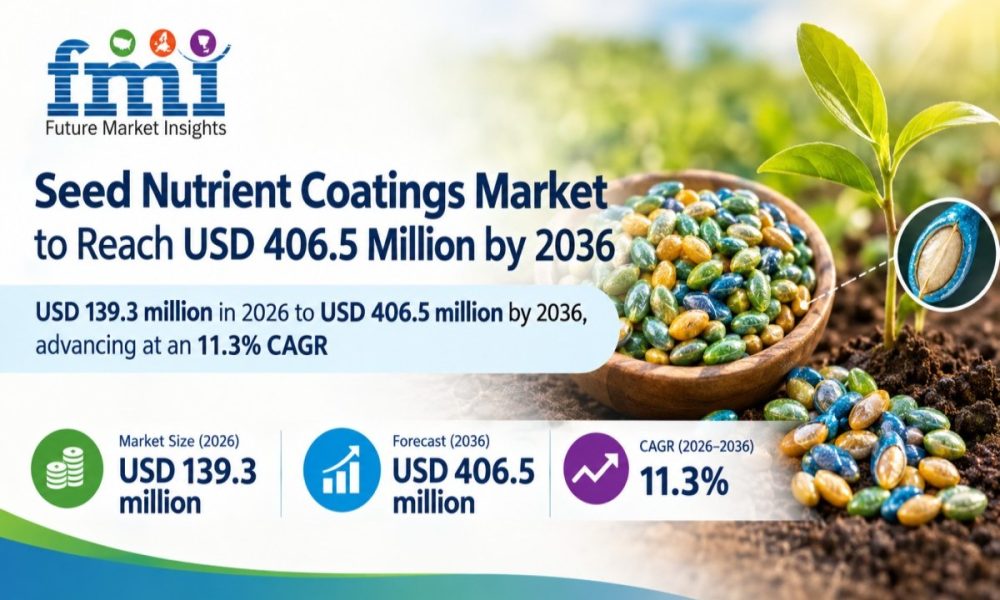
Global seed nutrient coatings market projected to grow from USD 139.3 million in 2026 to USD 406.5 million by 2036 at an 11.3% CAGR, according to Future Market Insights
The global Seed Nutrient Coatings Market is projected to reach USD 406.5 million by 2036, up from approximately USD 139.3 million in 2026, expanding at an 11.3% CAGR during the forecast period, according to the latest analysis by Future Market Insights (FMI).
The market was valued at USD 125.2 million in 2025 and is expected to create significant new commercial opportunities as seed companies, commercial treaters and growers evaluate nutrient delivery systems that fit established treatment and planting operations.
Get Detailed Market Forecasts, Competitive Benchmarking, and Pricing Trends:
https://www.futuremarketinsights.com/reports/sample/rep-gb-35403
Polymer-Based Systems Continue to Lead Product Demand
Polymer-based systems are expected to account for 46.3% of product type demand in 2026, maintaining their position as the largest product category.
Polymer-based coatings provide a film that helps keep low-dose nutrients or biological actives attached to seeds during storage, treatment and planting. Commercial seed plants evaluate coating materials against adhesion, dust behavior and seed-flow requirements before incorporating them into production recipes.
Corn and Cereals Represent the Largest Crop Type
The corn and cereals segment is projected to account for 45.1% of crop type demand in 2026.
Large treated seed volumes allow seed companies and suppliers to spread treatment qualification costs across broad-acre crop programs. This creates a commercial environment in which dose efficiency, recipe compatibility and treatment consistency become important purchasing considerations.
Corn and cereal programs also provide opportunities for nutrient and biological functions to be incorporated into established seed-treatment packages.
In-Plant Treatment Remains the Leading Treatment Point
In-plant treatment is expected to account for 48.7% of treatment point demand in 2026.
Seed-company plants provide centralized control over treatment recipes, dosing sequences and qualification procedures. This makes in-plant application more consistent than decentralized treatment approaches when several components must be combined.
Liquid Slurries Support High-Throughput Treatment
Liquid slurries are forecast to account for 50.7% of formulation demand in 2026, making them the leading formulation category.
Liquid systems allow commercial treaters to meter multiple compatible ingredients into a documented treatment batch. Loading can also be adjusted according to crop requirements or seed lots.
Agri-Input Distributors Remain Important to Market Access
Agri-input distributors are expected to account for 42.9% of sales channel demand in 2026.
Distributors connect technical product claims with crop-specific purchasing decisions and position seasonal inventory near growers before planting.
Seed nutrient coatings can require application guidance because handling requirements vary between factory treatment and farm-level use. Local agronomic support can therefore influence the transition from technical evaluation to commercial purchasing.
Fertilizer Volatility Creates a Stronger Value Test
Fertilizer-cost volatility is increasing attention on seed-applied nutrition where suppliers can demonstrate measurable agronomic value.
Growers compare nutrient coatings with existing fertilizer programs before accepting an additional treated-seed cost. The commercial question is therefore tied to field economics as much as formulation performance.
USA and South Korea Show Strong Growth
FMI’s country-level analysis identifies the USA as the fastest-growing highlighted market, with a projected 11.0% CAGR through 2036, followed by South Korea at 10.7%.
Germany is projected to grow at 10.4%, the UK at 10.1%, and Japan at 9.0% during the forecast period.
The relatively narrow spread between the highlighted country forecasts reflects growth opportunities across both established seed-treatment markets and countries where regulatory and commercial frameworks are evolving.
Country-Level Market Analysis
United States
The United States seed nutrient coatings market is forecast to expand at an 11.0% CAGR through 2036.
Large commercial seed-treatment programs create opportunities for nutrient functions that can fit established factory recipes and federal regulatory requirements.
South Korea
South Korea is projected to record a 10.7% CAGR through 2036.
The market benefits from established agricultural input channels and regulatory classifications covering soil microbial preparations and soil activators.
Germany
Germany’s seed nutrient coatings market is projected to grow at a 10.4% CAGR during the assessment period.
United Kingdom
The UK market is projected to expand at a 10.1% CAGR through 2036.
The country’s fertilizing-product regulatory framework is undergoing development, with proposed requirements covering conformity assessment and novel products.
Competitive Landscape
The Seed Nutrient Coatings Market includes microbial crop nutrition specialists, integrated agricultural input companies and seed-coating technology providers.
Key companies profiled by FMI include Pivot Bio, Groundwork BioAg, Verdesian Life Sciences, Bayer SeedGrowth, Syngenta, Corteva Agriscience, BASF and Germains Seed Technology.
Competitive positioning is influenced by nutrient-delivery performance, formulation stability, treatment compatibility, technical support, regulatory documentation and geographic reach.
Microbial nutrition companies focus on nutrient-use and biological functions, while integrated agricultural companies connect seed-applied technologies with established treatment platforms. Coating specialists contribute formulation and commercial treatment capabilities.
Key Market Developments
Recent developments include the expansion of dry seed-treatment options, biological seed treatments and integrated nutrient technologies.
- Pivot Bio launched RETAIN Dry in March 2026 for direct sorghum-seed application, expanding its application options for growers.
- Corteva Agriscience highlighted Ympact as a growth-nutrition seed treatment incorporating humic and fulvic compounds with micronutrients.
- Groundwork BioAg expanded its Rootella portfolio with concentrated mycorrhizal formulations designed to support nutrient uptake.
These developments illustrate the broader movement toward incorporating biological and nutrient functions into established seed-treatment programs.
Analyst Perspective
“Seed nutrient coatings earn repeat business when measurable nutrient performance survives commercial treatment and normal planting conditions. Seed companies will favor suppliers that prove recipe compatibility before asking production teams to accept another performance claim.” — Nandini Roy Choudhury, Principal Consultant, Future Market Insights
Exclusive Discounts on Full Report: https://www.futuremarketinsights.com/reports/seed-nutrient-coatings-market
Report Scope
The FMI study covers the Seed Nutrient Coatings Market by product type, crop type, treatment point, formulation, sales channel and region.
Product categories include polymer-based systems, biological-microbial systems, nutrient-loaded systems and others. Crop types include corn and cereals, soybean and pulses, vegetables, cotton and others.
Treatment points include in-plant application, commercial seed treaters, on-farm treatment and others. Formulations cover liquid slurries, dry powders, film coats and encrusting, while sales channels include agri-input distributors, cooperatives, agri-retail chains and online-direct-to-farm routes.
FMI’s methodology combines primary and secondary research with market triangulation. Primary research covers seed companies, commercial treaters, biological-input developers, coating formulators, distributors and growers. Desk research incorporates government guidance, regulatory information, seed associations, company disclosures and industry sources.
Key Executive Benefits
- Decision-Ready Insights
- Reduced Strategic Risk
- Market Entry Confidence
- Competitive Advantage
- Faster Growth Decisions
- Primary Market Validation
To explore how FMI Custom Research can support your strategic priorities, connect with our team at – [email protected]
About Future Market Insights (FMI)
Future Market Insights, Inc. is an ESOMAR-certified, ISO 9001:2015 market research and consulting organization trusted by Fortune 500 companies. With a global presence across the U.S., UK, India, and Dubai, FMI delivers data-driven insights across 30+ industries and 1200 markets worldwide.



