
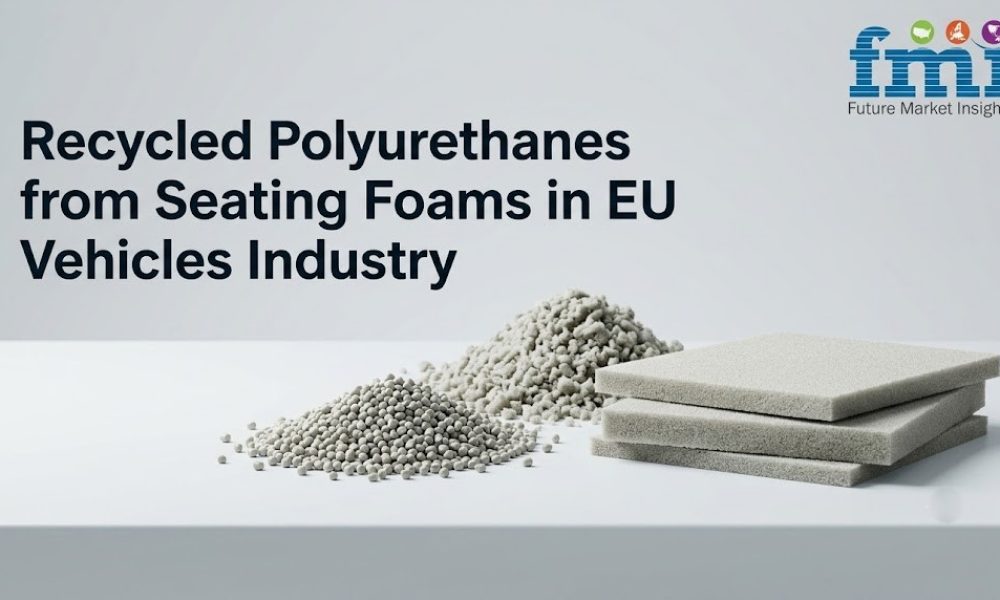
The global Recycled Polyurethanes from Seating Foams in EU Vehicles Industry is projected to grow from USD 18.6 million in 2026 to USD 93.3 million by 2036, advancing at a 17.5% CAGR during the forecast period. The industry was valued at USD 15.8 million in 2025, with demand being supported by EU vehicle circularity requirements, increasing recovery of automotive seating foams, and automakers’ efforts to introduce verified recycled materials into vehicle interiors.
Vehicle seating provides a significant recovery opportunity because flexible polyurethane foam is widely used in seat cushions and backrests. As automakers and seating suppliers increase attention on recycled content, recovered polyurethane and recycled polyol are gaining relevance where material quality can meet automotive performance and validation requirements.
Recycled Polyurethanes from Seating Foams in EU Vehicles Industry: Key Growth Drivers
EU end-of-life vehicle requirements and OEM circular-material programs are increasing the value of recoverable seating foam. The industry is moving beyond waste collection toward higher-value recovery routes that can return polyurethane chemistry into automotive seating and interior applications.
Material quality remains central to adoption. Recycled polyol must deliver consistent foam performance, formulation compatibility, and documentation before it can enter approved vehicle programs. Automakers, seat suppliers, and recyclers therefore increasingly work through controlled qualification processes that evaluate recovered material across repeated production and testing cycles.
Passenger cars are expected to account for 76.0% of vehicle-type demand in 2026, reflecting their broad production base and large installed volume of seating foam. Direct OEM sales are projected to represent 61.0% of distribution demand in 2026, as automakers and Tier 1 seating companies play a central role in material approval and supply-chain integration.
Get detailed market forecasts, competitive benchmarking, and pricing trends: https://www.futuremarketinsights.com/reports/sample/rep-gb-32911
Glycolysis Leads Recycling Route Demand
By recycling route, glycolysis is estimated to hold 31.0% of the market in 2026. Its position reflects its direct pathway toward recycled polyol production, allowing recovered polyurethane chemistry to be returned to controlled foam formulations.
By source stream, post-industrial scrap is projected to account for 58.0% of demand in 2026. Cleaner and more consistent manufacturing scrap can be easier to sort, document, and qualify than mixed post-consumer material.
By foam type, flexible molded foam is expected to capture 72.0% share in 2026. The segment benefits from its extensive use in automotive seat cushions and backrests, creating a broad and relatively identifiable recovery stream.
Recycled Polyol Creates Higher-Value Recovery Opportunities
Recycled polyol is projected to represent 54.0% of product-form demand in 2026. Its ability to move directly into controlled foam formulations provides a route for recovered chemistry to remain closer to the original value chain rather than being diverted into lower-value applications.
The opportunity is particularly relevant for suppliers that can maintain consistent chemical properties across batches. Automotive seating programs require predictable density, comfort, durability, and processing characteristics, making formulation consistency an important factor in supplier qualification.
New seat cushions are anticipated to account for 36.0% of application demand in 2026. Closed-loop programs can initially focus on established seating components where material specifications and performance requirements are already well defined.
However, automotive qualification cycles remain a restraint. Recycled polyurethane suppliers must demonstrate repeatable material quality before recovered inputs can be approved for serial production. Feedstock contamination, inconsistent chemistry, and limited traceability can increase testing requirements and delay commercial adoption.
Country Markets Show Different Growth Patterns
Country-level demand varies according to vehicle production, seat-system manufacturing, feedstock availability, recycling infrastructure, and access to approved material programs.
Germany is projected to record a 18.6% CAGR through 2036, followed by Spain at 18.3%, France at 17.9%, Poland at 17.8%, Italy at 17.4%, Czechia at 17.0%, and Slovakia at 16.7% during the forecast period.
Germany benefits from a strong vehicle manufacturing and seating supplier base, particularly across major automotive production hubs. Spain provides a substantial manufacturing and component network, creating opportunities for controlled recovery of seating foam and integration into new vehicle programs.
France’s vehicle and component manufacturing base supports demand for recovered polyurethane, while Poland and Czechia benefit from their positions within Central European automotive production networks. Italy’s recycling and materials-processing capabilities support gradual adoption, while Slovakia’s concentrated vehicle manufacturing base creates opportunities for certified recycled materials supplied through regional networks.
Access the Complete Report in PDF Format: https://www.futuremarketinsights.com/reports/brochure/rep-gb-32911
Competitive Landscape
The competitive landscape includes Dow, Adient, Lear, Covestro, BASF, Huntsman, and Gruppo Fiori.
Market competition spans chemical companies, automotive seating suppliers, and recycling specialists. Differentiation increasingly depends on recycled polyol quality, PU recycling and formulation capabilities, automotive program access, feedstock control, traceability, and the ability to meet qualification requirements for serial vehicle production.
Recent developments include Dow and Gruppo Fiori developing a process in September 2025 to recover polyurethane seat foam from end-of-life vehicles without disassembly. In February 2026, Adient, Jaguar Land Rover, and Dow advanced a pilot using 20% end-of-life vehicle PU foam re-polyol in automotive seating. These developments demonstrate the movement toward closed-loop recovery and higher-value reuse of automotive seating foam.
“The next stage of seat-foam recycling depends on maintaining material consistency from recovery through formulation and automotive validation. Suppliers that can control feedstock quality, recycled polyol performance, and traceability can help automakers move recovered polyurethane from pilot programs toward repeatable serial production.”
— Nikhil Kaitwade, Principal Consultant, Future Market Insights
Recycled Polyurethanes from Seating Foams in EU Vehicles Industry: Report Scope
The report covers the industry by recycling route, source stream, foam type, vehicle type, seat area, product form, application, and sales channel. The study covers Europe, with detailed analysis of Germany, France, Italy, Spain, Poland, Czechia, and Slovakia.
The forecast period extends from 2026 to 2036, with market values presented in USD million. The market definition includes recovered polyurethane materials and recycled polyol derived from vehicle seating foams for reuse in seat systems and interior components across EU vehicle programs.
The scope excludes virgin polyurethane seating materials, non-seat polyurethane waste, furniture foam recycling, bedding foam recovery, and recycled plastics used outside polyurethane chemistry.
Business Impact
FMI helps organizations transform market complexity into strategic clarity, enabling leadership teams to identify growth opportunities faster, optimize resource allocation, strengthen competitive positioning, and make high-stakes business decisions with confidence.
To explore how FMI Custom Research can support your strategic priorities, please connect with our team at – [email protected]
About Future Market Insights (FMI)
Future Market Insights, Inc. (FMI) is an ESOMAR-certified, ISO 9001:2015 market research and consulting organization, trusted by Fortune 500 clients and global enterprises. With operations in the U.S., UK, India, and Dubai, FMI provides data-backed insights and strategic intelligence across 30+ industries and 1200 markets worldwide.



