
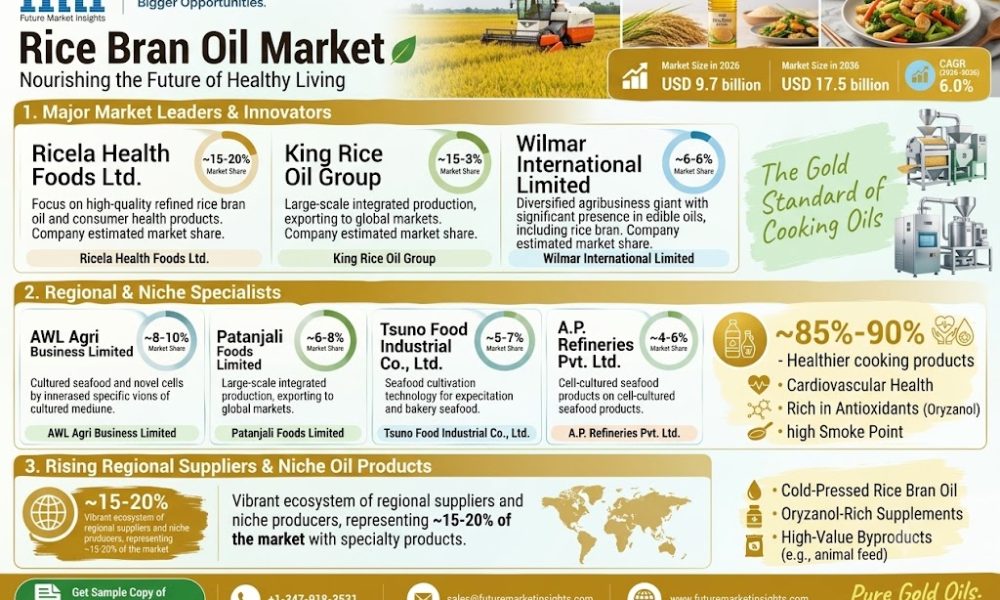
The global rice bran oil market is forecast to increase from USD 9.4 billion in 2026 to USD 17.5 billion by 2036, expanding at a 6.0% CAGR during the 2026-2036 forecast period, according to Future Market Insights. The market stood at USD 8.9 billion in 2025. Growth is being supported by demand for high-temperature cooking applications, mild sensory characteristics, and value-added positioning around naturally occurring components such as gamma-oryzanol.
Get detailed market forecasts, competitive benchmarking, and pricing trends:
https://www.futuremarketinsights.com/reports/sample/rep-gb-16708
Regional Segment Leaders
As this is a global Rice Bran Oil Market report, the segment analysis reflects product types, end-use applications, and sales channels across key edible oil markets.
- Cold Pressed – 33.0% of Product Type demand in 2026: Cold pressed rice bran oil benefits from lower-process-intensity positioning and is suited to premium food and specialty retail applications where processing characteristics and product differentiation influence purchasing decisions.
- Cooking Oil & Deep Frying – 35.0% of End Use demand in 2026: This segment leads because rice bran oil is suitable for high-temperature cooking and frying applications, supporting demand across household, foodservice, and food-processing operations.
- Business to Business Channels – 40.0% of Sales Channel demand in 2026: Business-to-business channels account for the largest share as food processors, institutional buyers, and private-label operators purchase rice bran oil against defined quality, supply, and specification requirements.
Market Growth Context
The Rice Bran Oil Market is developing around demand for cooking oils that combine high-temperature performance with a mild sensory profile and differentiated nutritional positioning. Rice bran oil is used across household cooking, foodservice, and food-processing applications, where predictable performance and consistent specifications remain important purchasing considerations.
Commercial performance also depends heavily on how quickly freshly generated rice bran is stabilized after milling. Rapid deterioration of untreated bran can affect the quality and economics of oil recovery, making collection speed, stabilization technology, refining discipline, and feedstock control important parts of the supply chain.
Cold pressed products are expected to maintain a significant position within the product-type landscape, accounting for 33.0% of demand in 2026. Their lower-process-intensity positioning can support premium applications and specialty retail channels, where buyers may place greater emphasis on processing characteristics and product differentiation.
Cooking Oil & Deep Frying leads end use with a 35.0% share in 2026. Rice bran oil’s suitability for high-temperature applications supports its use across frying and cooking requirements, while its mild flavor can allow manufacturers and foodservice operators to incorporate it without substantially altering the sensory profile of prepared foods.
Demand conditions vary across countries. Japan has an established rice-oil culture across household and industrial food applications, while Italy and Brazil benefit from domestic rice-processing activity. France and Germany present greater substitution challenges because buyers already have established access to rapeseed, sunflower, and olive-oil supply channels.
Rice bran oil therefore competes within the broader edible oils and fats market, where price, performance, raw-material availability, supply reliability, and established purchasing relationships influence sourcing decisions.
Business-to-business channels account for 40.0% of sales channel demand in 2026. Food processors, institutional buyers, and private-label operators often require suppliers to meet defined specifications consistently, making predictable quality, delivery reliability, and production continuity important factors in supplier selection.
Commercial opportunities through 2036 are expected to depend on reliable feedstock procurement, rapid bran stabilization, efficient refining, consistent oil specifications, and the ability to compete with established vegetable-oil alternatives across different applications and markets.
Competitive Landscape
The competitive landscape features companies involved in rice bran oil processing, refining, distribution, and edible oil production.
- Key Rice Bran Oil Players: AWL Agri Business Limited, King Rice Oil Group, Ricela Health Foods Ltd., A.P. Refineries Pvt. Ltd., Wilmar International Limited, Sethia Oils, 3F Industries Ltd., Tsuno Food Industrial Co., Ltd., and Patanjali Foods Limited are among the notable companies identified in the market.
Competitive differentiation depends on feedstock access, stabilization speed, refining capabilities, product consistency, supply reliability, and the ability to meet specifications across household, foodservice, food-processing, and private-label applications.
Supplier performance is particularly important because rice bran is a time-sensitive feedstock. Companies that can efficiently coordinate bran collection, stabilization, extraction, refining, and distribution may improve consistency and reduce quality-related variability across commercial production.
The competitive environment also reflects substitution pressure from established edible oils. Rice bran oil suppliers therefore need to demonstrate reliable performance and consistent delivery while maintaining commercially competitive positioning against rapeseed, sunflower, olive, and other vegetable oils.
Analyst Perspective
“Rice bran oil suppliers compete on more than the final oil specification. Rapid bran stabilization, disciplined refining, dependable feedstock access, and consistent delivery are critical because buyers compare rice bran oil directly with established vegetable-oil alternatives.” – Nandini Roy Choudhury, Principal Consultant, Future Market Insights
About Future Market Insights (FMI)
Future Market Insights, Inc. (FMI) is an ESOMAR-certified, ISO 9001:2015 market research and consulting organization, trusted by Fortune 500 clients and global enterprises. With operations in the U.S., UK, India, and Dubai, FMI provides data-backed insights and strategic intelligence across 30+ industries and 1200 markets worldwide.
For Press & Corporate Inquiries
Rahul Singh
AVP – Marketing and Growth Strategy
Future Market Insights, Inc.
+91 8600020075
For Sales: [email protected]
For Media: [email protected]
For Web: https://www.futuremarketinsights.com/



