
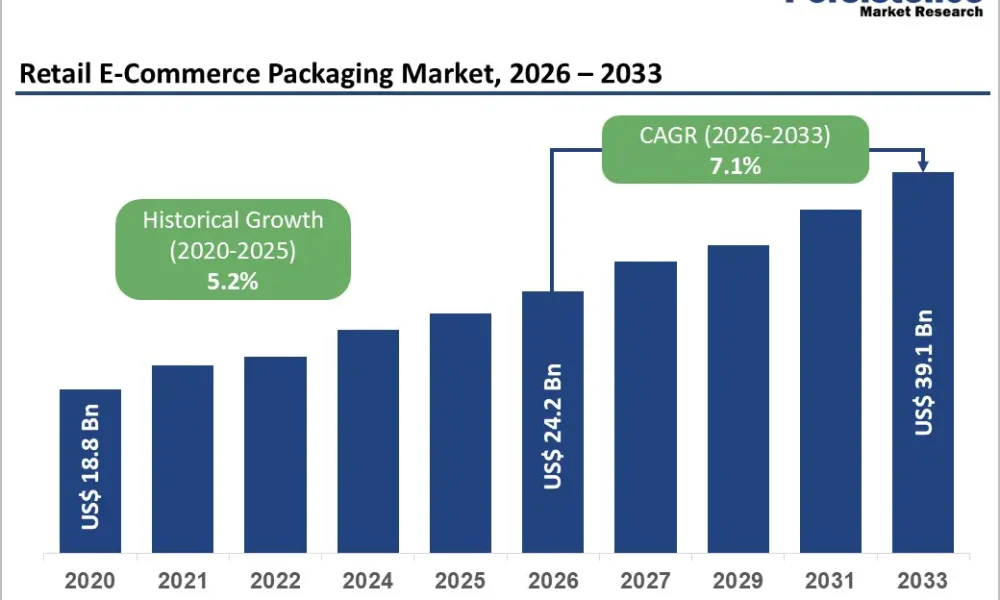
The retail e-commerce packaging market is witnessing steady expansion as global online retail volumes continue to rise across categories such as electronics, apparel, groceries, and personal care. According to Persistence Market Research, the global retail e-commerce packaging market size is likely to be valued at US$24.2 billion in 2026 and is expected to reach US$39.1 billion by 2033, growing at a CAGR of 7.1% between 2026 and 2033. Growth is supported by increasing digital shopping adoption, the need for secure transit packaging, and evolving sustainability mandates.
Retail e-commerce packaging plays a critical role in product protection, branding, and customer experience. Corrugated boxes, protective mailers, and cushioning formats remain central to shipment safety and cost efficiency. Regulatory pressure to improve recyclability and incorporate recycled content is reshaping material innovation strategies. Sustainable and lightweight packaging solutions are emerging as leading segments, while mature e-commerce markets with strong online penetration continue to dominate geographically due to higher shipment volumes and advanced logistics infrastructure.
Discover Exclusive Data – Request Your Free Sample : https://www.persistencemarketresearch.com/samples/36070
Key Highlights from the Report
➤ The global retail e-commerce packaging market is projected to grow from US$24.2 billion in 2026 to US$39.1 billion by 2033 at a CAGR of 7.1%.
➤ Sustained growth in online retail volumes remains the primary catalyst for packaging demand expansion.
➤ Regulatory mandates focused on recyclability and recycled content are accelerating material innovation.
➤ Protective packaging formats are gaining traction due to increased parcel handling and longer supply chains.
➤ Sustainable and recyclable packaging solutions are emerging as a leading product segment.
➤ Regions with high e-commerce penetration and established logistics networks represent the leading geographical markets.
Market Segmentation
The retail e-commerce packaging market can be segmented by product type into corrugated boxes, protective mailers, cushioning materials, and other protective formats. Corrugated packaging continues to hold a dominant share due to its strength, recyclability, and cost effectiveness. Protective mailers and flexible packaging formats are gaining importance in lightweight shipments, particularly for fashion and electronics. Cushioning solutions are evolving with sustainable materials to reduce environmental impact while maintaining product integrity.
From an end user perspective, the market spans fashion and apparel, consumer electronics, personal care, food and beverage, and other retail categories. Consumer electronics drive significant demand for protective and shock resistant packaging. Apparel and accessories benefit from lightweight and flexible mailers that reduce shipping costs. Food and beverage e-commerce is creating new requirements for insulation and freshness protection. Across segments, the shift toward eco friendly packaging is influencing procurement strategies and supplier partnerships.
Want Specific Data? Request Report Customization : https://www.persistencemarketresearch.com/request-customization/36070
Regional Insights
Regions with strong online retail penetration and advanced fulfillment networks continue to lead the retail e-commerce packaging market. High parcel shipment volumes, developed last mile delivery systems, and consumer preference for doorstep delivery support consistent packaging demand. Mature regulatory frameworks also encourage the adoption of recyclable and recycled materials, shaping supplier strategies in these markets.
Emerging markets are experiencing accelerated growth as internet access improves and digital payment adoption expands. Retailers in these regions are investing in modern warehousing and packaging automation to meet rising consumer expectations. The push toward sustainable packaging is gradually gaining momentum, driven by regulatory awareness and changing consumer attitudes toward environmental responsibility.
Market Drivers
The primary driver of the retail e-commerce packaging market is the sustained growth in global online retail volumes. As consumers increasingly prefer digital shopping platforms for convenience and variety, parcel shipments continue to rise. This directly increases demand for durable, cost efficient, and scalable packaging formats. The need for reliable transit protection across extended supply chains further strengthens packaging requirements.
Regulatory pressure to improve recyclability and incorporate recycled content is another significant growth driver. Governments and regulatory bodies are implementing stricter environmental guidelines to reduce packaging waste. Brands are responding by redesigning packaging materials to meet compliance standards. This shift is encouraging innovation in sustainable corrugated solutions and recyclable protective materials, supporting overall market expansion.
Market Restraints
Despite strong growth prospects, the retail e-commerce packaging market faces certain constraints. Rising raw material costs can impact profit margins for packaging manufacturers. Volatility in input prices may influence pricing strategies and procurement decisions. Smaller players may find it challenging to absorb cost fluctuations while maintaining competitive pricing.
Another restraint is the increasing scrutiny over packaging waste and excessive material usage. Consumers and regulators are pushing for minimal packaging designs. Over packaging can lead to reputational risks for brands and potential regulatory penalties. Balancing product protection with sustainability goals requires continuous investment in design optimization and material innovation.
Market Opportunities
Significant opportunities are emerging in sustainable and innovative packaging formats. Companies that invest in recyclable, compostable, and high recycled content materials are well positioned to capture growing demand. Retailers are increasingly partnering with packaging suppliers that align with their environmental commitments. This creates long term supply contracts and brand loyalty opportunities.
Technological advancements in packaging design and automation also present growth prospects. Smart packaging solutions that enhance tracking, tamper resistance, and customer engagement are gaining traction. As online retail becomes more competitive, packaging differentiation through sustainability and functionality will play a critical role in shaping future growth trajectories.
Exclusive Data Awaits – Continue to Checkout : https://www.persistencemarketresearch.com/checkout/36070
Company Insights
Key players operating in the retail e-commerce packaging market include
- Smurfit Westrock
- International Paper
- Amcor
- Mondi Group
- Sealed Air
- Huhtamaki
- Sonoco Products Company
- DS Smith
- Berry Global
- WestRock
- Packaging Corporation of America
- Nippon Paper Industries
- Oji Holdings Corporation
- Stora Enso
- Georgia-Pacific
- Mayr-Melnhof Karton
- Tetra Pak
- CCL Industries
These companies focus on expanding sustainable product portfolios and strengthening global supply capabilities to address growing online retail demand.
Recent Developments
In March 2025 a leading packaging manufacturer expanded its sustainable corrugated packaging portfolio to meet increasing recyclability standards.
In September 2025 a major industry participant announced investments in advanced protective packaging solutions to support rising e-commerce shipments.
Future Opportunities and Growth Prospects
The retail e-commerce packaging market is poised for steady growth through 2033, supported by rising online retail volumes and stronger sustainability mandates. Innovation in recyclable materials and protective packaging formats will remain central to competitive differentiation. As regulatory pressure intensifies and consumer awareness grows, companies that prioritize environmental compliance and operational efficiency will capture long term value.




