
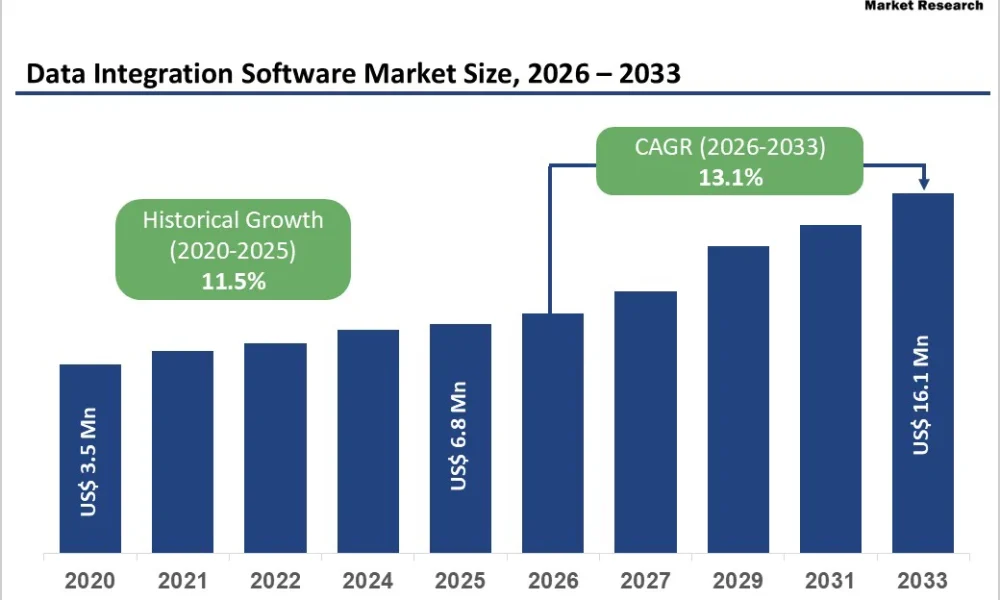
The global Data Integration Software Market is entering a dynamic growth phase as enterprises modernize their digital infrastructure to manage increasingly complex, distributed data ecosystems. The market size is likely to be valued at US$ 6.8 billion in 2026 and is projected to reach US$ 16.1 billion by 2033, growing at a CAGR of 13.1% between 2026 and 2033.
This robust expansion reflects a structural shift in enterprise IT strategies. Organizations are no longer operating within single, centralized environments. Instead, they are managing multi-cloud, hybrid cloud, edge computing, SaaS applications, IoT devices, and AI-driven analytics platforms simultaneously. Seamless data movement and synchronization across these systems have become mission-critical.
With 89% of enterprises already employing multi-cloud strategies, data integration software has evolved from a back-end utility to foundational digital infrastructure enabling AI adoption, real-time decision-making, and competitive advantage.
Understanding Data Integration Software
Data integration software enables organizations to:
- Connect disparate systems and applications
- Synchronize structured and unstructured data
- Transform and standardize data formats
- Ensure governance, compliance, and security
- Deliver real-time analytics-ready data
Traditional ETL (Extract, Transform, Load) tools are being complemented—and in many cases replaced—by:
- Real-time streaming integration
- API-based connectivity
- AI-driven data mapping
- Low-code/no-code integration platforms
- Cloud-native integration services
Modern integration platforms support environments spanning public cloud providers such as Amazon Web Services, Microsoft Azure, and Google Cloud, as well as on-premise infrastructure.
Market Growth Drivers
- Multi-Cloud and Hybrid Cloud Adoption
Enterprises are distributing workloads across multiple cloud providers to optimize performance, reduce risk, and avoid vendor lock-in. This creates complex data flows between cloud-native and legacy systems.
Companies such as IBM and Oracle are expanding hybrid cloud integration capabilities to address enterprise demand for seamless interoperability.
Data integration software ensures consistency across:
- ERP systems
- CRM platforms
- Financial systems
- IoT platforms
- Customer data lakes
As hybrid environments scale, integration complexity increases exponentially, driving sustained market growth.
- AI-Driven Automation and Intelligent Governance
AI is reshaping integration processes. Intelligent mapping, anomaly detection, automated metadata tagging, and predictive optimization are becoming standard features.
Vendors such as Informatica and Talend are embedding machine learning capabilities into integration workflows to enhance efficiency and reduce manual configuration.
AI-powered platforms can:
- Automatically detect schema changes
- Recommend transformation logic
- Identify data quality issues
- Optimize integration pipelines
This shift toward intelligent automation significantly lowers operational overhead and improves governance.
- Government Digital Transformation Initiatives
Governments worldwide are investing billions in digital transformation programs, modernizing public sector data systems, and implementing centralized digital platforms.
Countries such as United States, India, and Singapore are leading digital governance initiatives, increasing demand for secure and scalable integration infrastructure.
These initiatives require:
- Cross-departmental data exchange
- Citizen data management systems
- Secure data governance frameworks
- Compliance with data sovereignty regulations
Data integration software serves as the backbone of these modernization efforts.
- Real-Time Analytics and Decision Intelligence
Organizations are shifting from batch processing to real-time analytics. Streaming data integration supports use cases such as:
- Fraud detection
- Predictive maintenance
- Dynamic pricing
- Supply chain optimization
Companies like Snowflake enable real-time data warehousing, increasing reliance on advanced integration pipelines.
The demand for instantaneous insights is a powerful driver of integration software adoption.
Elevate your business strategy with comprehensive market data. Request a sample report now: https://www.persistencemarketresearch.com/samples/23536
Regional Analysis
North America: Market Leader
North America leads the global market with approximately 37% share in 2025. Several factors contribute to its dominance:
- High multi-cloud adoption rates
- Presence of Fortune 500 enterprises
- Strong venture capital ecosystem
- Concentration of leading software vendors
Major technology hubs across the United States continue to innovate in AI, SaaS, and enterprise data solutions.
Enterprises in financial services, healthcare, retail, and technology sectors heavily rely on advanced integration frameworks to maintain competitive advantage.
Asia Pacific: Fastest-Growing Region
Asia Pacific is projected to grow at a 15.6% CAGR through 2032, making it the fastest-growing region.
Growth drivers include:
- Rapid economic development
- Expanding manufacturing digitalization
- Government-backed smart industry programs
- Growing startup ecosystems
Countries such as China, India, and South Korea are accelerating Industry 4.0 initiatives.
As manufacturing and logistics ecosystems digitize, integration platforms become essential for unifying operational data streams.
Europe
Europe’s growth is influenced by stringent data protection regulations such as GDPR and rising demand for data sovereignty-compliant integration solutions.
Financial institutions, automotive manufacturers, and public sector organizations are key adopters.
Segment Analysis
Deployment Model: On-Premise Dominance
On-premise solutions hold 62% market share in 2025, reflecting:
- Regulatory compliance requirements
- Data sovereignty mandates
- Enterprise preference for direct infrastructure control
- Enhanced security management
Industries handling sensitive data—such as healthcare, defense, and finance—continue to favor controlled on-premise deployments.
However, cloud-native integration platforms are steadily gaining traction as security capabilities improve.
End-User Insights
Manufacturing: Fastest Growing Segment
Manufacturing is projected to grow at 16.8% CAGR through 2032, emerging as the fastest-growing end-user segment.
Drivers include:
- IoT-enabled production lines
- AI-driven predictive maintenance
- Smart supply chain systems
- Government-backed smart manufacturing initiatives
Integration software connects:
- Industrial IoT sensors
- ERP systems
- Quality management platforms
- Logistics networks
This unified data architecture supports operational efficiency and cost optimization.
BFSI and Healthcare
Banking and healthcare sectors remain strong adopters due to:
- Regulatory reporting needs
- Fraud monitoring
- Patient data interoperability
- Risk analytics
Secure, compliant integration frameworks are essential in these sectors.
Emerging Opportunity: AI-Driven Low-Code Integration Platforms
One of the most promising growth opportunities lies in AI-powered low-code and no-code integration platforms.
By 2025, 70% of new applications are expected to adopt low-code approaches. These platforms enable:
- Democratized data integration
- Faster deployment cycles
- Reduced reliance on specialized developers
- Cost-effective scaling for SMBs
Mid-market organizations increasingly prefer simplified, AI-assisted integration tools to accelerate digital transformation without large IT teams.
Competitive Landscape
The data integration software market is moderately consolidated, with key players focusing on:
- Cloud-native architecture expansion
- AI and automation integration
- API ecosystem development
- Strategic partnerships and acquisitions
Vendors are investing heavily in platform interoperability and vertical-specific solutions to capture niche enterprise needs.
Innovation areas include:
- Metadata-driven automation
- Unified data governance frameworks
- Real-time streaming connectors
- Embedded analytics capabilities
Challenges Facing the Market
Despite strong growth, the market faces several challenges:
- Data privacy and compliance complexities
- Integration of legacy systems
- High implementation costs for large-scale deployments
- Cybersecurity risks in distributed environments
However, advancements in encryption, AI-based threat detection, and cloud security frameworks are mitigating these risks.
Future Outlook (2026–2033)
The next phase of growth will be defined by:
- Convergence of AI and integration platforms
- Edge computing integration capabilities
- Unified data fabric architectures
- Hyperautomation initiatives
Enterprises will increasingly adopt “data fabric” strategies that enable seamless data movement across hybrid and multi-cloud ecosystems.
As AI-driven decision intelligence becomes central to enterprise competitiveness, integration software will serve as the foundational enabler of accurate, real-time insights.
Conclusion
The global data integration software market is positioned for sustained double-digit growth, expanding from US$ 6.8 billion in 2026 to US$ 16.1 billion by 2033, at a 13.1% CAGR.
North America leads in market share, while Asia Pacific emerges as the fastest-growing region. On-premise deployments currently dominate, but AI-driven cloud-native platforms are rapidly reshaping the competitive landscape.
Manufacturing stands out as the fastest-growing end-user segment, supported by IoT adoption and smart industry initiatives. Meanwhile, AI-powered low-code platforms present significant opportunities for democratized integration and SMB expansion.
In the AI-driven digital economy, data integration software is no longer a back-end IT function—it is a strategic pillar enabling agility, governance, automation, and competitive resilience.
Related Reports:




